
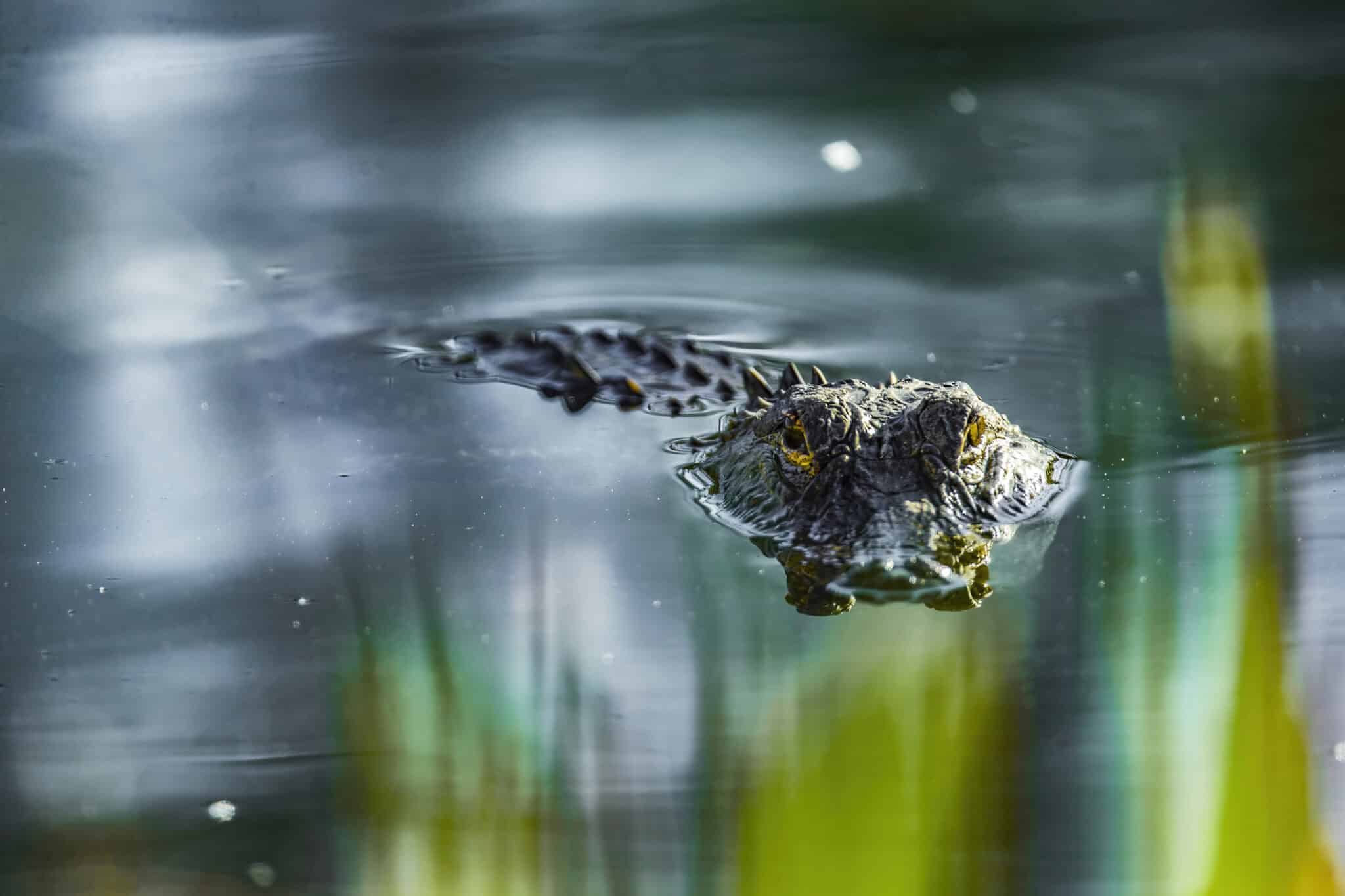
In the dark waters of the wetlands, alligators hide a millennial secret that makes them predators even more formidable than imagined. These prehistoric reptiles deliberately swallow stones to turn their bodies into a perfected hunting weapon. A recent scientific discovery has just proven what Indigenous peoples have known for centuries: this strategy dramatically enhances their underwater predation abilities.
An Ancestral Wisdom Confirmed by Science
For generations, Indigenous peoples observed an intriguing behavior in crocodilians: these formidable predators voluntarily ingested pebbles. Far from being accidental, this practice seemed to serve a precise purpose that modern science has finally elucidated.
In 2019, a team of researchers from the University of Utah decided to test this ancestral hypothesis. Their experimental protocol was as rigorous as it was bold: comparing the diving performance of seven juvenile American alligators with and without these mysterious stones in their stomachs.
Results That Defy Imagination
The conclusions of this study exceeded all scientific expectations. Without their mineral ballast, the alligators managed to remain submerged for about six minutes on average. But once equipped with their gastroliths — the scientific term for these swallowed stones — their underwater endurance literally skyrocketed.
The average dive duration climbed to eleven minutes, a phenomenal 88% improvement. Even more impressive, the maximum dives recorded a 117% increase. The absolute record spoke for itself: starting from a baseline of 14.7 minutes, some specimens reached the astonishing mark of 35.4 minutes of continuous immersion.
Every alligator tested saw its abilities improve by at least five additional minutes, underscoring the universal effectiveness of this technique across the species.
A Hunting Weapon Sharpened by Evolution
This remarkable transformation can be explained by a physical mechanism of elegant simplicity. The ingested stones act as a natural ballast, allowing the reptiles to maintain an optimal hydrostatic balance underwater. With this extra weight, they can fully inflate their lungs without risking an unintentional return to the surface.
This technical feat gives them a decisive double tactical advantage. On one hand, they can remain motionless on the riverbed for extraordinary lengths of time, turning each ambush into a lethal trap for prey that approaches without suspicion. On the other hand, this respiratory endurance enables them to execute their signature hunting technique: the controlled drowning of their victims through underwater rotation, a formidable maneuver known as the “death roll”.
A Multimillion-Year Prehistoric Heritage
This behavioral strategy is not a recent evolutionary innovation. Paleontologists have uncovered numerous fossils of plesiosaurs — these Mesozoic sea giants — containing accumulations of stones in their abdominal cavities. The frequency of these discoveries rules out any coincidence and reveals a fascinating evolutionary continuity.
These Jurassic and Late Cretaceous marine reptiles, extinct more than 65 million years ago, already used this buoyancy-control technique. This persistence across geological ages testifies to the remarkable effectiveness of this adaptation.
Nature’s Ingenious Brilliance in Its Purest Form
Beyond its spectacular aspect, this discovery illustrates the sophistication of the adaptive strategies developed by living beings. Alligators are not content to be formidable predators through their jaws and brute strength: they have also developed a biological technology that allows them to optimize their hunting environment.
This scientific revelation reminds us that even the strangest animal behaviors may conceal evolutionary logics of surgical precision, shaped by millions of years of natural selection.
