
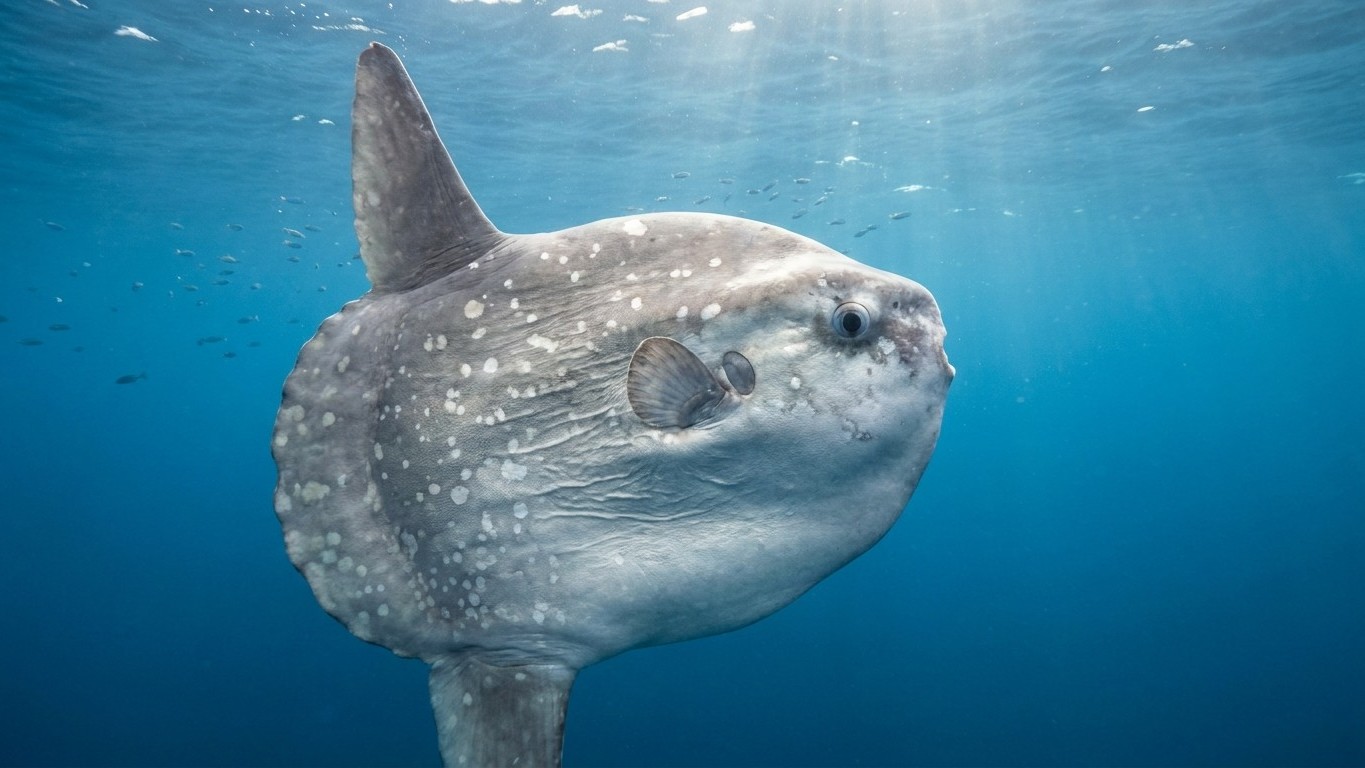
Three hundred million. Speak this number aloud and let it echo. It is the number of eggs the female ocean sunfish, the Mola mola, can release in a single spawning. Females can produce 300 million eggs per spawning, more than any other known vertebrate. No mammal, no reptile, no other bony fish comes close. And yet, among these hundreds of millions of future individuals, almost all vanish before they have lived a single thing. The ocean is rarely gentle.
Key takeaways
- What unimaginable number of descendants can a female ocean sunfish release in a single spawning?
- How do these star-shaped larvae transform into ocean giants?
- Why, despite weighing 60 million times more, does the adult sunfish remain vulnerable?
The Absolute Record in the Vertebrate Kingdom
A female measuring about 1.5 m has been found carrying roughly 300 million eggs in her ovaries, a figure that has long challenged biologists’ credulity. For scale: if every egg were a person, they would fill four times the entire country of France. This is one of the most fecund species among teleosts; the female lays 300 million oocytes each year for a sparsely populated population. Their number is inversely related to their size, since the eggs measure only 0.2 mm in diameter.
This paradox — tiny in number yet colossal in quantity — speaks volumes about the evolutionary strategy of the Mola mola. This “bombardment” strategy is simply about ensuring that a handful of offspring survive the ocean’s intense predation. Biologists call this the r-strategy: betting on raw quantity rather than parental investment. It is the exact opposite of what elephants or great apes do, where years are spent rearing a single youngster. Two survival philosophies, two extremes of life.
The eggs are pelagic, floating in the open sea until they hatch. Scattered across the vastness of the ocean, they become a resource for hundreds of predatory species. Fertilization itself occurs in open water: with external fertilization, the adults must gather during the breeding season. A discreet gathering for a species that is typically solitary.
Star-Shaped Larvae
At hatching, the contrast is striking. The larvae measure only 2.5 mm and resemble tiny porcupine fishes, bristling with protective spines that disappear as they grow. Their bristly silhouette evokes a starfish more than a fish, certainly not the imposing gray disk they will become. The larvae are star-shaped, even shuriken-shaped. The branches of the stars fade away with time.
Development unfolds in two distinct acts. The sunfish goes through two distinct larval stages during its transition to the adult: the first is a typical larval stage resembling a pufferfish, where the fry has large pectoral fins, a caudal fin, and body spines; the second is a highly transformed stage in which the tail is completely resorbed. Losing its tail to grow: a radical metamorphosis with no parallel among most vertebrates.
If a few larvae survive the first days, the youngsters first live in schools, then become solitary. Safety in numbers lasts only for so long. Once past a certain size threshold, the Mola mola has little to fear, aside from a few very specific predators.
From the Size of a Grain of Rice to Two Tons
Those who get past early childhood embark on one of the most vertiginous growth spurts in the animal kingdom. Growth is prodigious: from egg to giant adult, body mass can multiply by 60 million. No other known species makes such a leap. To illustrate: it’s like a grain of rice becoming a semi-trailer truck. In captivity, growth rates of nearly 1 kg per day have been observed, with an individual gaining 373 kg in 15 months.
The sunfish holds the record for the heaviest bony fish: specimens caught off the coast of Japan have exceeded 2 tons and 3.3 m tall when counting fins. Morphologically, it is no less odd than its statistics. A flat, disk-shaped body without a conventional tail: it swims by beating its dorsal and anal fins. Its skin, up to 15 cm thick, is protected by a gelatinous layer. The result is a giant, head-like thing that swims, a flying object from the depths that sailors have long mistaken for wrecks or sleeping sharks.
Its diet is gelatinous: jellyfish, siphonophores, salps, prey with little calories, hence its extreme size to compensate. It must ingest substantial amounts to maintain mass, sometimes diving to depths of more than 600 meters, then rising to bask in the sun, side against the surface. This behavior, called “basking,” is often misread as laziness. The fish spends much of its life at the water’s surface, basking in the sun, a behavior that helps regulate its body temperature after deep dives in search of food.
A Floating Hotel for Parasites
Reaching adulthood does not mean living without trouble. The sunfish is notoriously famous for its heavy parasite load. More than 50 parasite species have been recorded on and in the Mola mola, including the ectoparasite copepod Pennella which burrows deeply into the flesh. To respond, the animal has developed astonishing interspecies diplomacy: it invites seabirds and cleaner fish to peck at its skin. It is also the only fish known to solicit help from birds to deparasitize itself. Lying on the surface, it attracts gulls that peck at its skin parasites.
The three predators that dare to take on an adult are rare but formidable. There are only three main ones: sea lions, orcas, and large sharks. Facing them, the mola gains substantial mass and thick skin that are advantageous against predators. The armor of flesh replaces the spines of youth.
The most serious threats today come from another direction. The sunfish is all too often a casualty of plastic waste, bycatch, poaching, propellers, and collisions with boats. In the European Union, the sale of the sunfish is prohibited. This partial protection does not suffice to offset the growing pressure on the oceans. A creature capable of laying 300 million eggs might seem invincible. But when the environment degrades faster than the larvae can grow, even the record fertility of all vertebrates is no longer enough.
Sources: baleinesousgravillon.com | hissez-o.fr
