
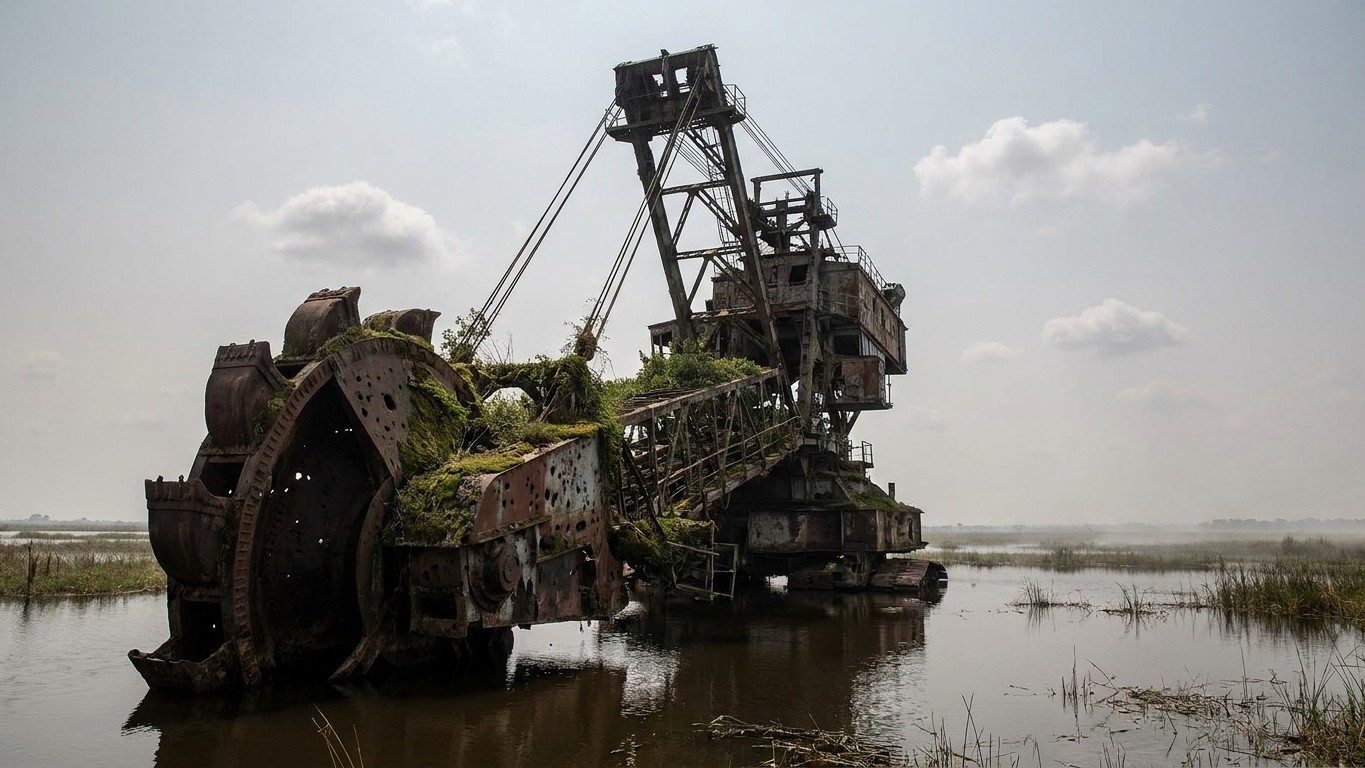
At 240 kilometers from its starting point, the giant excavator halted and never looked back. Forty years later, it still rusts in the same spot, pocked by bullet marks, in one of the planet’s vastest wetlands. It wasn’t a mechanical failure nor a funding problem that stopped the Jonglei Canal project in 1984. It was war.
The project, however, is not a recent idea. The initiative was studied by the Egyptians and the British for the first time in 1898, then again in 1946, when a commission named the “Jonglei Investigation Team” was established and published a report in 1953. It would take another two decades before the earthmovers really got to work. Plans were drawn up between 1954 and 1959, and construction began in 1978. The ambition on paper was simple, yet colossal on the ground: to bypass the Sudd swamps, this vast wetland in South Sudan where the White Nile loses a significant portion of its water to evaporation.
Key takeaways
- A giant German excavator comes to a brutal halt after six years of uninterrupted work
- The true cause of this stoppage remains hidden within geopolitical conflicts and local interests
- Four decades later, the rusted carcass still embodies a dilemma between development and ecological survival
A machine as large as a building
To dig a 360-kilometer canal through this swampy region, an outsized machine was required. The world’s largest wheel-dipper excavator, nicknamed “Sarah,” could move between 2,500 and 3,500 cubic meters of earth, enough to carve roughly 2 kilometers of canal in five days. Other sources mention an even brisker pace, with a capacity up to 40,000 cubic meters of soil per day for this German-made excavator. Whatever the exact figure, the image remained the same: a steel behemoth progressing slowly through the mud, as tall as a multi-story building, emblematic of an engineering ambition worthy of the grand schemes of the 20th century.
At the time, this project stood as Africa’s largest infrastructure undertaking. The hydraulic stakes extended far beyond Sudanese borders. By bypassing the marshes, it was calculated that the Nile’s evaporation would drop significantly, enabling Egypt to increase its cultivable land by about two million acres. Cairo and Khartoum saw it as a win‑win arrangement, almost an obvious geopolitical truth. Yet this obviousness overlooked a major detail: the populations who had lived for generations to the rhythm of the Sudd’s floods.
1984, the year everything ground to a halt
The project advanced rapidly, perhaps too rapidly for those who watched it nibble away at their territory. In six years, more than two-thirds of the route had been dug. Then the rupture came. Construction began in 1978, but the outbreak of political instability in Sudan delayed the works for many years, and in 1984, when the Sudan People’s Liberation Army (SPLA) halted the project, 240 km of the canal out of 360 had been excavated. The figure is precise, almost cruel in its symbolism: two-thirds of a route never completed, frozen forever in the landscape.
This halt was no industrial accident. Faced with Sudan’s postcolonial civil conflict, the SPLA, led by John Garang, stopped the canal’s construction in 1984. Behind that decision lay a grievance far older than the project itself. Many herders depended on these wetlands where they grazed their cattle, and altering the Nile’s course would have radically transformed their way of life, so these populations attacked the project that was subsequently interrupted. The canal, conceived thousands of kilometers away by Egyptian and Sudanese engineers, would have drained the only ecosystem capable of feeding hundreds of thousands of Dinka and Nuer pastoralists.
The excavator itself paid the price of this rebellion. The rusted remains of the giant German-made digging machine, nicknamed “Sarah,” can be seen on satellite images near the southern end of the canal, and it was damaged by a missile. A detail that speaks volumes about the nature of the conflict: it wasn’t a motor failure that felled the world’s largest excavator, but a rocket strike. The hull became, by force of circumstance, one of the strangest monuments of the Sudanese civil war, which would endure for more than twenty years and culminate in South Sudan’s independence in 2011.
A ghost that refuses to disappear
The silence did not last forever. Once peace was relatively restored in the early 2000s, the idea resurfaced, this time framed by renewed economic considerations. Peace having been restored in 2000, speculation grew about restarting the project, but on February 2, 2008, the Sudanese government stated that reviving the project was not a priority, before Sudan and Egypt finally reached an agreement in 2008 to restart the project and complete the canal after 24 years of stoppage. On paper, the machine was set to restart. In practice, nothing moved for more than another decade.
The debate intensified again in 2022, this time within the budding state of South Sudan, against a backdrop of devastating floods in the region. Government officials, including Vice President Taban Deng Gai, argued for resuming work as a solution to the floods. In June 2022, Egypt supplied excavation equipment to South Sudan, which pushed the government to discuss potential restart talks, but no construction followed due to domestic opposition and unresolved environmental impact studies. A petition launched by a recognized South Sudanese scholar gathered widespread support against this revival, rekindling the same fears as in 1984: the draining of a UNESCO-listed wetland, home to hundreds of animal and plant species.
Today, the project remains halted, with the earthworks of the 1978-1984 phase vulnerable to erosion and overgrowth. The Jonglei Canal is neither dead nor alive. It hangs in a state of suspension, like its phantom excavator, between two wars and two visions of development: one seeking to master the river and the other refusing to sacrifice a wetland for a few extra points of flow downstream.
Sources: africa-press.net | jia.sipa.columbia.edu | independent.academia.edu
