
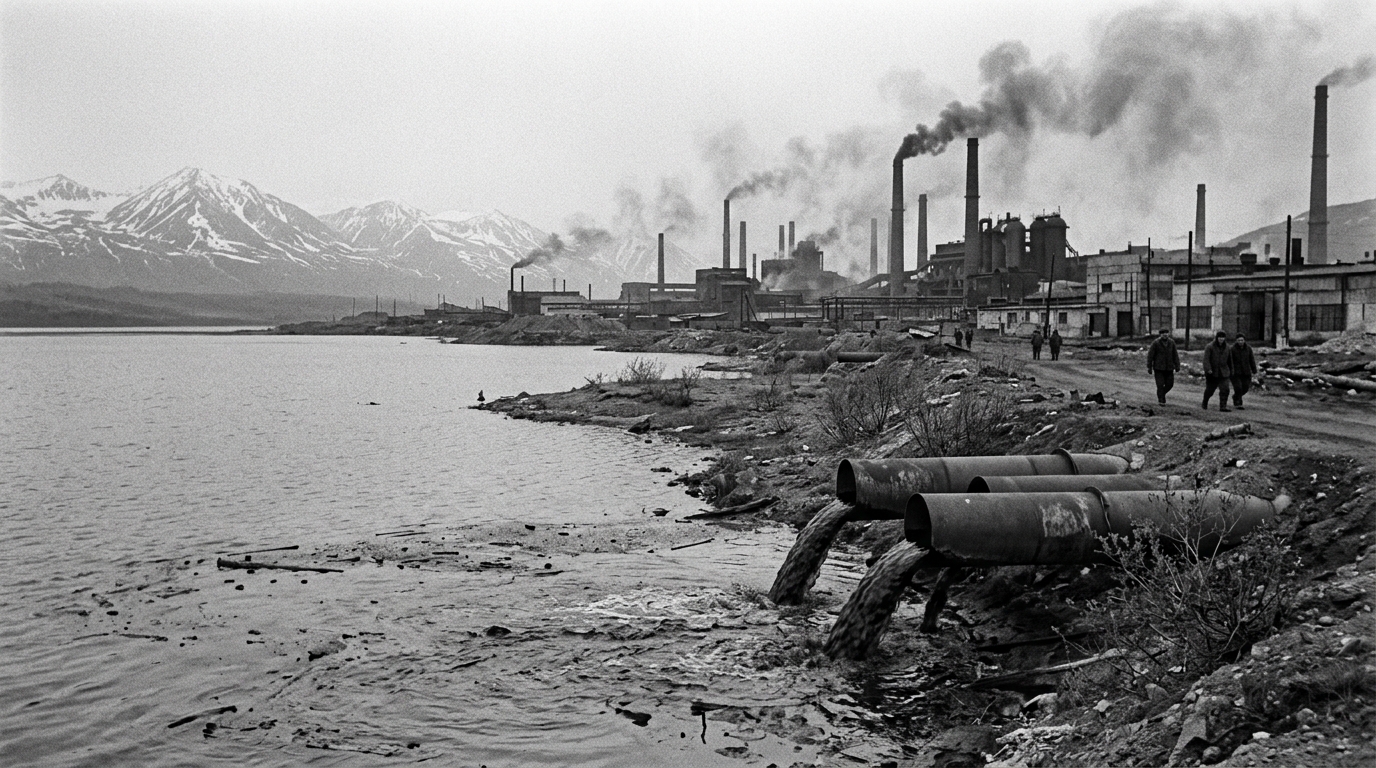
Imagine a place where spending sixty minutes beside the water would be fatal. This place isn’t science fiction: it really existed in the heart of the Urals, shielded from view for decades by a Soviet regime fixated on military secrecy. A lake transformed into an open-air nuclear trash heap, so toxic that it eventually bore an undesirable title—the most contaminated place on the planet. Here is a gripping story, largely unknown to the general public for nearly half a century.
A lake so radioactive that an hour at its edge could kill a man
Lake Karachay, at first glance, resembles any tranquil body of water in the Chelyabinsk region. Yet beneath its surface lies one of the most dangerous zones ever created by humans. According to a report from the Worldwatch Institute, this lake accumulated no fewer than 4.44 exabecquerels of radioactivity—a figure that far outstrips the release from the Chernobyl disaster, which discharged about 2 EBq in Europe and 14 EBq in total according to available comparative data.
Perhaps the most striking figure is the exposure dose measured right at the water’s edge. According to the Natural Resources Defense Council, the activity recorded in 1990 near the discharge point was such that an hour of exposure was enough to deliver a lethal dose to a person. A number that underscores what this site represented for decades: an invisible, silent trap, but unbelievably effective.
Mayak, the secret plant that turned a lake into a nuclear trash can
To understand how a simple lake could become such a concentrated hub of radioactivity, one must go back to the beginnings of the Mayak complex. Commissioned in 1949, this industrial site was tasked with producing plutonium for the Soviet military program, in the heat of the nuclear arms race against the United States. The pressures of speed and secrecy outweighed any consideration for environmental or health concerns.
As early as 1951, Soviet authorities chose Lake Karachay as the natural discharge for the most dangerous radioactive effluents from the plant. The logic was chilling in its simplicity: instead of treating these wastes, they simply dumped them into a nearby body of water, as one would empty a bucket into a gutter. This choice, taken in the urgency of the Cold War, would have dramatic consequences for decades. The matter took an even more critical turn in 1957, when a major explosion occurred on the site, caused by a failure in the waste-storage system. This accident, long little known to the Western public, drastically worsened the contamination already emanating from the complex.
Whole villages irradiated for decades without knowing it
What makes this story especially troubling is the total silence that surrounded the region for so long. Local populations lived near such a dangerous site without the slightest awareness, the information being classified at the highest levels of the Soviet regime. No alert, no preventive evacuation, no warnings—just the everyday life of residents unaware they were near one of the most radioactive places ever recorded.
Faced with the scale of the problem and, in particular, the risk of radioactive particle dispersion by wind during dry spells, authorities eventually reacted, well after the fact, with rather rudimentary measures. Between 1978 and 1986, around 10,000 hollow concrete blocks were dumped into the lake, in the hope of stabilizing contaminated sediments and preventing them from being blown away by the summer winds. A stopgap solution, revealing the urgency of the situation, but still far from addressing the root problem.
Sixty years of cover-up buried under concrete in 2015
It would take until the launch of the Russian federal program Nuclear and Radiological Safety for 2008 to 2015 to finally see a definitive solution emerge. The objective was clear: seal Lake Karachay once and for all by completely filling this body of water that had become the emblem of a silent environmental disaster. The project, colossal, required injecting about 650 cubic meters of a special concrete, through 38 wells carefully drilled at the lake’s base.
On November 26, 2015, the last concrete blocks were finally laid. A final layer of rock and earth would then be added in December, sealing the site during an official ceremony. The total budget allocated to this monumental project stood at around 17 billion rubles, or nearly 275 million dollars, a figure that gives a sense of the scale of work needed to erase, or rather bury, six decades of contamination. Today, the operator Rosatom continues to fund an annual monitoring system for the site, and measurements taken since the infilling indicate a clear reduction in surface radionuclide deposits—a hopeful sign, even if the memory of this place remains scarred by decades of concealment.
Lake Karachay no longer exists as it once did, at least not in its original form: it now lies beneath a thick blanket of concrete, rock, and earth, like a secret that has literally been buried. This story serves as a stark reminder of how emergency-driven industrial choices, made without regard for the environment or the people, can leave lasting scars on a territory. It also invites us to consider other sites, elsewhere in the world, where similar decisions may have been made, and whose existence we may still be ignorant of today.
