
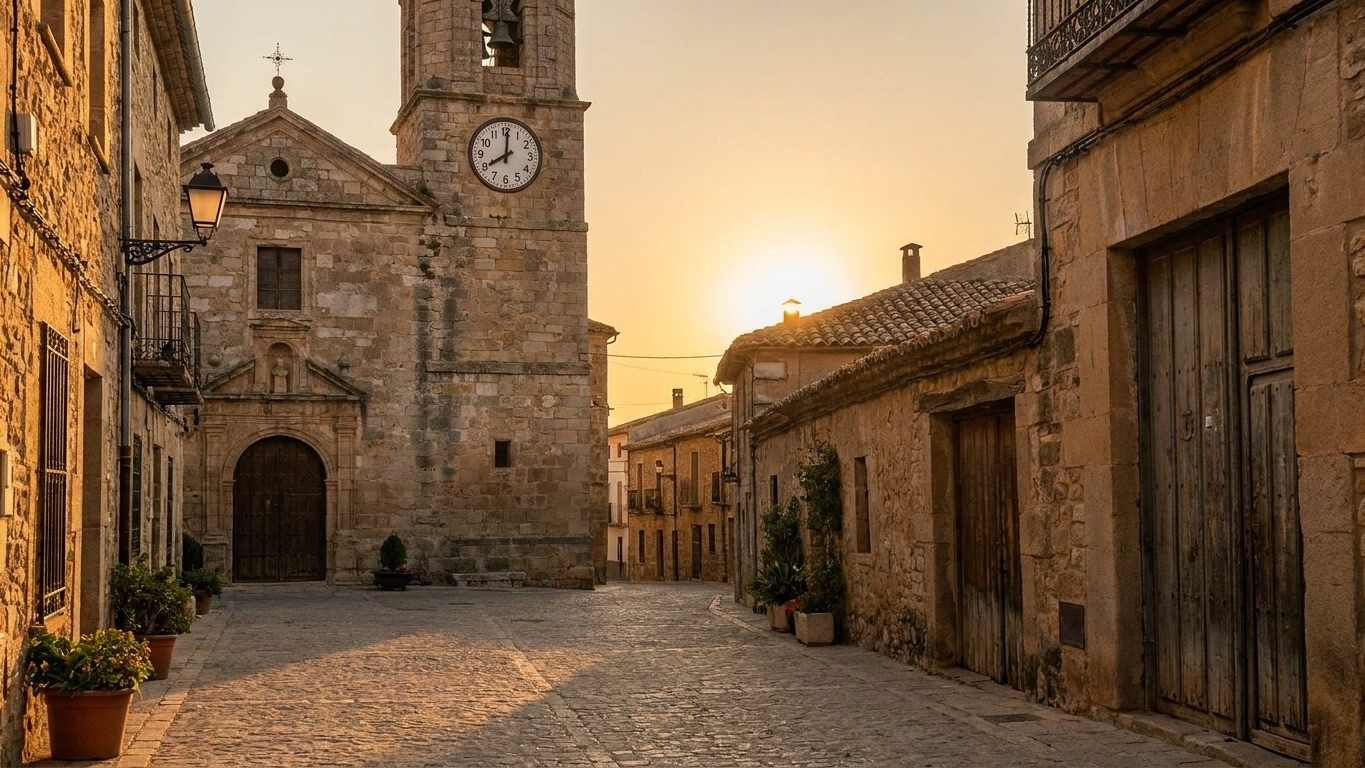
Ten o’clock p.m. is the hour when millions of Spaniards sit down to dinner, while their Portuguese or British neighbors have already finished for a long time and are getting ready to sleep. This anomaly is not a Latin cultural whim, as is often believed in France. It originates from a precise political decision made on a March evening in 1940, for which Spaniards continue to pay the price every night.
Key takeaways
- A Franco decree in March 1940 shifted Spain from Greenwich to Berlin time — officially temporary, it became permanent in 1942
- Unlike France and Italy, Spain never corrected this offset after World War II
- Spaniards endure permanent jet lag: late dinners, reduced sleep, but also a cultural identity that grew around the offset
A gesture of neutrality that turns into durable alignment
The story begins in the midst of World War II. In 1940, Francisco Franco shifts Spain’s time zone from Greenwich Mean Time to Central European Time, a change implemented on March 16, 1940 at 11 p.m., when the clocks jump directly to midnight. A simple decree, presented at the time as provisional, that abruptly moves the entire peninsula into the German time zone.
The political context leaves little doubt about the regime’s intentions. Franco, who governs Spain during the military dictatorship from 1939 to 1975, implements this time change within the context of World War II; officially neutral, the dictator sympathizes with the Axis powers, particularly Nazi Germany. Two years later, what was meant to be temporary becomes permanent. The change is made definitive in 1942 to stay in line with Europe occupied by Nazi Germany. The meeting between Hitler and Franco at Hendaye, in October 1940, crystallizes often in collective memory as the turning point, even though the decree itself predates that meeting by several months.
What strikes is the Spaniards’ solitude in this persistent anomaly. Other countries such as Italy, France or the United Kingdom also adopt the German time during the war, but after Allied victory, all revert to their natural time zone. France, for its part, retains a partial trace of this offset through daylight saving time broadly in use since 1976, but nothing comparable to the Spanish gap.
A country living on Warsaw time rather than Porto’s
Look at a map, and the anomaly jumps out. Cities like Vigo today share the same time as Warsaw, more than 3,000 kilometers away, while being an hour ahead of Porto, less than 150 kilometers away. The Greenwich meridian, the reference line that should determine legal time, actually bisects the Spanish territory itself, on the Castellón side. Geographically, Spain should have stayed aligned with Lisbon and London. Politically, it ended up tied to Berlin.
The consequences are read in the sky before they are read on a clock. With the current time zone, in summer the sun rises around 6:30 a.m., solar noon falls around 1 p.m., and sunset occurs after 8 p.m. A two-hour gap in summer between clock time and solar time, versus only one hour in winter. The body, it does not negotiate with administrative decrees: it continues to respond to natural light, not to what the alarm clock shows.
Dinner at 10 p.m., sleep one hour less: the health bill
The mechanism is almost mechanical, precisely. The sun sets late, the body delays its fatigue signal accordingly, dinner slips into late evening, and the bedtime follows the same logic. But the wake-up time must still bend to European standard working hours; this equation is a potentially explosive mix for rest, and Spaniards sleep on average about an hour less than what the World Health Organization recommends—a chronic sleep debt inherited directly from Franco’s decision.
It is not merely a temporary discomfort. Chronobiologists and Spanish sociologists have for years pointed to the cumulative effects of this permanent jet lag on productivity, public health and even family life. Advocates of returning to Greenwich Mean Time argue that realigning the country with its natural light cycle would improve sleep quality, productivity and family balance. The debate is thus not merely a historical curiosity confined to school textbooks: it regularly resurfaces in the Spanish political agenda, notably led by the Association for the Rationalization of Spanish Time, which has lobbied for decades for a return to the natural time zone.
Officials from this association have even directly addressed successive governments on the matter. The association proposes that the solution would be to return to the Greenwich time zone that governed Spain until early 1940, a request addressed without success to the last two presidents, Zapatero and Rajoy. Each spring, at the moment of the switch to daylight saving time, the issue resurfaces in the Spanish media, without ever resulting in concrete reform.
Why nothing changes, despite consensus
The paradox is there: almost everyone agrees on the diagnosis, but no one moves. Changing time zones would require rethinking television programming grids, school schedules, and the rhythms of the tourism industry that built its economic model around endless summer days and late dinners on terraces. An entire country has organized its social life around an offset inherited from an authoritarian regime, to the point that this offset has, over time, become a part of its cultural identity, claimed as the siesta and late-night dinners that almost serve as a tourist attraction. It will likely take more than a parliamentary report to undo eighty-six years of poorly aligned clocks.
Sources: rtbf.be | equinoxmagazine.fr
