
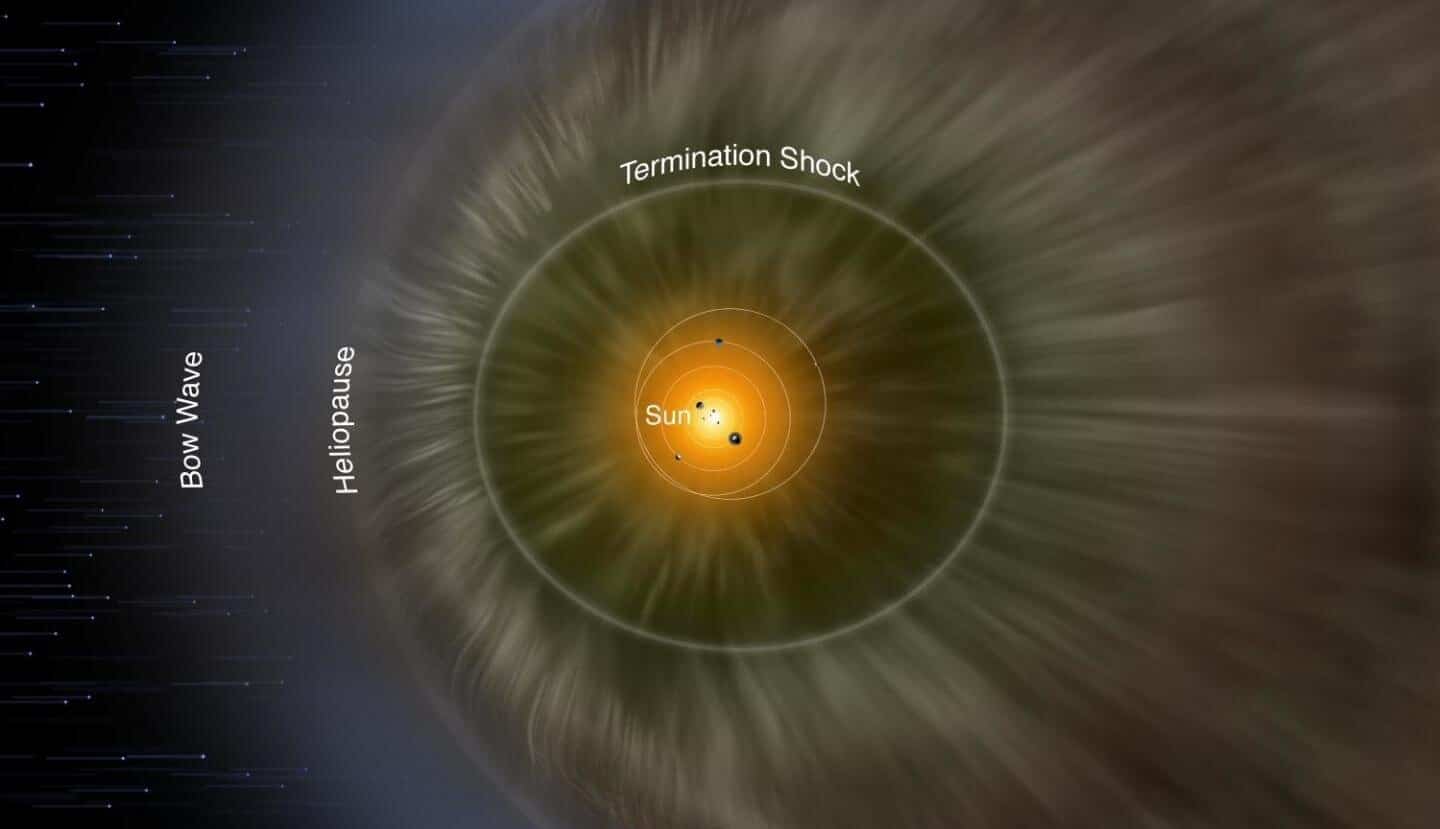
Scientists have managed to map the shape of the heliosphere, the protective bubble surrounding our Solar System. This new study could deepen our understanding of the Solar System’s environment and how it interacts with interstellar space.
What is the heliosphere?
The heliosphere is a magnetic bubble formed by the solar wind (a flow primarily composed of protons, electrons, and alpha particles) that extends from our Sun into interstellar space. It is what protects our Solar System from harmful radiation coming from the rest of the galaxy. But what is the shape of this envelope?
A few years ago, researchers relied on computer models to predict the characteristics of this renowned heliosphere using data from the Voyager probes. They focused on electrically neutral hydrogen atoms that originate from the interstellar medium and, once inside the heliosphere (some particles manage to pass through), become electrically charged.
By using these particles, scientists were able to “trace the boundary” separating our system from interstellar space, ultimately revealing a shape described as a “deflated crescent.”
As part of new work, Dan Reisenfeld and his team at Los Alamos National Laboratory turned to a different approach, drawing on data from NASA’s Interstellar Boundary Explorer (IBEX), which detects particles emanating from the heliopause—the outermost layer of the heliosphere. The team then focused on the edge of this region: the heliopause, where the solar wind meets the interstellar wind.
To perform the measurements, researchers employed a technique similar to echolocation used by certain animals such as bats. By emitting sound waves that bounce off objects and return an echo, these creatures can construct a mental map of their surroundings and navigate accordingly.
Up to 350 astronomical units
The researchers here relied on measures of energetic neutral atoms (ENA) produced by collisions between solar wind particles and those of the interstellar wind. “In doing so, we’re able to see the boundary of the heliosphere in the same way that a bat uses sonar to “see” the walls of a cave,” explains Dr. Reisenfeld.
Naturally, the strength of this signal depends on the intensity of the solar wind striking the ENA. Consequently, the researchers collected data over a full solar cycle, from 2009 to 2019. Relying on the signals returned by energetic neutral atoms, the team was able to construct a three-dimensional map of the heliosphere.
“We were able to ‘see’ the boundary of the heliosphere in the same way a bat uses sonar to ‘see’ the walls of a cave,” notes Dr. Reisenfeld.
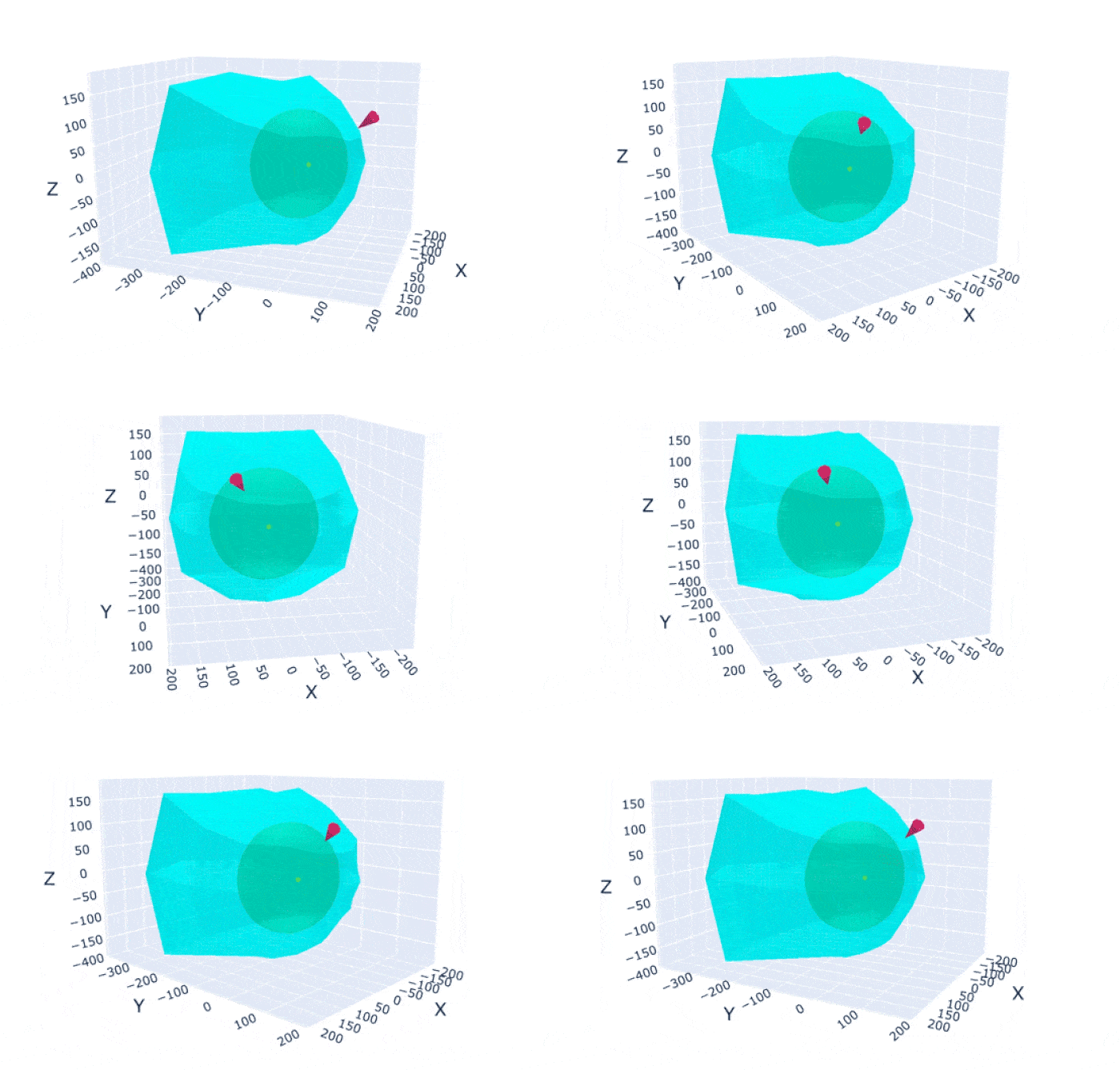
This new map suggests that the minimum distance between the Sun and the heliopause, facing the interstellar wind, is about 120 astronomical units. In the opposite direction, it extends to at least 350 astronomical units. For reference, one astronomical unit is the Earth-Sun distance, roughly 150 million kilometers.
These advances also pave the way for a better understanding of the interactions between our Solar System and interstellar space. By precisely mapping the heliosphere’s boundaries, scientists hope not only to better grasp its role as a shield against cosmic radiation but also to determine how these frontiers evolve with variations in the solar wind and galactic conditions. In the long term, these efforts could shed light on similar protective mechanisms around other stellar systems.
