
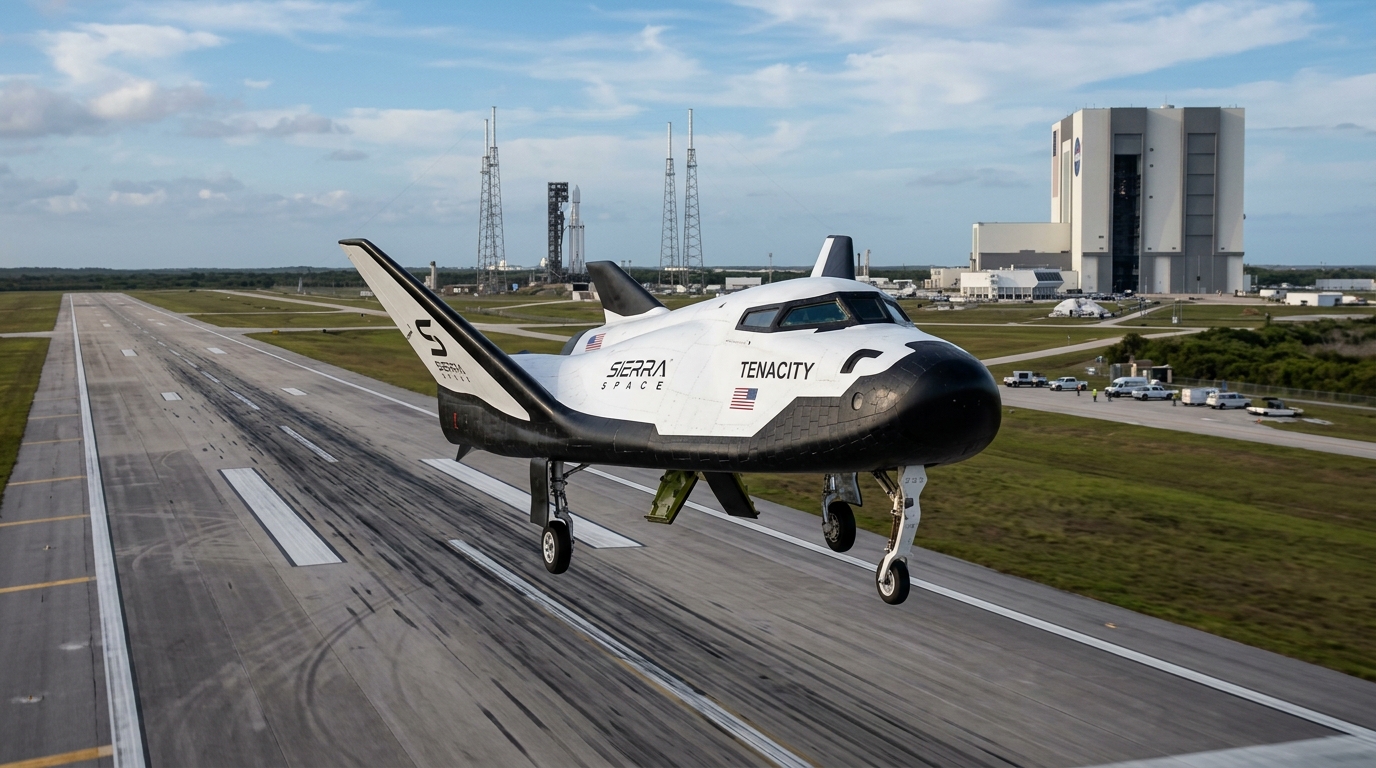
Imagine being asked to return from space smoothly, yet the only available means of transportation is to drop like a stone into the ocean before waiting for a boat. Not exactly the comfort of an Air France flight, is it? Yet, more or less, that is the everyday reality of today’s space capsules. And it is precisely here that Sierra Space’s Dream Chaser aims to change the game. This mini-shuttle, perched between an airplane and an orbital craft, promises to touch down calmly on a runway, exactly as a commercial airliner would on a return from a long-haul flight. After years of development and several delays, its first test flight is finally coming into focus. A rendezvous that the entire space industry is watching with keen interest.
A Return to Wings after the Capsule Era
Since the retirement of the American space shuttles, orbital transportation has massively shifted toward capsules. Efficient, for sure, but they return to Earth by splashdown in the sea, jostled by a brutal deceleration. The Dream Chaser reclaims a different philosophy, that of winged vehicles. With its lifting-body design, this compact spaceplane can glide through the atmosphere and land horizontally on a conventional runway, a bit as if one had miniaturized the legendary shuttles of old.
The advantage isn’t only aesthetic. During re-entry, the spacecraft experiences accelerations of less than 1.5 g, delivering a gentler return than a capsule that plunges into the ocean. For the most delicate scientific experiments, this comfort makes all the difference. The takeoff, meanwhile, remains vertical: the Dream Chaser launches atop a Vulcan Centaur rocket before gaining independence in orbit.
Tenacity, the First Unit That Will Change Everything
The vessel chosen for this grand premiere carries a name that captures the program’s story: Tenacity. Indeed, tenacity has been required to reach this stage. This initial flight, designated SSC Demo-1, was originally slated to lift off in 2025 to resupply the International Space Station. Yet NASA ultimately announced that the mission would not visit the station and would be postponed to the end of the year.
The reason? A spacecraft that was simply not yet ready. The propulsion system and the software had not yet earned the agency’s certification, and the availability of the launcher further complicated matters. The outcome: Tenacity will first conduct a mission in free flight, without docking to the ISS. The objective is to validate its performance in orbit, its re-entry, and, of course, this famous runway landing. In terms of payload, the Dream Chaser can carry up to 5,000 kg of pressurized cargo to orbit and return about 1,750 kg of freight to Earth. It is accompanied by the Shooting Star module, a consumable cargo compartment outfitted with solar panels that is expended on re-entry, carrying away waste with it.
An Industry-Wide Test Rendezvous Scrutinized
Expected by the end of this year, this evaluation flight represents far more than a mere technical demonstration. It takes place in a context where the contract linking Sierra Space to NASA has undergone a thorough rethink. The CRS-2 resupply contract, as originally signed, called for a minimum of seven cargo flights to the ISS. Those mandatory missions have now been removed in favor of a simple free-flight demonstration, with future flights becoming optional.
In other words, the pressure on this first test is immense. Succeeding at re-entry and on a runway landing would prove that the concept works, potentially opening the door to additional missions. A failure, on the other hand, would cast significant doubts on the program’s future.
More Than a Cargo Vehicle, the Key to a New Orbital Economy
Even though the schedule has been disrupted, it reflects a space landscape evolving at breakneck speed. The International Space Station is slated for deorbit around 2030, which naturally shrinks the window available for traditional supply missions. In response to this reality, Sierra Space has chosen to steer its winged vehicle toward new horizons.
The company now bets on defense applications and, above all, on future commercial space stations that are expected to take over from the ISS. In this vision, the Dream Chaser would no longer be merely a cargo truck for orbit, but a true link in a privately built space economy. Its versatility, its reusability, and its ability to deliver loads back to Earth intact make it an ideal candidate for this emerging market.
Ultimately, the Dream Chaser embodies a compelling idea: a space that is more accessible, where returns and resupplies occur with the ease of a commercial flight. The crucial test remains to prove this in the long-awaited free-flight demonstration. If Tenacity touches down on the runway as planned, it could signal a revival for winged vehicles in our ongoing exploration of space. And you, would you be willing to entrust your scientific experiments to this small shuttle that refuses to splash into the water?
