
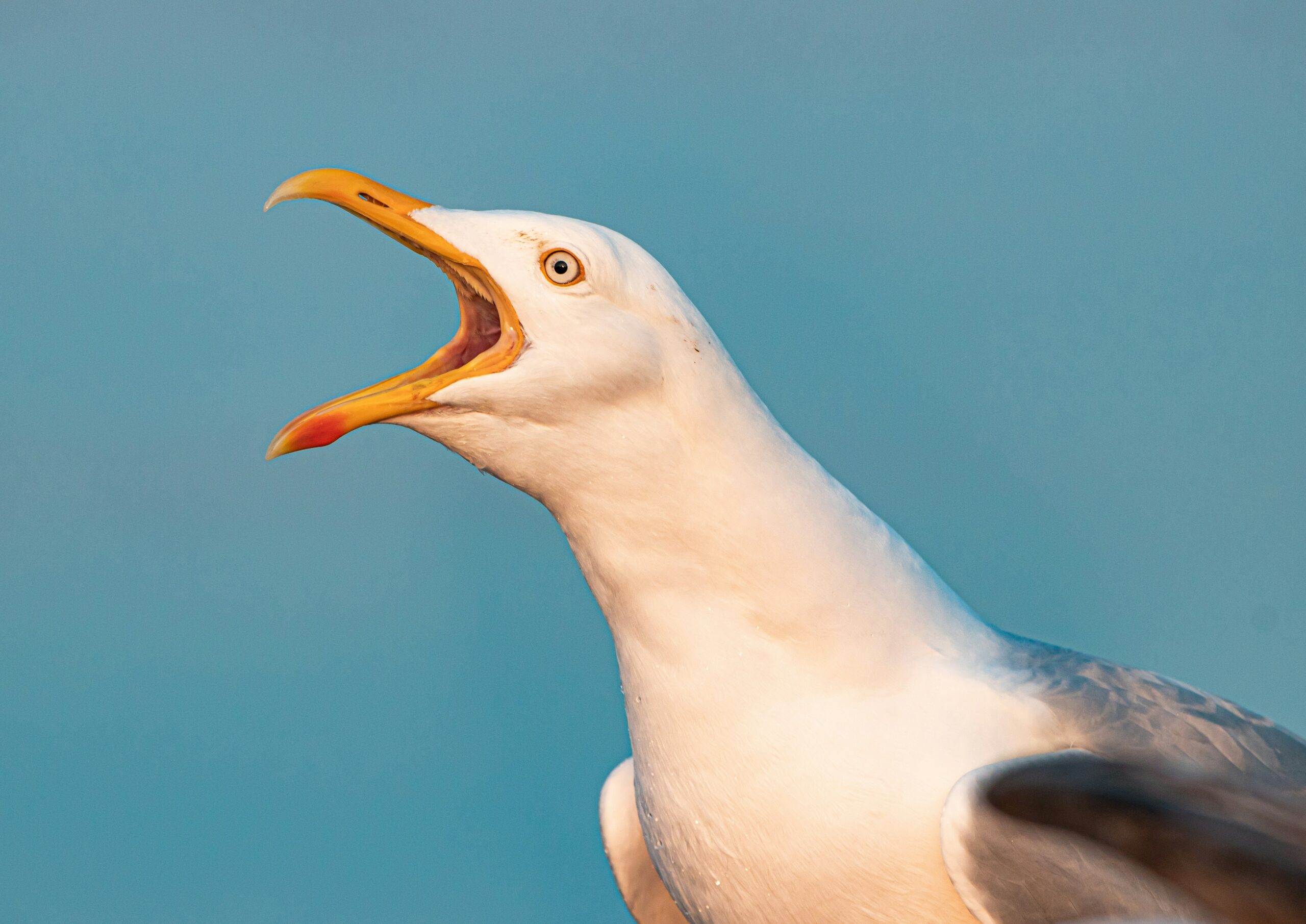
Facing seagulls that hover around beaches and parks, most of us have already tried the dirty look, threatening gestures, or a strategic retreat. Yet a team from the University of Exeter has just highlighted a far simpler, more unexpected, and especially non-violent method: all it takes is talking—better yet, shouting—to deter these fry-thieves. This study published in the Biology Letters, both rigorous and deliciously amusing, examines the relationship that gulls strike with human voices and reveals behaviors never before observed in a wild species.
Seagulls, those opportunists who grasp our intonations
In coastal regions, silver gulls have long earned a reputation as savvy opportunists. Their boldness, sometimes irritating, brings them a bit too close to our summer snacks. The Exeter researchers wondered whether there might be a way to deter them without scaring them away or mistreating them—a crucial issue for a species whose populations are in decline.
To test the birds’ responses, scientists set up a container filled with fries—a irresistible lure—and played back different recordings as a gull approached. Three stimuli were compared: a calm, spoken male voice; the same sentence shouted more aggressively; and, as a neutral control, the song of a robin. The tests involved 61 individuals spread across nine coastal towns, yielding a varied dataset on urban gull behavior.
From the very first trials, a clear pattern emerged: gulls react strongly to human voices, and far less to natural sounds. Merely speaking triggers heightened vigilance. But it is really the way the words are spoken that makes the difference, a detail the researchers had not anticipated.
Human shouts, an unexpected alarm signal for a wild species
When the male voice was broadcast in a normal tone, the gulls slowed their approach, watched the scene with caution, and some even moved away from the food. Yet this reaction was limited: only a handful ultimately took off. By contrast, when the shouted version played, the birds literally fled, often in under five seconds.
The robin’s song, meanwhile, hardly altered their behavior. Most gulls remained near the container with no sign of worry, confirming that it is not the loudness itself that triggers a response, but the human intonation. The researchers had deliberately standardized the sound level to avoid this bias.
This result is intriguing: until now, only domesticated animals, such as dogs or horses, were known for their ability to interpret our intonations. Seeing a wild species react so distinctly to the way we speak suggests a more advanced adaptation to human contact than previously imagined. Living in dense urban environments and exposed to our behaviors, gulls may have learned to associate certain vocal modulations with imminent danger.
A simple, non-violent method, and a reminder to live together
The researchers stress one point: the aim isn’t to stigmatize these birds, but to offer a safe way to coexist. Gulls are sometimes violently driven away or injured by frustrated people, even as many do not really attempt to snatch food. They are victims of prejudice, and their status as a threatened species deserves careful consideration.
This study shows that only minimal interaction is enough to deter them. There’s no need to throw objects or chase them: a simple verbal warning makes them more cautious, and a well-timed shout pushes them to retreat. The Exeter team’s message is clear: there are peaceful ways to protect your picnic while respecting the wildlife that shares our space.
The researchers acknowledge, however, the limits of their experiment—no direct human presence, no long-term follow-up—but their observations open a new avenue. They complement other work showing, for example, that fixing a gull with a stare can sometimes prevent it from approaching.
With this discovery as surprising as it is promising, a new question arises: are gulls perhaps far more attentive to us than we imagine?
