
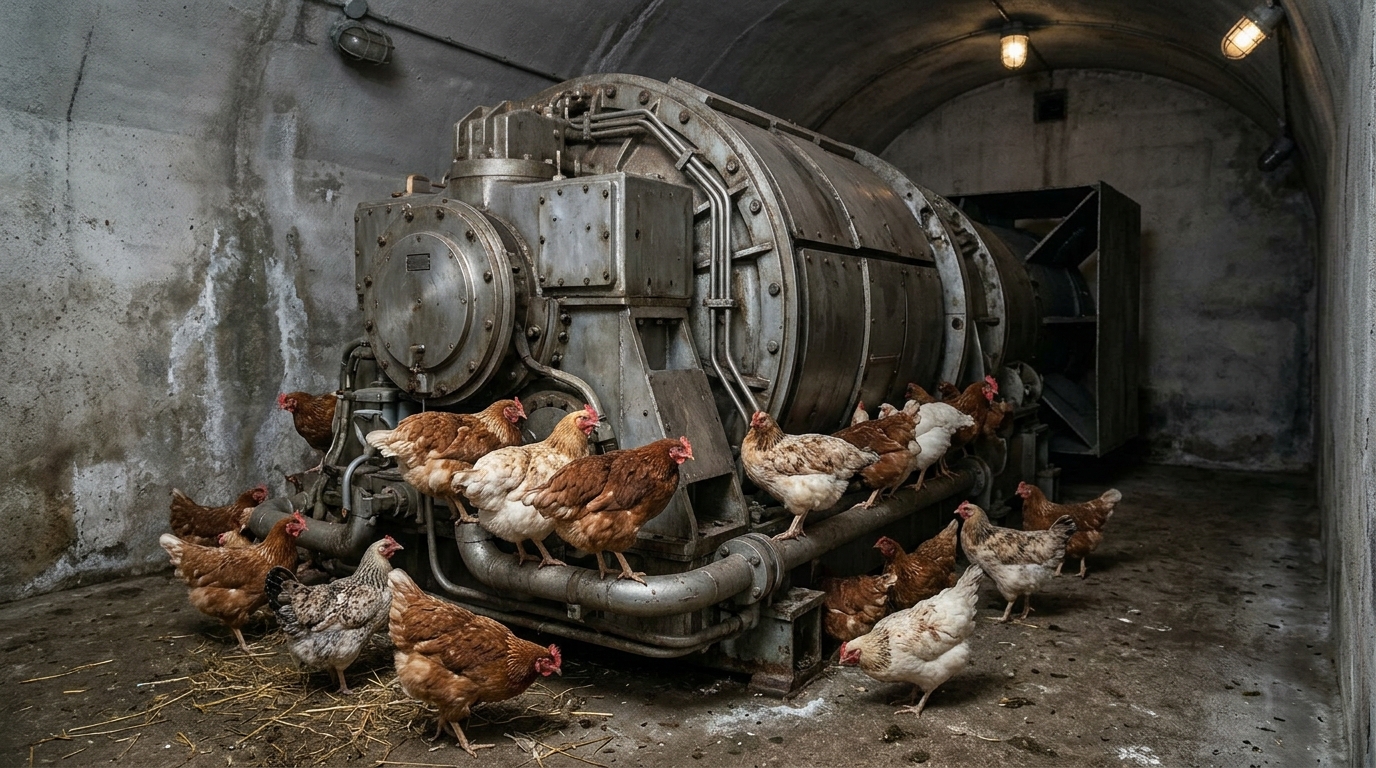
Imagine digging a tunnel through the German countryside and burying a nuclear bomb weighing more than seven tons, all concealed beneath a mere administrative label. This scenario, worthy of a spy novel, is far from fiction. It is the reality of a British military project kept secret for nearly half a century, and one of its most fascinating technical details concerns… live chickens. This paradox of cutting-edge technology and a folksy, rural solution explains why the story intrigues both curious minds and enthusiasts of military science, and why it deserves a detailed examination.
- The 1950s British Blue Peacock program envisioned burying 7.2-ton nuclear mines on the North German plain to deter a Soviet invasion
- To prevent frost from damaging the electronics, engineers considered sealing live chickens inside the casing before opting for fiberglass cushions
- Deemed politically too risky for a partner like West Germany, the project was abandoned and kept top secret until it was declassified in 2004
- A 7-ton nuclear mine buried beneath Cold War Germany
- Live chickens as an improbable heating system
- Why German cold nearly derailed a nuclear weapon
- Blue Peacock, a project buried twice: underground and in the archives
A 7-ton Nuclear Mine Buried Beneath Cold War Germany
In the 1950s, amid the strains of bloc confrontation, the United Kingdom launched a program known as Blue Peacock. The plan was audacious on paper and dizzying in execution: to bury tactical nuclear mines directly on the North German plain, at the precise location deemed most likely to face a Soviet invasion from the east. In the event of an attack, these devices could be triggered either by a simple remotely controlled wire or by an eight-day timer, giving Allied forces time to pull back before the detonation.
Each unit weighed roughly 7.2 long tons, a heft of metal, electronics, and a nuclear payload. The British Army officially ordered ten units in 1957, but under a misleading code name: the devices were logged as mere “atomic power units for troops in the field,” an intentionally vague designation meant to mask their true purpose from anyone who might stumble upon the administrative records. In practice, only two complete units—housing and nuclear payload included—would ever come to fruition.
Live Chickens as an Improbable Heating System
This is where the story tips into the realm of a nearly comic anecdote. The British engineers faced an unexpected hurdle: the onboard electronics performed poorly as soon as the ground froze, a common January condition on the North German plain. A bomb that failed to trigger at the right moment would lose all strategic value.
Facing this thermal puzzle, a team of scientists proposed an idea both ingenious and surprising: seal live chickens inside the casing, along with food and water. The plan rested on a straightforward biological principle: the birds’ body heat, maintained for roughly a week, would keep the electronics operating at a functional temperature. A nuclear device warmed by laying hens makes for a striking image, but it reveals the unbridled ingenuity of engineers of the era, who were willing to test anything to solve an urgent technical problem.
Why German Cold Nearly Stopped a Nuclear Weapon
If the chicken anecdote sticks in the memory, it actually illustrates a far more serious problem: the reliability of nuclear weapons buried in extreme climatic conditions. A device intended to remain operational for several days underground had to withstand freezing temperatures and thermal fluctuations without ever failing, otherwise the deterrent strategy would be compromised.
Ultimately, the scientists abandoned the avian route in favor of a far more pragmatic method: fill the device with fiberglass cushions, an insulating material capable of preserving heat without the logistical complications of confining animals underground. This less dramatic solution at least avoided dependence on the goodwill of birds kept in darkness.
Blue Peacock, a Project Buried Twice: Underground and Then in the Archives
Despite these technical feats, the Blue Peacock program never made it into the field. British authorities quickly recognized that deploying a nuclear weapon on the soil of an ally—West Germany—during peacetime would be politically explosive, not to mention risky in terms of potential radioactive fallout in the event of an accident or sabotage. Meanwhile, American and British research was steering toward warheads that were smaller, lighter, and paradoxically more destructive, rendering the giant-mined concept obsolete.
The Blue Peacock file was classified as top secret and faded into obscurity for nearly five decades. It wasn’t until 2004 that the British National Archives declassified most of the documents, revealing not only the existence of this outlandish project but also the audacious use of chickens. The choice of date for the disclosure, April 1, immediately raised suspicions in the British press about a possible April Fools’ joke. The National Archives publicly clarified the matter, noting in typically dry British fashion that “the civil service does not joke.”
This improbable story, as far-fetched as it may seem, serves as a reminder of how the Cold War pushed engineers to explore unconventional paths to solve very real problems. Between absurdity and pragmatic ingenuity, Blue Peacock stands as a unique testament to an era when strategic urgency nearly justified entrusting the fate of a nuclear weapon to a handful of hens kept warm underground. One thing is certain: the next time you pass a chicken in a coop, you might not look at it quite the same way.
