
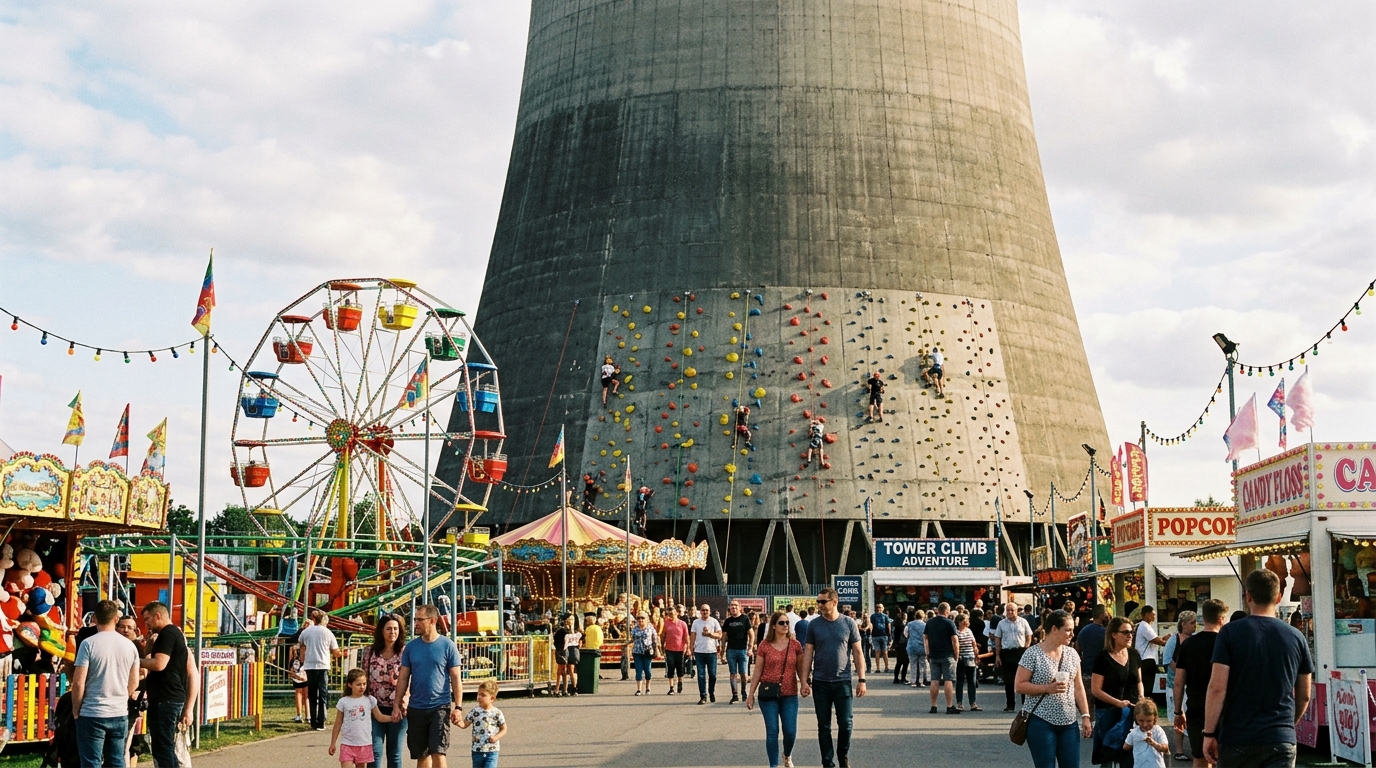
Imagine having to wait about twenty minutes under the blazing sun to board a ride tucked inside a nuclear cooling tower. That scenario, which sounds like a slightly grim episode of science fiction, is in fact the most tangible reality in the western part of Germany, just a short distance from the Dutch border. Every summer, whole families line up at the very spot where, forty years earlier, engineers dreamed of revolutionizing electricity production with plutonium. How could a colossal construction, swallowed by billions of marks, end up as a theme park rather than an active power plant? The story of Kalkar’s site deserves attention, for it encapsulates the tensions, fears, and contradictions that have shaped Europe’s relationship with atomic energy.
- The Kalkar SNR-300 fast breeder reactor, completed in 1985 after seven years of delay, never produced commercial electricity due to a political decision not to grant licensing in 1991
- The project, funded 68.5% by Germany, consumed about 7 billion marks, despite strong anti-nuclear opposition dating back to 1977
- In 1995, contractor Hennie van der Most bought the site to transform it into an amusement park, Wunderland Kalkar, which today welcomes around 600,000 visitors per year
- A nuclear reactor that never produced a watt of electricity
- Seven billion marks swallowed by the Rhineland sand
- When Greenpeace and residents were right about German nuclear power
- From industrial disaster to Europe’s most unlikely attraction
- What Kalkar tells us about our relationship with the atom and with recycling
A Nuclear Reactor That Never Produced a Watt of Electricity
The project kicked off in April 1973, amid the oil crisis, at a moment when Europe was desperately seeking alternatives to oil. Germany, which would fund 68.5% of the operation, joined with Belgium, the Netherlands, and the United Kingdom to build the SNR-300, a sodium-cooled fast reactor designed to run on plutonium. The ambition was clear: to generate 300 megawatts with a technology never before deployed on this scale in Germany. On paper, it looked like an industrial tour de force that would position the country at the forefront of energy innovation.
Yet this reactor, no matter how ambitious, would never produce any commercial electricity. It would stand as a frozen monument—finished but never switched on—a symbol of a technology that reached completion but never crossed the finish line.
Seven Billion Marks Spent in the Rhineland Sand
The construction, initially planned to last a few years, stretched far beyond expectations. It would take until 1985, more than seven years of additional delays beyond the original timetable, for the plant to be completed. By then the bill had risen to roughly 7 billion German marks, the equivalent of about 3.5 billion euros or more than 4 billion dollars in today’s value. A colossal sum for a structure that, in the end, would never serve the purpose it was designed for.
This financial chasm shows how far the grand nuclear projects of the 1970s and 1980s could derail, propelled by technological optimism colliding head-on with the political and social realities of the era.
When Greenpeace and Local Residents Won Against German Nuclear Power
From the outset, anti-nuclear opposition organized with unusual resolve. In September 1977, a large demonstration forced authorities to deploy “a heavy police operation including the complete closure of the northern Germany highways.” This climate of protest would not fade, and the Chernobyl disaster in April 1986 revived fears just a year after the building’s completion, strengthening a rejection already deeply rooted in regional public opinion.
The final blow came on March 21, 1991, when the minister of research, Heinz Riesenhuber, announced the definitive halt of the fast breeder. Notably, it was not an accident on the site that sealed the SNR-300’s fate, but a political decision: the state government of North Rhine-Westphalia, having chosen to move away from nuclear power, refused to grant the startup authorization. A reactor that was finished, funded, and technically operational, but abandoned for purely administrative and ideological reasons.
From Industrial Disaster to Europe’s Most Unlikely Attraction
In 1995, the story took a totally unexpected turn. Dutch entrepreneur Hennie van der Most bought the site, reportedly for around 3 million dollars, with a seemingly ludicrous idea: to turn this relic of German nuclear power into an amusement park. Thus Wunderland Kalkar was born, today visited by about 600,000 people each year and employing nearly 550 people at peak season.
The centerpiece remains, of course, the ride installed directly inside the former cooling tower of the plant, a backdrop that never ceases to surprise families who come to have fun without necessarily knowing the site’s industrial past. It is precisely this summer queue, now almost routine for locals, that conceals a history as weighty as it is fascinating.
What Kalkar Tells Us About Our Relationship with the Atom and with Recycling
Beyond the anecdote, the fate of the SNR-300 raises a broader question about our collective ability to turn industrial mistakes into new opportunities. Rather than letting this massive structure deteriorate like so many other nuclear wastelands abandoned around the world, the choice was made to give it a wholly unconventional second life, almost ironic, in the heart of the autumn of our energy certainties from the 1970s.
This unlikely recycling also reminds us that nuclear power, far from being a purely technical issue, remains deeply political, social, and emotional. In an era when debates about the place of the atom in the energy transition regularly surface, Kalkar offers a witty counterpoint: a technology abandoned not by failure but by democratic choice, and whose remnants continue, whether we like it or not, to fascinate children and adults alike.
From the oil crisis of the 1970s to the summer queues for a ride, Kalkar’s site perfectly embodies the sometimes surprising detours of industrial history. It reminds us that a pharaonic project can fail at the outset yet later find a use that was never envisioned at the origin. And might other nuclear wastelands elsewhere in Europe likewise be awaiting their own unlikely reconversion?
