
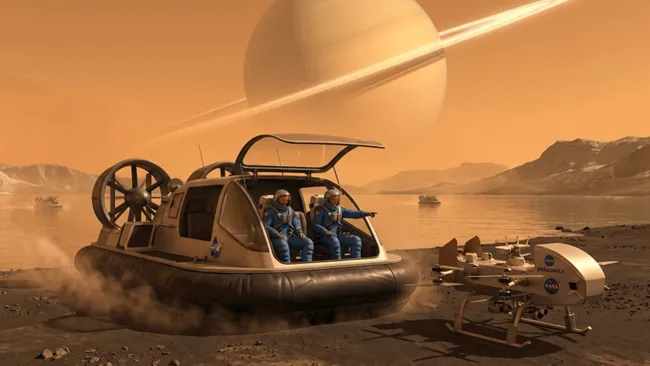
Experts gathered in June 2026 to take seriously an idea that had until now seemed like science fiction: sending humans to Titan, Saturn’s largest moon. Not in the near future—but as the next destination after Mars, to be planned right now.
What you will learn
- Why Titan is considered one of the most favorable destinations for human life in the solar system despite its extreme conditions
- What concrete obstacles were identified at the summit—from travel duration to spacesuits
- How upcoming robotic missions, notably Dragonfly, are paving the way for potential human exploration
Normalizing a Bold Idea
The Humans to Titan Summit 2026, the first gathering of experts devoted to this topic, took place on June 11 and 12 at the Southwest Research Institute. The goal wasn’t to plan a concrete mission, but—according to the organizers—to “kick off a movement”: to establish Titan as the next serious human destination after Mars, and to begin identifying the challenges to be addressed.
Amanda Hendrix, director of the Planetary Science Institute and president of the Explore Titan group, summarizes the ambition: “Everyone recognizes that this reality is still very far off, but it is important to normalize the idea that Titan is actually a perfectly reasonable destination for humans.”
Why Titan, rather than elsewhere?
Titan is one of the most unique moons in the solar system. It possesses a dense nitrogen-dominated atmosphere—thicker than Earth’s—that offers natural protection against many harmful forms of radiation, a significant advantage for astronauts. It has rivers, lakes, a climate, dunes, and a complex organic chemistry—even though its weather system is hydrocarbon-based rather than water-based.
This richness in resources—methane, nitrogen, oxygen—could fuel broader and deeper exploration beyond Titan. Its position within Saturn’s system also makes it a potential staging point for sample-return missions to other moons such as Enceladus.
Identified challenges, a path emerging
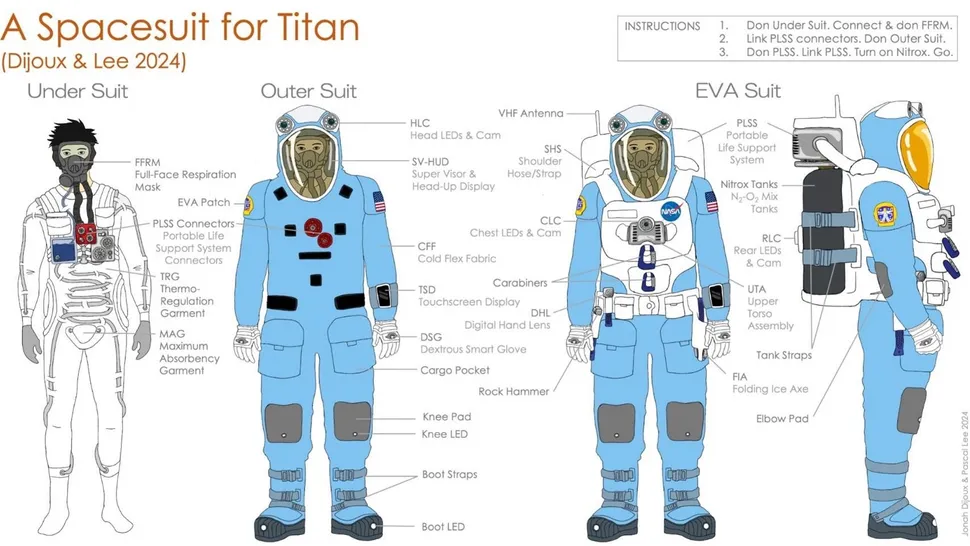
Experts tackled a wide range of practical questions: the design of spacesuits and habitats, airlock systems, available lighting levels, and risks related to hydrocarbon-driven monsoons and floods. The absolute priority identified at the summit remains the travel duration—Titan is roughly 1.2 billion kilometers from Earth—and the need to shorten this transit or mitigate its effects on astronauts.
Scot Rafkin, of the Southwest Research Institute, emphasizes that the obstacles are not of a fundamental physical nature: “Human exploration of Titan isn’t a physics question. It’s a question of time, technology, and commitment.” Each advance in propulsion, supply, robotics, life support, or communications brings Titan closer while benefiting the broader exploration of the solar system.
The next robotic steps
Before any human journey, NASA’s Dragonfly mission — a nuclear-powered drone lander whose launch is planned for 2028, with arrival six years later — will be humanity’s next visit to Titan. Its rotors will enable it to travel across kilometers to collect and analyze surface samples.
A second “Humans to Titan” summit is planned around Dragonfly’s 2028 launch date — the next milestone in this long-term effort.
