
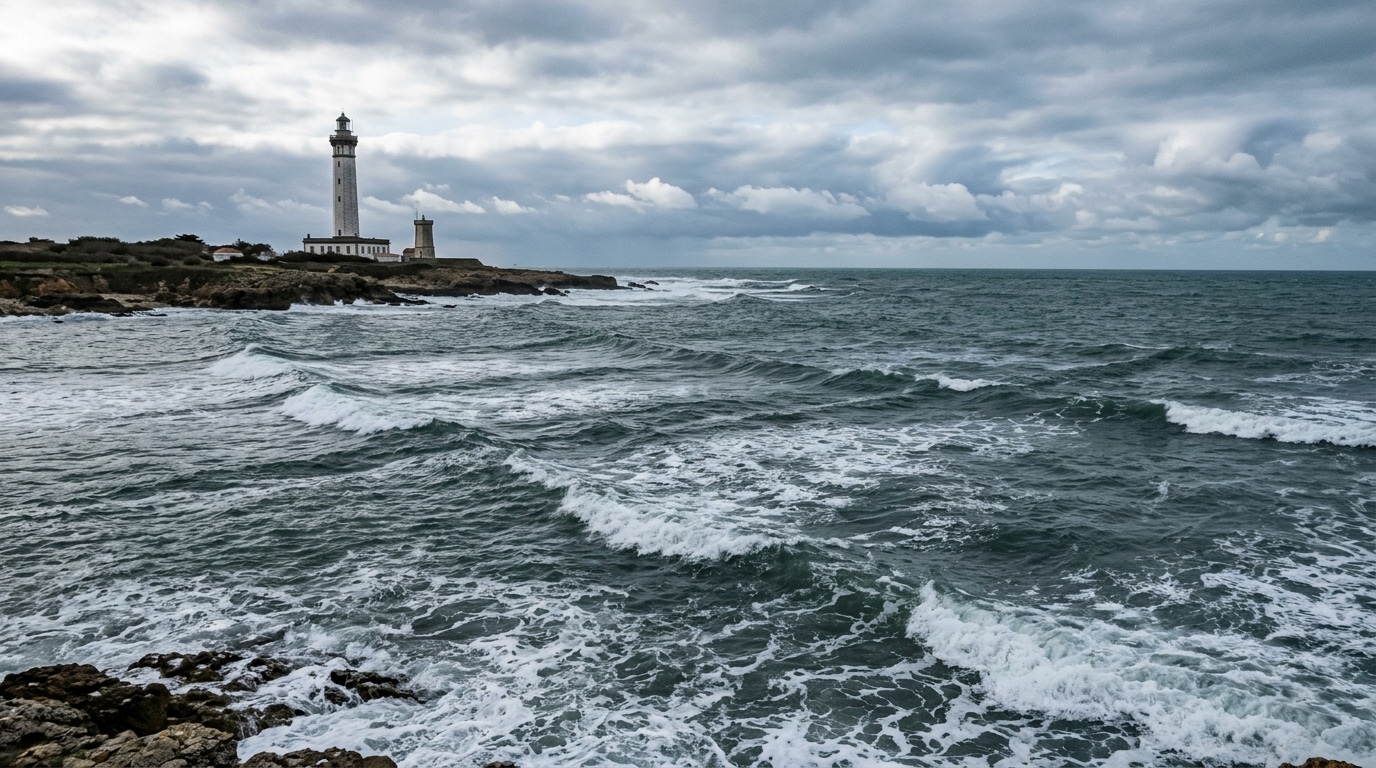
The sea has not finished surprising those who watch it closely. Between the troughs forming offshore, the whitecaps whitening the surface under a steady wind, and the long undulations that come to rest on the sand, the ocean constantly offers a changing show. But sometimes this habitual ballet gives way to a stranger figure: an almost perfect grid that appears on the surface of the water. This is exactly what one can observe at the foot of the Whale Lighthouse, where the sea occasionally cuts into true squares. A phenomenon that intrigues walkers, yet is well explained by the physics of waves.
- A cross sea forms when two trains of waves coming from different directions, separated by more than 45 degrees, overlap and draw a checkerboard pattern.
- This phenomenon results from the encounter between distant swell and locally generated sea waves, depending on the wind’s speed, its duration, and its fetch.
- Cross seas, though spectacular, make navigation unpredictable and hazardous for small craft, hence the importance of consulting warning bulletins before any outing.
- A mysterious checkerboard forms offshore from the Whale Lighthouse
- Two trains of waves cross paths and sketch this sea into squares
- Long-range swell meets the local wind and creates this optical phenomenon
- Why this marine spectacle remains rare and fascinating to observe
- What this cross sea reveals about the power of the ocean
A mysterious checkerboard forms offshore from the Whale Lighthouse
From the wind-swept promontory where the Whale Lighthouse stands, certain visitors are lucky enough to glimpse an unusual marine surface. Instead of the classic waves advancing in a single direction, the water fragments into regular little blocks, like a gigantic floating chessboard. The phenomenon is spectacular enough to catch the eye and rare enough to raise questions. Many imagine a hidden swirl beneath the surface or a simple light effect on the water. In reality, it is neither a particular current nor an optical illusion, but a weather-ocean phenomenon that is well identified and documented.
Two trains of waves cross paths and sketch this sea into squares
This checkerboard has a precise name: it is known as a cross sea. A cross sea appears when wave trains from different directions meet. A swell originating far offshore can, for example, cross with waves generated by the local wind. When these two systems overlap with directions close to perpendicular, their crests and troughs interlace and visually form the famous grid. The Australian Bureau of Meteorology, which studied this configuration, notes that cross seas are characterized by wave directions separated by more than 45 degrees. This misalignment is precisely what allows the checkerboard pattern to form so clearly.
Long-range swell meets the local wind and creates this optical phenomenon
To understand this crossing, one must distinguish between two kinds of waves. On one side, locally generated sea waves, produced by the present or recent wind, with a short interval between crests. On the other, swell, born from winds blowing sometimes thousands of kilometers away, capable of traveling long distances with a clearly defined dominant direction, or even two or three swells at once. The wind remains the main engine of this mechanism, according to three criteria: its speed, its duration, and the fetch, the distance it travels across the water. When swell arriving from offshore crosses waves raised by the current wind, and their orientations diverge sufficiently, the checkerboard appears. Along the French Atlantic coast, this kind of confrontation between distant swell and local wind is not unusual: a depression like Davide had, in fact, generated strong waves and gusts between Finistère and Cotentin, reminding how much these depressions can influence sea state along broad coastal stretches.
Why this marine display remains rare and fascinating to observe
Observing a well-formed cross sea requires a fairly precise alignment of conditions. Not only must two trains of waves coexist, but their angle must be sufficiently marked to draw a pattern readable from the shore. The Whale Lighthouse makes for a privileged observation post for this kind of spectacle. Periods of strong tides can also heighten the phenomenon’s visibility by amplifying water movements near the shore. This is what makes each appearance of this checkerboard so special: it is not a scheduled event, but a chance encounter between two independent marine dynamics.
What this cross sea reveals about the power of the ocean
Beyond its aesthetic aspect, the cross sea reminds us that the ocean constantly blends several forces. The Australian Bureau of Meteorology notes that this type of sea imposes uncomfortable or unpredictable motions on small vessels, because waves no longer behave in a single, predictable direction. This reality is regularly borne out in the field: Météo-France recently placed Rapa Island, in French Polynesia, on orange vigilance for waves and submersion in response to a southwest swell measured between 3 and 3.5 meters, expected to reach up to 5 meters overnight. At the same time, several Polynesian archipelagos were under yellow alerts for rain, swell or storms, while Storm Agneta battered the Mediterranean with red alerts in Greece and Bulgaria, and six French départements remained under yellow storm warnings.
These successive episodes illustrate why prudence remains essential whenever the sea is unpredictable, even when it appears calm on the surface. A few simple reflexes help avoid unpleasant surprises:
- Check the Météo-France vigilance bulletins before any sea outing or along exposed coasts
- Avoid approaching the water’s edge during an announced swell, even if the waves look modest
- Be cautious of cross-sea zones, particularly uncomfortable and potentially dangerous for small vessels
- Take into account high tidal periods, which amplify water movements near the coast
The rescue services’ records remind us how meaningful these precautions are. The SNSM logged 43,603 people rescued during 10,426 operations at sea, on beaches and during civil safety missions. Between May 1 and September 30, 2026, 3,517 operations related to boating and nautical leisure were coordinated solely in the Mediterranean, involving more than 10,500 people, with 42 deaths or disappearances compared to 43 the previous year. The SNSM also cited nearly 6,500 operations and more than 30,000 people assisted during the entire summer season of 2026. All these figures show that behind the beauty of a marine checkerboard lies a powerful mechanism, to be respected as much as admired.
