
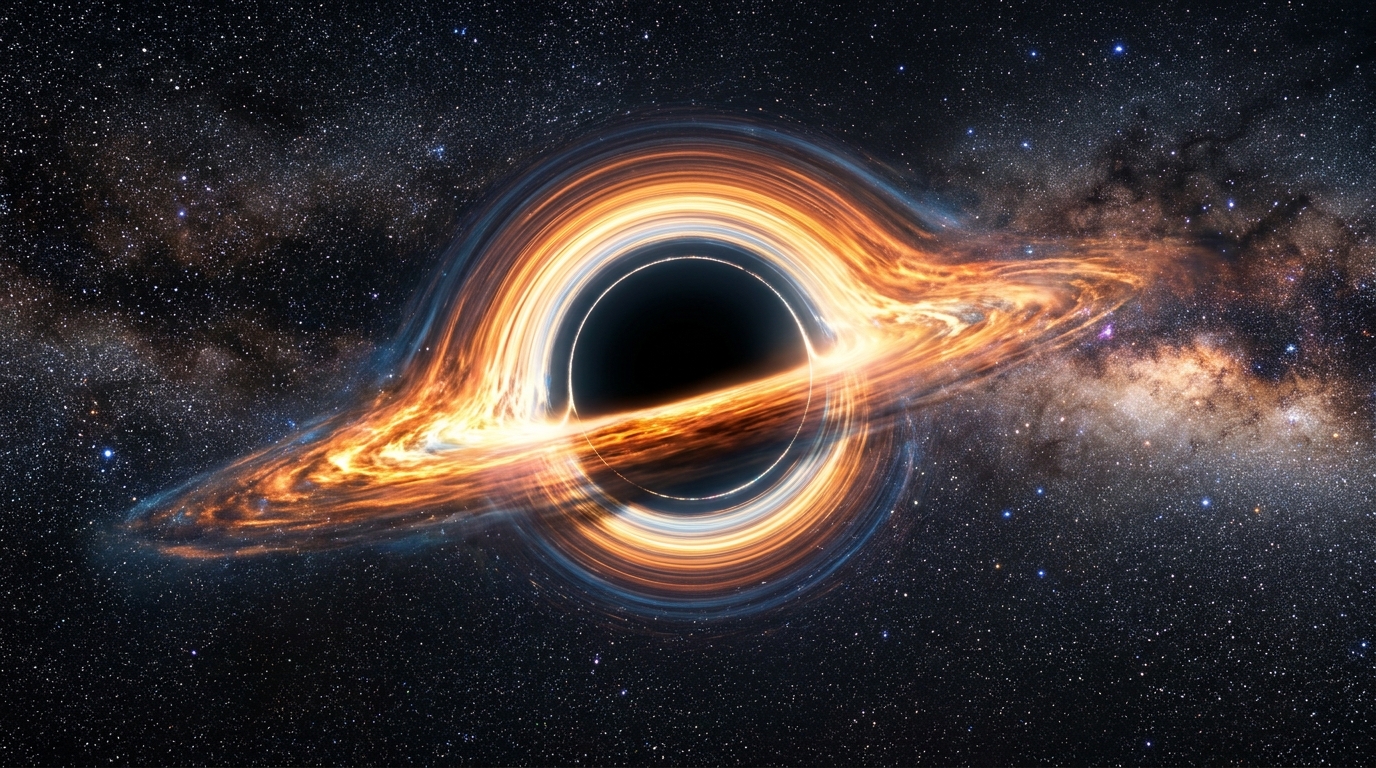
Imagine a cannon so powerful that it propels tons of matter at nearly the speed of light, and yet, instead of shooting straight like an arrow, it traces a majestic spiral through the void. Behold one of the most perplexing spectacles the Universe offers us. At the centers of some galaxies, hidden in darkness, supermassive black holes eject beams of particles to staggering distances. But these jets do not fly straight: they twist, undulate, drawing a cosmic choreography that seems to mock our intuition. For a long time, this ballet remained invisible to our eyes. Today, an observation technique of extraordinary finesse finally allows us to follow this motion with a precision bordering on prodigious. Let us dissect this fascinating phenomenon together.
A cosmic cannon that spews matter at nearly light-speed
At the heart of what astronomers call active galaxies lies an engine of unprecedented violence: a supermassive black hole, whose mass can reach millions, or even billions, of times that of our Sun. Around it whirls a disk of incandescent matter, like water rushing into a giant siphon. Under the influence of colossal gravitational and magnetic forces, part of this matter is not swallowed: it is violently expelled along the poles, forming two relativistic jets of charged particles.
These jets travel at speeds approaching the speed of light, nearly 300,000 kilometers per second. They extend sometimes over distances that exceed the size of the galaxy hosting them. One could imagine a garden hose under maximum pressure, except that here the fluid is incandescent plasma and the jet tears through intergalactic space across millions of light-years. A phenomenon of such power that it shapes the environment of the entire galaxy.
Why this jet refuses to go straight and begins to whirl
If logic would have it that a jet propelled so violently would travel in a straight line, reality is far more subtle. These beams bend, undulate, and adopt a spiral trajectory. The main cause bears an elegant name: precession. It is exactly the motion of a top that, as it slows, does not topple outright but begins to describe circles with its axis. The jet follows this same principle, its origin point slowly oscillating around a central axis.
Several mechanisms can trigger this dance. The disk of matter feeding the black hole itself may be inclined and rotate in a misaligned way. It can also happen that two black holes orbit each other, their gravitational interactions perturbing the jet’s direction. Finally, the rotation of the black hole itself distorts spacetime around it, dragging everything nearby into a subtle swirl. The result: what was thought to be rectilinear reveals itself as a cosmic spiral of striking elegance.
The Earth-sized virtual telescope that tracks the invisible
How can we observe a phenomenon located millions, sometimes billions of light-years away, with enough sharpness to pick out the twists of a jet? The answer lies in a technical feat called Very Long Baseline Interferometry (VLBI). The principle is as ingenious as it is bold: instead of a single giant telescope, several radio telescopes spread across the globe are linked together.
By combining the signals captured simultaneously by these antennas separated by thousands of kilometers, we obtain the equivalent of an instrument whose diameter would be the entire planet. This technique offers an absolutely extraordinary resolution, capable of distinguishing minute details in these distant structures. It is thanks to it that astronomers manage to measure the jet’s precession, to follow image after image the slow swaying of its origin point, and to confirm that the matter indeed describes a helix around the central monster.
What the spiral whispers to us about the monster at the center
This spiraling dance is much more than a mere spectacle. It constitutes a true signature, a coded message that informs about the properties of the invisible black hole. By analyzing the spiral’s angle, its period, and its regularity, one can estimate the rotation speed of the black hole, the inclination of its disk, and sometimes infer the presence of a hidden companion.
These observations offer a unique window into the dynamics of galactic nuclei and into how these giants devour their surroundings. They also help to better understand how jets influence star formation and the evolution of galaxies as a whole. In short, every twist of the jet becomes a valuable clue for reconstructing the portrait of an object that one can never directly see, by definition.
Thus, what was once taken for a simple straight line jet shooting from nothingness turns out to be a cosmic waltz of infinite precision, orchestrated by the Universe’s most extreme gravity. Thanks to a virtual telescope as vast as the Earth, we now capture this distant ballet with unprecedented acuity. One vertigo-inducing question remains: how many other invisible choreographies still await in the depths of the cosmos to be finally deciphered?
