
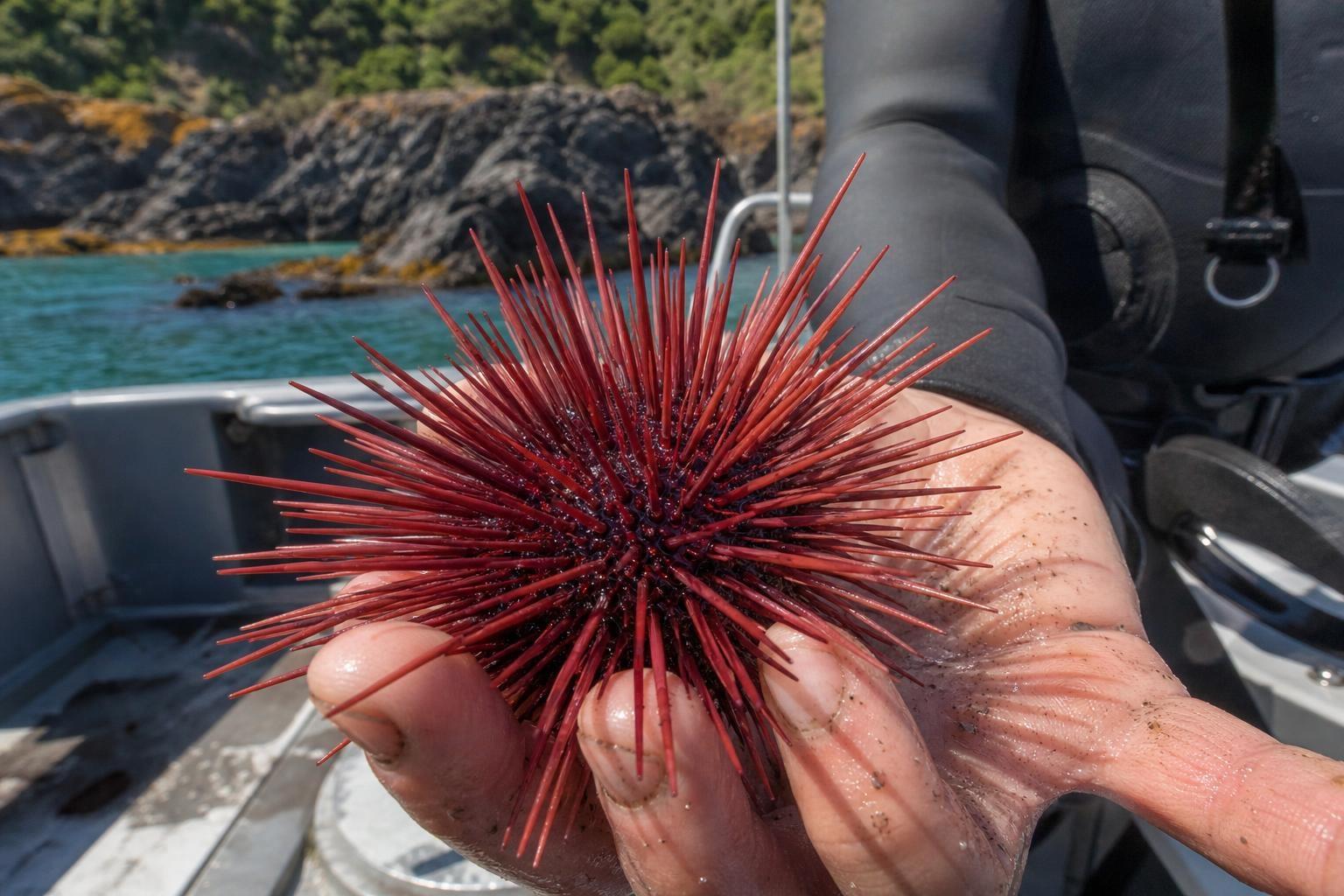
They are small, thorny enigmas, outliving empires while barely changing at all. Along the Pacific edge of California, these crimson echinoderms drift through decades with composure, adding little more than millimetres and memories. Divers see them year after year, stationed on rocks like ruby keep-sakes, and many are older than our cities. “It’s like time forgets them,” says one veteran diver with a grin and a shrug.
Centuries in the shallows
The species in question, Mesocentrotus franciscanus, is a master of the long game, with verified lifespans surpassing two full centuries. Scientists have pieced together those ages using clever forensics, from radiocarbon signals locked in body parts to painstaking tag‑and‑recapture studies. Growth is glacially slow, especially in cold, nutrient‑rich waters, and the animals never really hit a hard stop on getting larger. They simply keep going, adding tissue and toughness while the decades gather around them.
What truly startles researchers is the lack of classic ageing markers. Old individuals remain fertile, keep their feeding vigor, and show no obvious spike in disease or mortality. In technical terms, they flirt with “negligible senescence,” a rare club shared by a few clams, rockfish, and bristlecone pines. As one marine biologist put it, “They don’t seem to age in the usual way,” and the data keeps agreeing.
Why so slow to age?
Part of the secret is a life lived slowly, buffered by cold water and stability. A reduced metabolic pace means fewer errors to accumulate, and fewer reactive molecules chipping away at cellular machinery. Their tissues regenerate with startling efficiency, patching punctures and rebuilding spines like a patient craftsperson. Year after year, they replace worn cells and keep their internal systems in tune.
Genetics likely plays a role, with robust DNA maintenance and well‑tuned stress‑response pathways. But environment matters too: deep shade, steady currents, and a diet of drifting kelp keep the physiological load manageable. Imagine a lifetime of gentle sips, not frantic gulps—the body can keep house more cleanly when it isn’t always racing the clock.
Life strategy: unhurried, resilient
Their playbook is simple yet elegant, and a few traits explain much of their endurance:
- Indeterminate growth with low metabolism, paired with powerful regeneration and year‑round reproductive capacity.
Each trait stacks with the others, forming a small but formidable fortress against time’s usual assaults.
Architects of reefs—and their risks
These urchins are not just long‑lived; they are shapers of coastal worlds. On healthy reefs, they nibble kelp and coralline algae, helping maintain balance within rich, swaying forests. Predators—sheephead fish, sea otters, and sunflower sea stars—keep them in check, ensuring the kelp canopy can breathe and rebuild after winter storms.
Remove those predators and the equation tilts. In recent years, disease struck sunflower sea stars, while historical otter declines left gaps in control. Warmer waters and marine heatwaves stressed kelp, and urchins—especially purple relatives—exploded into hungry throngs. The result is “urchin barrens,” where spiny grazers strip reefs to stone, leaving a minimal menu and a violet‑brown hush where forests once stood.
Red urchins also support a human fishery, prized for their buttery, golden gonads known as uni in Japanese cuisine. Responsible management is crucial, because a creature built for centuries can be undone by a few hot years of pressure. Regulators, divers, and scientists are now testing adaptive harvests, targeted removals in barren zones, and kelp restoration to stitch resilience back into the seascape.
What long lives reveal about ageing
To study these animals is to question our assumptions about getting old. If a spiny invertebrate can stay fertile and functional well past two human lifetimes, then cellular collapse is not an unavoidable, universal destiny. Instead, it is a spectrum shaped by metabolism, maintenance, and ecological context. “Slow living, high repair,” as one researcher summed it up, “can bend the curve.”
Biomedicine pays attention here, because the same repair pathways—antioxidant defences, protein turnover, DNA care—run through our own cells. While no one expects a sea urchin to hand over a fountain‑of‑youth formula, their biology offers working proof that ageing can be delayed, diluted, or re‑routed under the right constraints. Nature’s experiments, conducted across tides and centuries, are far longer than any lab trial.
A different clock, a different ethic
Standing on a kelp‑wrapped shore, it helps to remember that some neighbours keep time differently. These urchins do not sprint; they persist. They teach patience, careful book‑keeping, and a kind of bodily frugality that leaves room for repair. Protecting them—and the predators, forests, and currents that shape their days—is less romance than responsibility.
“Think slow, grow slow,” the reef seems to whisper. For a small red orb with patient spines, that mantra has carried it farther than most living things ever dream.
