
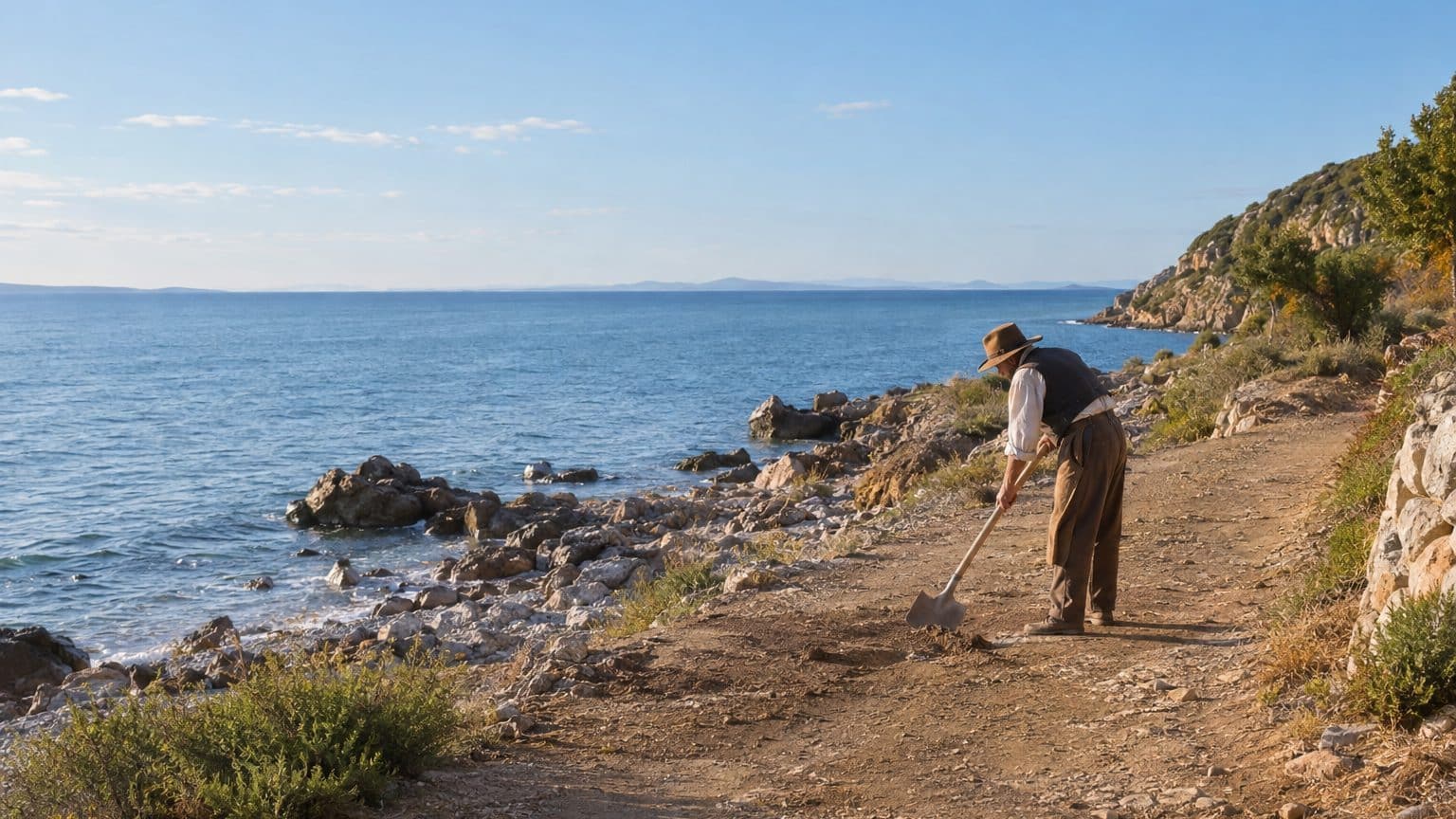
The Promenade des Anglais was not drawn up to showcase a winter parade for the wealthy. It sprang from a relief project, opened to provide work for Niçoises and Niçoises struck by poor harvests. The initiative came from an Anglican pastor, Lewis Way, who in 1822 launched a subscription among the city’s British residents. The laborers hired were to level a path, not design a garden.
The grand hotels came later.
- An Anglican pastor launches a subscription in 1822 to help unemployed Nice residents.
- The initial chantier widens a 2‑meter‑wide path along the coastline.
- The route is inaugurated in 1824 under the Italian name “Strada del littorale.”
A name that tells the wrong story
Two words are enough to manufacture a misunderstanding. “Promenade” evokes idleness, and “des Anglais” evokes a wintering aristocracy, and the mind stitches them together into: a boulevard built for those who could afford to show themselves there. The shortcut is not far-fetched, since the architectural wealth of the seafront bears witness to a city dedicated to wintertime climatic retreat, which earned it UNESCO World Heritage status in 2021. But it forgets the trigger of the project, and that trigger was nothing glamorous.
Yet the desire for a stroll did exist. The Archives Nice Côte d’Azur note that, in the Croix-de-Marbre suburb where the English lodged, walking routes were rare and awkward. What put men to work, however, can be summed up in two words: poor harvests.
1822: A pastor’s quest for the unemployed
Lewis Way, an Anglican pastor, opens a subscription among his countrymen tied to the city, what we would today call a fundraising drive. His aim: to help Nice residents without work, deprived of resources by the poor harvests.
Cityxee notes two years of poor harvests before the project, giving the affair the appearance of a crisis rather than a seasonal hiccup. A publication dedicated to tourist heritage speaks of a frost that would have devastated orange groves in 1822 and left workers without jobs. The two accounts do not agree on the exact cause, but point to the same reality: residents without income. According to Riviera Radio, a wealthy widow, Lady Olivia Barnard Sparrow, would also have lent a hand to the pastor’s effort.
The residents in distress were employed to level a first roadway two meters wide along the coastline. Barely wider than a city carriage, it was no boulevard. According to the Archives Nice Côte d’Azur, it began at the Paillon and ended at the present-day rue Meyerbeer, and Niçoises and Niçois worked there as laborers.
The project concluded in 1824, two years after the fundraising.
The principle appears quite modern: rather than handing out alms, one pays a hand to build a facility that would endure. L’Info durable and Cityxee describe the operation in the same terms—putting Nice residents to work, two secondary sources that corroborate each other.
1824: An administrative name, a popular nickname
At the inauguration, in 1824, the road was christened “Strada del littorale.” The name is Italian because the County of Nice belonged to the Kingdom of Sardinia at the time, the city becoming French only in 1860, 36 years later. The Niçoises and Niçois did not confine themselves to the official designation: in their nissart dialect, they quickly spoke of the “camin dei Inglés,” the English path.
This nickname tells, in its own way, who took the initiative. It comes from the street rather than from offices. The Archives Nice Côte d’Azur specify that public acts used the official denomination, while the population said “camin dei Inglés” or “passeggiata degli Inglesi.” As for the date when the appellation “Promenade des Anglais” becomes official, the sources diverge.
What the sources establish, and what they conceal
The narratives cited here come from the press and tourism bodies, such as the walking route on the Nice Côte d’Azur site, which also mentions a 2-meter-wide road. The 1822 subscription, the narrow path and the 1824 inauguration are cross-checked by several of them. For the rest, prudence is warranted.
As for the amount of the subscription, no consulted text provides it.
Charity and interest do not exclude one another. A publication on tourist heritage suggests that the neighboring English community could also benefit from a path along the beach, and it is not unreasonable to think that the donors found their account in aiding needy families as well.
In 2024, Nice dedicated an entire weekend to the avenue’s bicentennial, reminding that British residents had initiated its construction. The promenade’s original vocation was not so much to connect two points as to allow strolling along the Bay of Angels, facing the Mediterranean, with hopes of therapeutic benefits. The first section, however, measured only two meters in width.
Sources: nicepresse.com | archives.nicecotedazur.org
