
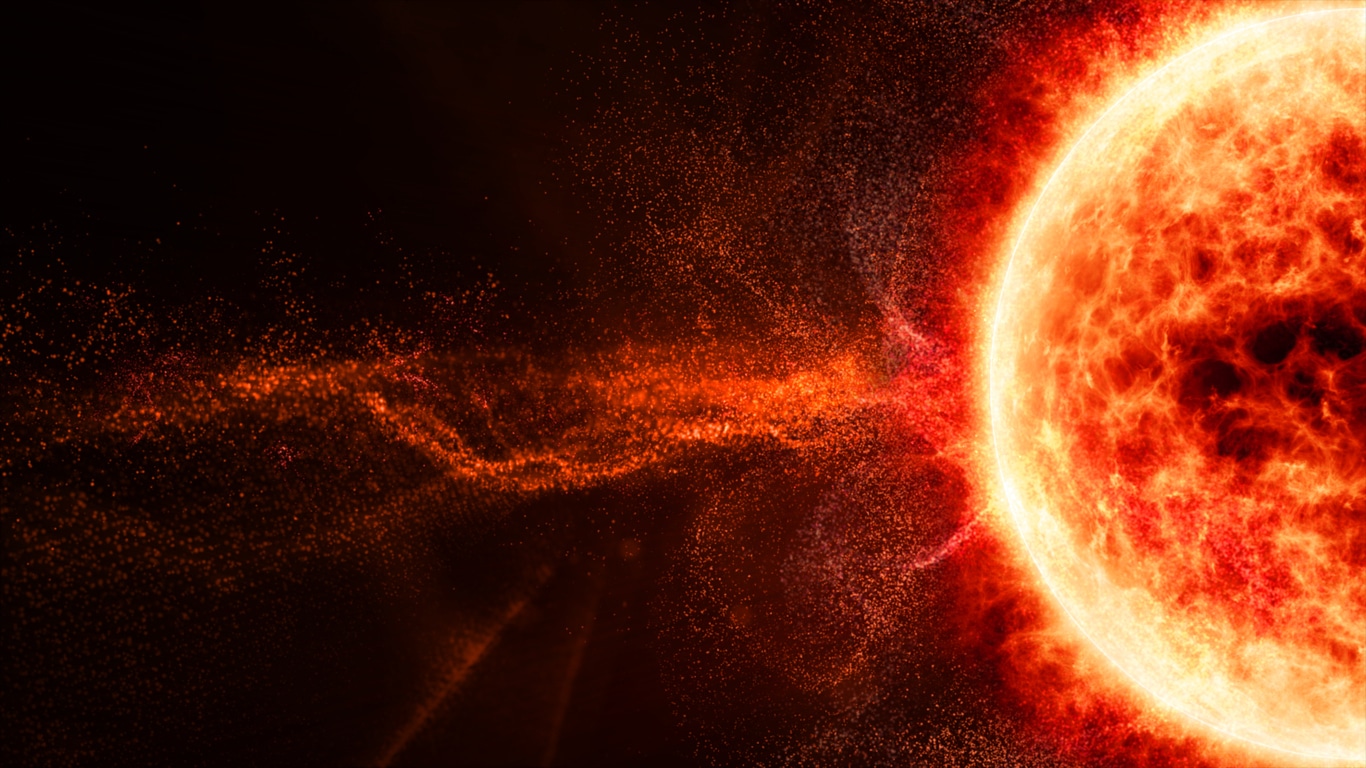
About fifteen years ago, a Japanese researcher identified a peculiar phenomenon by studying tree rings: a sudden and massive rise in the production of radioactive isotopes linked to extreme solar storms. Recently, scientists have drawn on these findings to map and understand the history of such extreme solar events.
The Miyake Events
In 2012, Japanese physicist Fusa Miyake discovered an anomaly by analyzing the growth rings of ancient cedars. According to the expert, the share of carbon-14 soared notably in the wood around the years 774 and 775 CE, roughly twenty times higher than typical fluctuations. In fact, this abrupt spike signals a massive arrival of highly energetic particles in Earth’s atmosphere. Soon, other researchers confirmed that the phenomenon affected the entire planet, by analyzing additional tree rings in North America and Europe.
Scientists quickly ruled out explanations such as supernovas and neutron-star explosions. Attention shifted to the Sun, whose eruptions can in minutes unleash substantial magnetic energy and propel radiation and magnetized plasma bubbles (coronal mass ejections) across the electromagnetic spectrum.
What is now known as the Miyake Event corresponds to a sudden and massive increase in radioactive isotope production following the arrival of a powerful flux of cosmic rays from an extreme solar storm. The radiation strikes the atmosphere and converts nitrogen into carbon-14, which is rapidly absorbed by trees through photosynthesis. Since Miyake’s early work, scientists have identified five other anomalies of the same kind.
Medium-strength solar storms also cause concern
At the University of Groningen (the Netherlands), the director of the dating laboratory, Michael Dee, worries more about intermediate events, larger than the small eruptions well documented by satellites but smaller than the Miyake events. In practice, these medium-sized storms are not strong enough to leave traces in tree rings. The researcher collaborated with other scientists on a new study published in the journal Communications Earth & Environment in January 2026.
Michael Dee realized that the large carbon-14 peaks left by the Miyake events act as universal time-bar codes in tree rings. He believes he has identified four intermediate events around the years 14, 553, 675 and 954 CE. Thus, we are looking at a frequency of about one event every 200 years.
The greatest danger: the nature of the storms
According to scientists, the ultimate aim of this research is to anticipate risks for our technology-dependent society by precisely assessing how often powerful solar storms occur. Yet, it is important to keep in mind that the principal danger lies in the very nature of these events. The concern revolves around coronal mass ejections capable of disturbing the Earth’s magnetic field by generating geomagnetically induced currents (GICs).
The risks mainly affect electrical grids (blackouts), undersea internet cables, pipelines and oil and gas networks, and railway systems. These are the four most vulnerable physical pillars to the impact of GICs. However, two other major risk types can also be cited, which, while not touching the ground, nonetheless affect near-Earth space: civil aviation and satellites (GPS, weather, telecommunications). In 2025, the European Space Agency (ESA) carried out simulations to prepare for the worst-case scenarios.
