
Between 1945 and the entry into force of the Partial Test Ban Treaty in August 1963, about five hundred devices exploded in the atmosphere. The neutrons released by these detonations raised the amount of atmospheric carbon-14 in the Northern Hemisphere, nearly doubling it. This peak, reached between 1963 and 1965, has since been nicknamed the “bomb peak.”
Every living being born or renewed during those decades bears the trace of it.
This radioactive carbon does not disappear for good: it gradually dilutes into the oceans and the biosphere, which leads to a steady decline in its atmospheric concentration after the peak. It is this curve, as precise as a fingerprint, that Swedish researchers have learned to read right inside the human body.
- Nuclear tests before 1963 doubled atmospheric carbon-14 levels, creating a peak identifiable in human cells.
- Radioactive carbon-14 gradually dilutes into the biosphere, forming a curve as precise as a fingerprint to date cells.
- Forensic scientists use this bomb-peak dating to distinguish archaeological remains from recent legal cases.
A chemical clock in the brain and heart cells
The discovery comes from Kirsty Spalding and Jonas Frisén of the Karolinska Institute in Stockholm. By analyzing growth rings of Swedish pines, they observed that the proliferation of atomic tests in the 1950s and 1960s caused a surge in atmospheric carbon-14 levels. In 2005, they published in the journal Cell a method to date the birth of a human cell from its sole carbon-14 content. The principle rests on a simple equation: for each level of carbon-14 there corresponds a precise moment on the atmospheric curve, hence a manufacturing date.
Their first target: the neurons of the hippocampus, the region of the brain associated with memory. A team led by Jonas Frisén used brain cells obtained from 120 people who had consented to their use after death, and some cells displayed notably lower carbon-14 levels than others, evidence that they had been produced after 1963, once the tests had ceased.
The adult brain therefore makes new neurons, at least in the hippocampus.
The method was subsequently used to probe other tissues. Spalding and Frisén first showed that fat cells renew themselves more quickly in obese people than in healthy individuals. Jonas Frisén also intuited that the bomb curve could settle, without touching any living patient, questions of anatomy that had remained unresolved.
Cardiac cells, too, renew themselves over the course of life.
When forensic scientists read carbon as a birth date
This chemical clock quickly proved valuable for forensic science. As early as the 1990s, Vienna’s police had called on physicist Walter Kutschera to determine which of two elderly sisters, found dead in the same apartment, had died first, a significant inheritance at stake, and the analysis of rapidly renewing tissue provided the answer. The method already worked on humans, even before Spalding and Frisén applied it to brain cells.
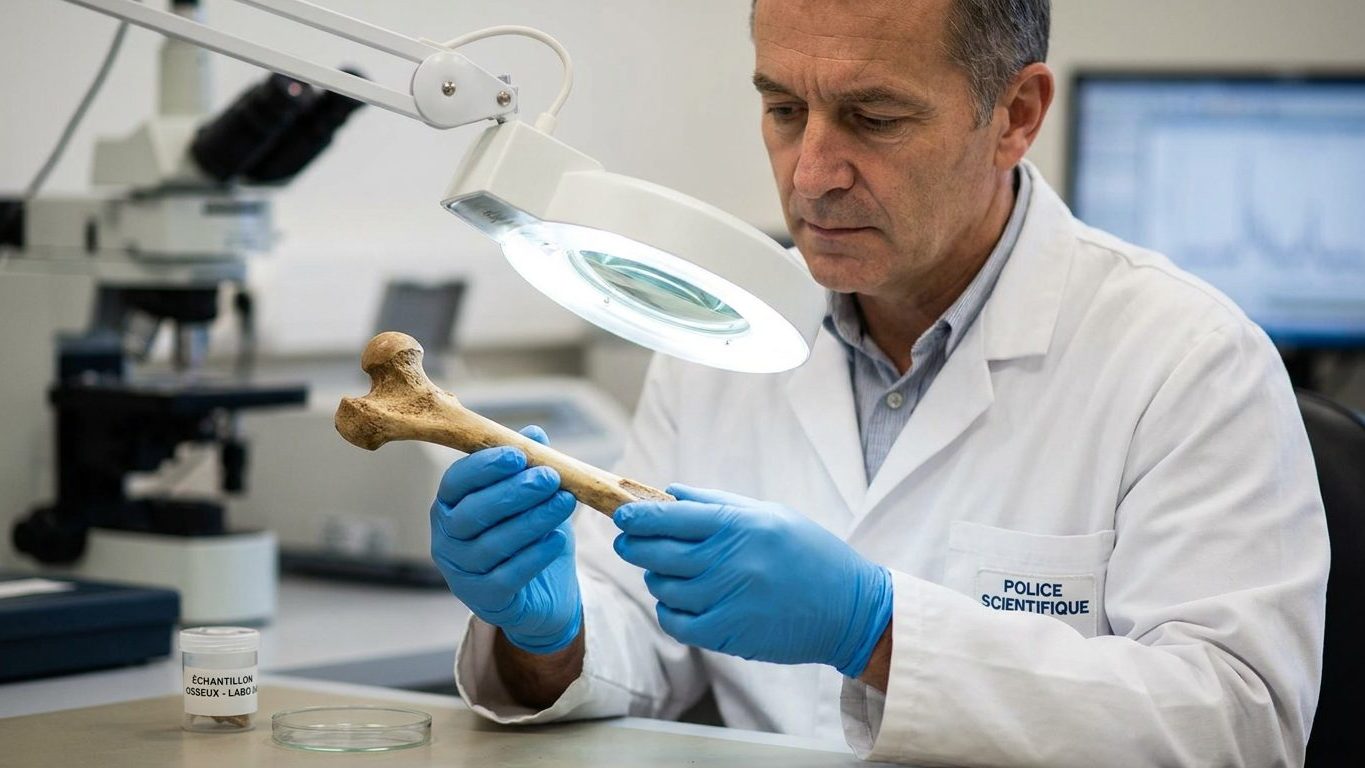
In France, the Lille forensic institute has used this technique on several occasions. On June 17, 2017, a partial human skull was discovered on the Audresselles beach, in Pas-de-Calais, by the authorities, with no contextual information. Clues found nearby—clothes and a plastic bag—already pointed to a death occurring between 1970 and 1980, and bomb-peak carbon-14 dating confirmed this recent period, even though the case no longer carried judicial relevance under French law. The carbon contained in the bone told, on its own, the story of a death that was decades old.
Determining whether skeletal remains pertain to archaeology or a recent legal matter remains a fundamental forensic challenge, which only bomb-peak dating via mass spectrometry can effectively settle, despite the costs and specialized infrastructures that limit its routine use. A bone claimed to be a century old can thus turn out to be forty years old, exposing a fraud attempt.
A trace that will fade, but very slowly
The carbon-14 released by nuclear tests does not go away: its half-life reaches 5,730 years. In practical terms, half of this radioactive carbon will still be present in the biosphere for more than five and a half millennia. What declines, however, is its relative concentration in the atmosphere, diluted year after year into the oceans, soils, and living organisms.
According to estimates by Frisén and Spalding, the peak will have completely disappeared from the atmosphere by 2050.
Bomb-peak dating remains sensitive to individual variations in dietary regimes, which influence carbon-14 activity in tissues. A marine diet, richer in older carbon drawn from the ocean, can slightly shift the reading of the cellular clock. It is this kind of detail that specialized laboratories must correct before delivering a reliable date to investigators.
