
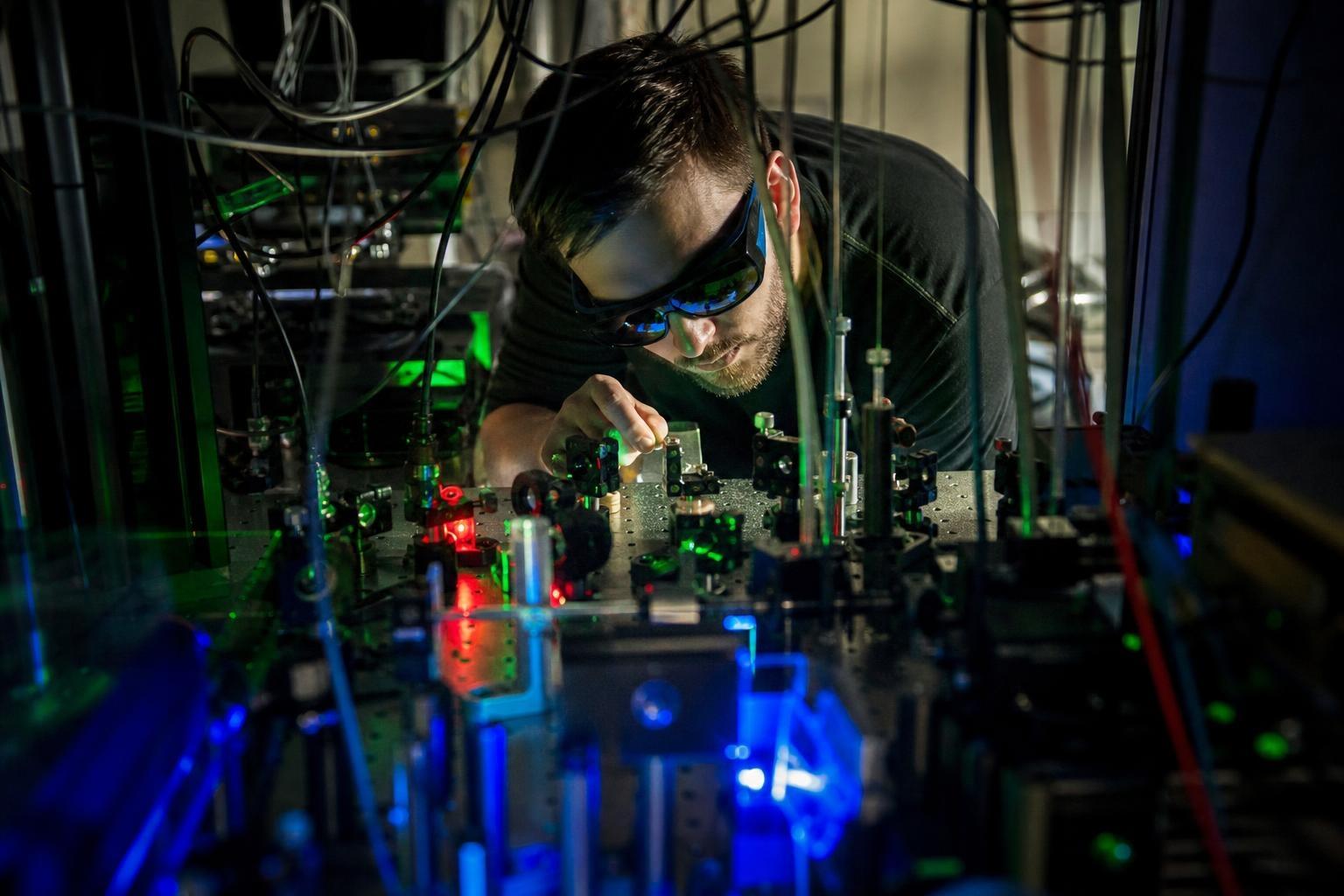
Light, the archetype of the intangible, has been coaxed into behaving like matter with a paradoxical twist. In carefully designed experiments, physicists discovered a way for light to acquire both rigidity and frictionless motion—two qualities that rarely coexist. “It looks impossible, but quantum rules don’t play by our everyday intuition,” one researcher quipped after the first signals appeared.
The recipe fuses precise engineering with quantum collectivity. By trapping light in special structures and letting it interact strongly with matter, scientists created a hybrid medium where photons act like particles with a shared identity. The result resembles a crystal that can glide without drag, a shimmering pattern that also flows.
What makes a supersolid special?
A supersolid is not simply a fancy crystal or an exotic liquid. It’s a phase where long-range order—think evenly spaced peaks in density—coexists with superfluid-like motion. Put differently, the system is both neatly arranged and astonishingly smooth at once.
- It shows spatial order (a repeating pattern) while retaining phase coherence (the hallmark of superfluidity).
This duality sounds like a contradiction, yet quantum many-body physics allows both properties to nest in the same state. Imagine honey that crystallizes mid-flow, except the honey is made of light, and the “crystal” is a wave with a locked rhythm. “You get stripes that don’t stick, and currents that don’t fade,” said one team member, marveling at the interference fringes.
How do you persuade light to behave like matter?
Pure light barely interacts, which is why your flashlight beams pass through each other without a nudge. The trick is to place photons in a high-quality cavity or microstructured material, where they strongly couple to excitations of matter—such as atoms, excitons, or vibrational modes. This coupling turns bare photons into polaritons, hybrid quasiparticles that inherit both light’s nimbleness and matter’s interactions.
With tailored pumping and loss, plus carefully tuned couplings, these polaritons can condense into a single quantum state—similar to a Bose–Einstein condensate—while spontaneously forming a pattern. The pattern signals broken translational symmetry (solid-like order), and the condensate’s phase coherence supports frictionless flow. That coexistence is the supersolid signature.
Crucially, the medium’s design creates an effective interaction landscape where density ripples become energetically favored. Long-range couplings mediated by the cavity mirror fields let distant regions “talk,” making periodic structures stable. “It’s self-organization lit by lasers,” joked another physicist, noting how the pattern literally glows into being.
The telltale fingerprints in the lab
How do you know you’ve got a supersolid rather than a fancy optical illusion? Experiments look for simultaneous evidence of crystalline order and superfluid-like behavior. In momentum space, that means sharp peaks (Bragg features) riding on a coherent background. In real space, interference fringes appear with a persistent, common phase across the patterned structure.
Researchers also probe flow under gentle stirring or potential gradients, watching for suppressed viscosity. They map correlations to reveal long-range coherence, and they adjust parameters to trigger the onset of periodic modulation. When the pattern locks in without killing the flow, the supersolid box is effectively ticked.
Because the system is driven and dissipative, time dynamics matter. The steady state must sustain both order and coherence despite losses, which is a stringent test. “You don’t just make it; you have to keep it alive,” one experimentalist noted about maintaining the quantum dance.
Why this breakthrough matters
Supersolid light is more than a physics curiosity. It provides a new platform to study emergent order far from equilibrium, where drive and dissipation shape quantum phases. That helps refine our models of collective behavior, from exotic magnets to unconventional superfluids.
On the practical side, patterned-yet-coherent photonic states could enable ultra-sensitive sensing, reconfigurable light-based circuits, and robust information routing with minimal loss. The ability to sculpt interaction-driven textures directly in optical fields hints at programmable quantum materials made of light—fast, tunable, and inherently clean.
Supersolid platforms also act as analog simulators for complex Hamiltonians that are hard to compute. By dialing couplings and geometry, researchers can explore frustrated orders, long-range interactions, and topological features using the most versatile medium we know: light itself.
What comes next
The road ahead is both technical and conceptual. Engineers want longer lifetimes, stronger interactions at lower power, and integration on photonic chips. Theorists are dissecting stability windows, excitation spectra, and the role of fluctuations in driven quantum systems that never truly sit at equilibrium.
Expect efforts to scale to larger, two-dimensional lattices, to stitch multiple supersolid domains with controlled defects, and to braid vortices that might store resilient quantum information. As tunability improves, the boundary between optical hardware and quantum matter will blur even further.
“It’s rare to witness a phase that breaks one symmetry yet preserves another so delicately,” a collaborator reflected. Rarer still to do it with light—our most familiar messenger—recast as a crystal that can flow. In the laboratory glow, the paradox becomes a tool, and the tool, a new way to shape what light can become.
