
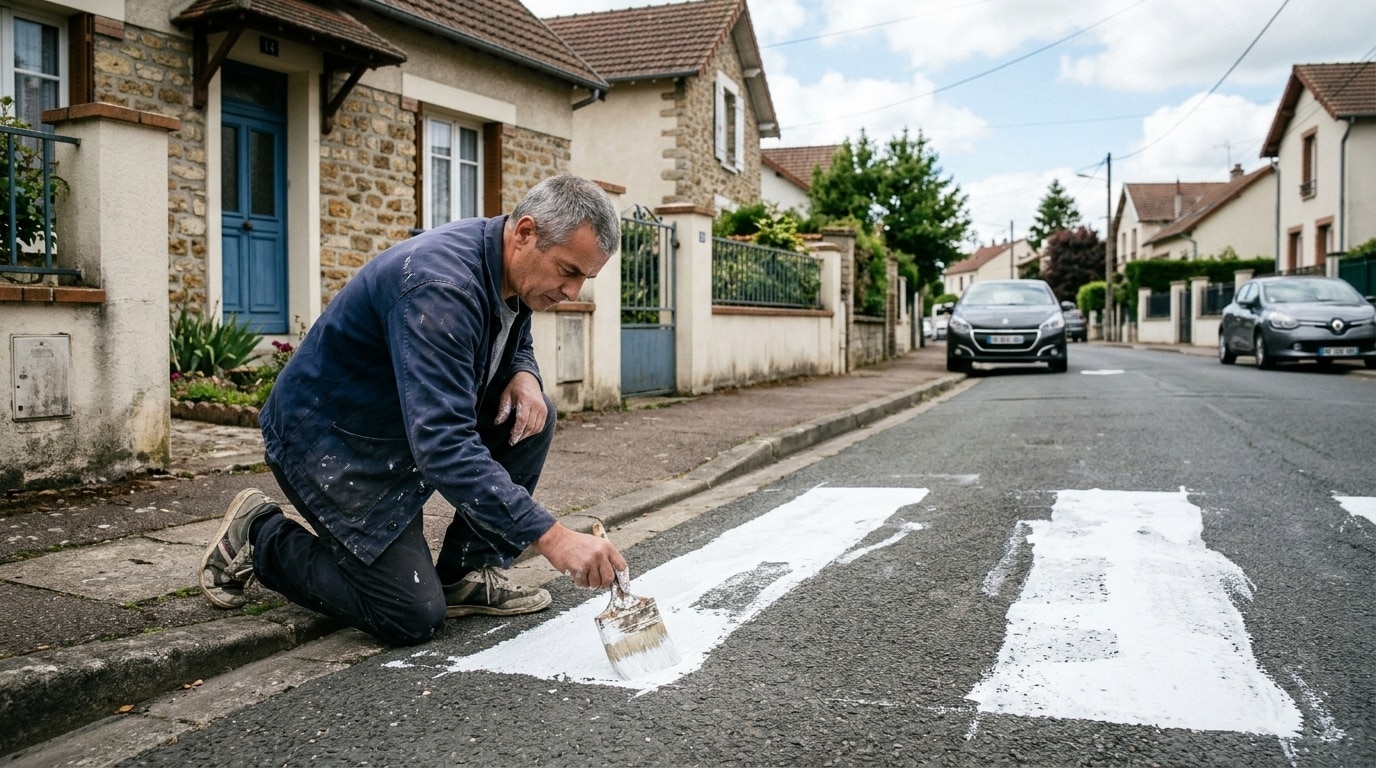
A street with little visibility, vehicles racing by without slowing, and pedestrians forced to play tightrope walkers to cross safely. This scenario is familiar to many residents of suburban neighborhoods or poorly designed town centers. Faced with the perceived inaction of public authorities, some decide to take matters into their own hands, quite literally, brush in hand. But when you pronounce yourself Sunday’s urban planner by painting white stripes on the asphalt yourself, the noble intention can quickly turn into an administrative, even legal, headache. For road safety, no matter how urgent, there are precise rules that cannot be bent, even with the best intentions in the world.
- A private individual cannot legally create a pedestrian crossing without authorization, because street works fall under the competence of local authorities or the state.
- An unauthorized marking can be erased by municipal services and may create a false sense of security, as drivers are not obligated to stop at an unapproved crossing.
- The proper step is to submit a written, reasoned request to the town hall, ideally as a collective effort and supported by local associations or elected officials.
- A gesture born out of exasperation with reckless drivers
- Why a private individual cannot create a pedestrian crossing on their own initiative
- The legal and practical consequences of an unauthorized marking
- The steps to obtain a safe modification from the city hall
An act born of frustration with reckless drivers
The diagnosis is usually the same: a busy road, drivers who pay little heed to speed limits, and the total absence of a pedestrian crossing essential for safe crossing. To some neighbours at their wits’ end, the solution seems obvious. Equipped with white paint and a bit of courage, they themselves trace the characteristic stripes of a protected crossing in front of their home, hoping to force motorists to slow down and finally respect pedestrian priority.
This type of initiative often springs from a sincere wish to protect residents, especially children who use this route to get to school. The idea behind it is simple: if the town hall won’t move, might as well act ourselves to reduce the risk of an accident. Yet the road, as dangerous as it may be at that exact spot, remains a public space subject to strict regulation, and this improvised Good Samaritan is likely to find themselves in a much more complicated situation than they imagined.
Why a private individual cannot create a pedestrian crossing on their own initiative
Contrary to what one might think, painting a pedestrian crossing is not simply a matter of drawing a few neat white stripes on the asphalt. The installation of such an amenity must meet precise technical criteria: sight distance, road width, traffic flow, presence of appropriate lighting, and many other parameters that only competent services are authorized to evaluate. A private individual cannot, on their own, create a pedestrian crossing on a public road without authorization, even if their intentions are excellent.
Street maintenance—whether municipal, departmental, or national—falls under the jurisdiction of local authorities, their associations, or the state, depending on the case. It is therefore up to the town hall, or the relevant road manager, to decide whether to install a protected crossing at a given location. This competence is not merely an administrative formality: it ensures that every road improvement is conceived to harmonize with the surrounding traffic, to avoid creating new hazards where the aim was to eliminate them.
The legal and practical consequences of an unauthorized marking
repainting a pedestrian crossing oneself without the approval of the competent authorities is therefore not a simple lapse without consequences. This marking, carried out outside any legal framework, may simply have to be erased by municipal services, who will not fail to notice the anomaly during a routine check or following a report. The willing neighbor then finds themselves in a delicate position: not only was their gesture not recognized as a legitimate solution, but they may also have to answer for this unauthorized intervention on public property.
Beyond the administrative aspect, this initiative poses a real safety concern. A non‑standard crosswalk, not officially recognized and potentially poorly positioned, can give pedestrians a false sense of security while drivers are not obliged to stop there merely because of the marking, since it is not an officially acknowledged feature. This paradoxical situation illustrates why regulations, even if perceived as heavy or slow, were designed precisely to prevent such dangerous confusion on public roads.
The steps to obtain a safe modification from the city hall
When confronted with a situation deemed dangerous, the appropriate approach is to turn directly to the town hall, which remains the reference contact for any request to modify road infrastructure. It can then route the request to the competent manager, whether it be municipal services, the departmental council, or another entity depending on the status of the road in question. It is generally advisable to submit a written request, clearly outlining the reasons for the appeal and illustrating, if possible, the danger of the road segment involved.
To support this approach and increase the chances of being heard, several levers can be mobilized:
- Gather other residents affected by the problem to form a collective request, often more effective than a solitary petition
- Seek the backing of neighborhood associations or parent associations if the issue concerns children’s safety
- Document the situation with factual elements, such as how often pedestrians use the crossing or incidents that have already occurred
- Engage local elected officials during public meetings or office hours, moments well suited for raising such concerns
This administrative patience may seem frustrating when the danger of a crossroads has been evident for months, but it ensures that the final arrangement is truly adapted and durable, rather than a makeshift solution that will not withstand the first rain or the first inspection.
In the end, the impulse to protect one’s neighborhood is completely legitimate, and it would be a pity to stop at the frustration of bureaucratic slowness. It is better to channel this energy through the proper channels, because a well-directed citizen mobilization often carries more weight than a lone brushstroke, however well intentioned it may be.
👉 A small gesture for Space Group? Follow us on Google, add us to your favorites and find us on Google News so you never miss a discovery.
