
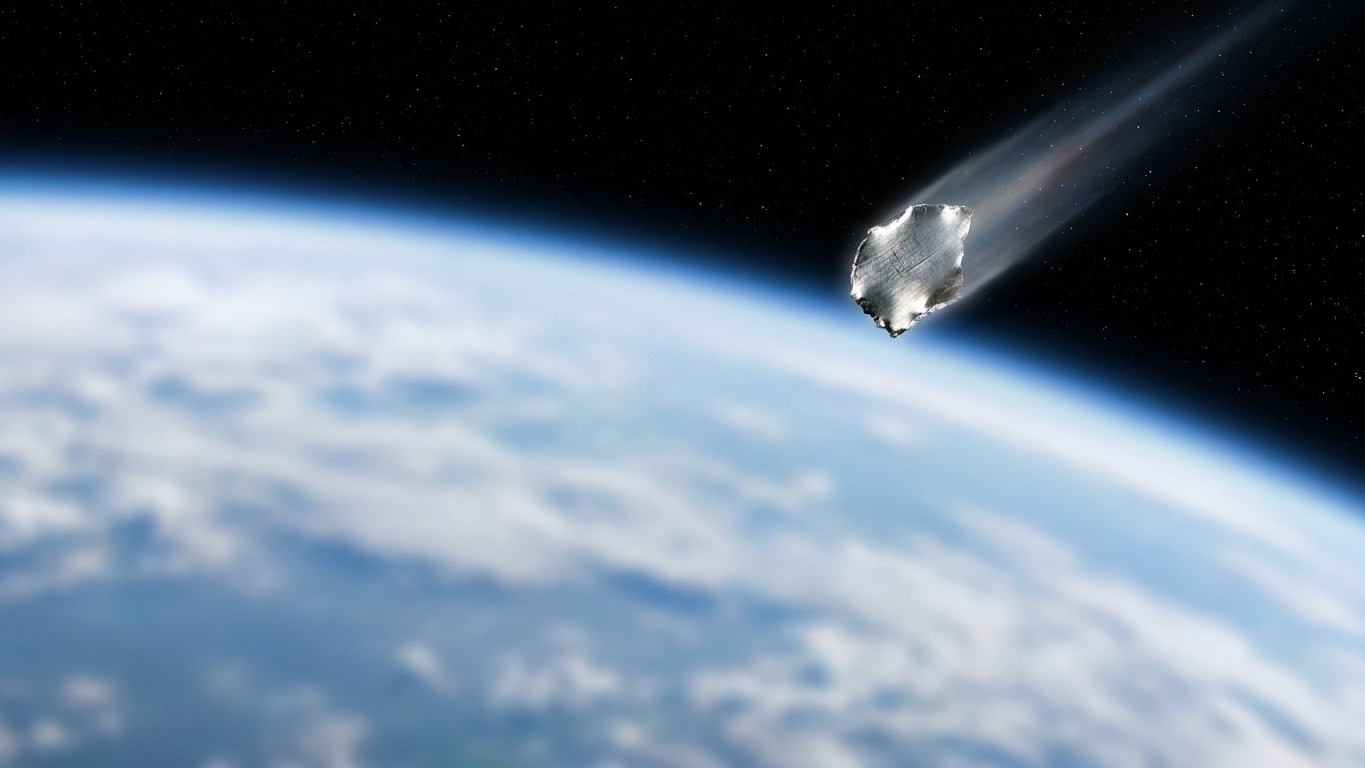
A fragment no wider than a two‑euro coin, capable of piercing a fuselage like rifle fire. That is what is whizzing overhead at several kilometers per second right now. Space surveillance networks track individually more than 36,000 orbital objects, regularly monitored and kept in their catalog, which covers objects about 5 to 10 cm in low orbit and 30 cm to 1 m in geostationary orbit. A staggering figure, to be sure, but it tells only part of the story: most of these objects have served no purpose for a long time.
Key takeaways
- What is the real hidden threat lurking in Earth’s orbits?
- Why do invisible debris pose the major danger to space?
- How can humanity prevent a catastrophic domino effect in orbit?
A Coin-Sized Fragment That Strikes Like a Car at Full Speed
Size is meaningless in orbit. It’s the speed that counts. A piece of debris in low Earth orbit travels at roughly 7 to 8 km/s, or 25,000 to 28,000 km/h, and during a head-on collision between two objects on crossing trajectories, impact speeds can reach 15 km/s. To put this in perspective: that’s more than ten times the speed of a rifle bullet. At that regime, kinetic energy explodes, because it grows with the square of the speed. The practical result is that even a fragment measuring a centimeter carries the kinetic energy of a detonated grenade. A simple coin-sized shard hits a space structure with the same violence as a compact car speeding along a highway in a head-on crash. No need for a heavy mass to cause irreversible damage: orbital velocity turns any aluminum confetti into a lethal projectile for a satellite.
This isn’t just a doctored image from scientists needing media traction. An official from the European Space Agency, cited in a CBC News investigation, summed it up plainly: at 36,000 kilometers per hour, even a piece as small as a centimeter has the kinetic energy of a grenade exploding. We are indeed talking about an object smaller than a standard ice cube.
Who Monitors This Orbital Highway of Scrap?
Behind the figure of 36,000 lies a meticulous, ant-like effort carried out by several organizations around the world. The American space surveillance network, the European Space Agency through its Space Debris Office, and commercial players like LeoLabs as well as national agencies (ISRO, JAXA, CNES) cross their radar and optical data to catalog each object, assign it an identifier, and compute its trajectory. The scale of the problem is dizzying when traced back to its sources: over half a century of space activity has seen more than 6,700 launches placing around 20,000 satellites into orbit, roughly half of which are still operational, less than a third have reentered, and the rest pose a collision risk as space debris. Taken together, everything that orbits Earth weighs heavily: the total mass of space objects in Earth orbit is about 13,000 tonnes—roughly the weight of thirty Eiffel Towers turning silently above our cities.
The traffic is only intensifying. The year 2023 set a record with more than 2,800 satellites entering low Earth orbit, most joining major commercial telecommunications constellations. As a result, two-thirds of all active satellites now operate in this same orbital belt, compelling operators to heighten vigilance to avoid collisions with one another, not to mention debris.
The Real Danger Is What We Can’t See
The 36,000 cataloged objects, impressive as they are, represent only the tip of the iceberg. Below the threshold of reliable detection, statistical models are staggering: ESA estimates about 1.2 million objects between 1 and 10 centimeters, and more than 140 million fragments under 1 centimeter. These fragments are virtually impossible to track one by one, yet they remain large enough to inflict serious damage to a vessel. The International Space Station illustrates this dilemma well: its habitable compartments and its pressurized tanks can normally withstand impacts from debris up to about 1 centimeter in diameter, but beyond that there is no realistic armor. When a cataloged object presents a collision risk deemed too high, the procedure is well practiced: the station typically maneuvers to avoid when the collision probability exceeds 1 in 10,000, a situation that occurs infrequently—about once a year on average.
The scenario dreaded by all industry experts is known as the Kessler syndrome. It describes a chain reaction in which collisions generate debris that in turn causes new collisions, potentially rendering entire bands of orbit unusable. A domino effect that, once triggered, would be almost impossible to halt. The most exposed region isn’t negligible: it is precisely where Earth observation satellites and part of the future commercial space infrastructure operate.
In the Face of Urgency, Space Is Trying to Clean Up
Aware of the problem, the European Space Agency launched in 2023 an initiative called Zero Debris Charter, with the aim of making space activities debris-neutral by 2030. The charter has already found notable resonance: it has been signed by around a dozen countries and more than 100 other commercial and non-commercial entities. Experimental debris-removal missions, employing robotic arms, nets, or harpoons, are beginning to demonstrate technical feasibility, even though they remain costly and limited in scale compared with the millions of fragments involved.
What stands out, ultimately, is the gap between the total invisibility of this problem from the ground and its real extent. No one looks up and considers this highway of iron that moves at 28,000 km/h just above the clouds, and yet every satellite launch, every discarded rocket stage, every anti-satellite test adds its share to this growing cloud. The next time a smartphone displays GPS location or a weather forecast proves accurate, it is worth remembering that this technological comfort rests on an increasingly crowded orbital space, where a fragment as small as a coin can jeopardize years of investment.
Sources: payloadspace.com | esa.int
