
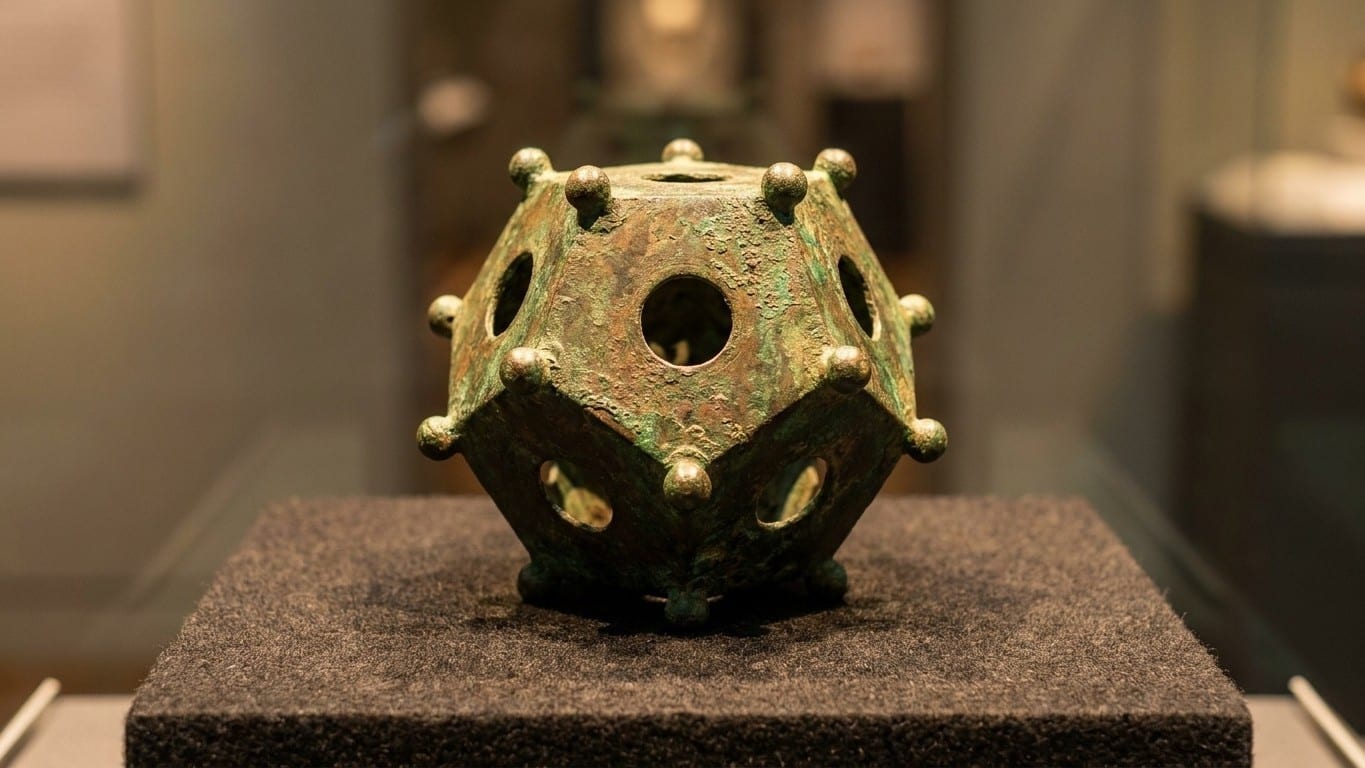
A hollow bronze object, barely larger than a fist, pierced with twelve pentagonal faces and crowned with tiny spheres at each vertex. Since the first specimen was recorded in 1739, more than a hundred of these items have been found, dating from the 2nd to the 4th centuries CE, and their function or meaning remains unknown. Nearly three centuries of research, dozens of theories, and still nothing. The Gallo-Roman dodecahedron is probably the best-documented archaeological puzzle that no one understands.
Takeaways
- Why do ancient Roman texts, though exhaustive, completely overlook these objects?
- Could a discovery in 2023 finally reveal their true function?
- How to explain that identical dodecahedra also appear in Southeast Asia?
A Geography That Speaks Where a Text Fails to Explain
To date, about 120 specimens of these objects have been found, mostly in Europe, notably in France, Germany, Switzerland, Belgium, England, Hungary, and Italy. But this tally masks a much more precise reality: the first paradox of the object lies in its geographic distribution. The dodecahedra are found exclusively in the northwestern provinces of the Empire, on territory that roughly corresponds to the old Celtic world, with roughly sixty percent of known specimens originating from Gaulish and Germanic provinces. None have been unearthed in Italy, Spain, Africa, Greece, or the eastern provinces. Rome, strictly speaking, did not know these objects. It is Gaul that produced them, used them, and carried them off in its secrets.
Among roughly a hundred cataloged dodecahedra, about thirty originate from France, notably from Gaul Belgica and the southern part of Gaul-Lyonnais, in Burgundy, in western Franche-Comté and the northern Rhône-Alpes. It is therefore not a Roman object in the broad sense: it is a Gallo-Roman object, born from the contact between Celtic culture and the conquering civilization. This detail changes everything in the interpretation.
What deepens the mystery is the absolute silence of ancient texts. One of the most troubling enigmas is the silence of written sources. Neither Pliny the Elder, nor Vitruvius, nor any technical or military author mentions them. There is no description in Roman literature, and these objects do not appear in mosaics either. For an empire that catalogued everything, from aqueducts to recipes, this gap is truly astonishing.
Fifty Theories and No Certainty
Robert Nouwen, in his 1994 survey, cataloged an impressive list of hypotheses: surveying instruments, sprayers, lamps, jeweler’s gauges, coin calibers, toys or cup-and-ball games, scepter pommels, gaming dice, multi-sized chandeliers, works of craftsmanship… By 2025, Guggenberger and Leach bring the count to about fifty distinct theories proposed since 1739. Fifty theories for a single object. It is a sign of collective failure as much as a testament to lasting fascination.
The military track has long held appeal. For Amelia Sparavigna, a physicist at the Polytechnic Institute of Turin, these objects would have been measuring tools used by the Roman army as rangefinders. In a study published in 2012, she argued that they could calculate the distance separating troops from enemy positions by matching pairs of holes of different sizes. Appealing on paper. The Norton Disney team, however, judged that these objects were not used for measuring, since their sizes varied from one specimen to another. A standardized measuring instrument that is not standardized: the theory contradicts itself.
What remains the central paradox, the one that shuts many doors: one thing seemed certain to the early observers, these appeared to be precious objects, because working metal was, at the time, a highly delicate operation. A high degree of technical mastery was required to manufacture them, which suggests that their use was clearly important. And yet these objects show little wear and bear no numbers or inscriptions. They are crafted with care yet seem not to be used, or used so infrequently. This is not the behavior of a craftsman making a tool.
The Druidic-Pythagorean Hypothesis, the Latest Theory to Date
In June 2023, a group of amateur archaeologists was digging a field in Lincolnshire when, on the penultimate day of their campaign, they uncovered one of the largest specimens ever found. The object was discovered in a Roman-era pit dating to about 1,700 years ago, placed inside a 4th-century Roman ceramic vase. It measures around 7.6 cm tall and weighs 0.23 kg, with a composition of 75% copper, 7% tin, and 18% lead. An intact archaeological context, the object carefully deposited in a container. The most likely theory, according to the Lincolnshire diggers, is that it was a ritual or religious object, the Romans being highly superstitious and generally seeking signs to guide their daily decisions.
It is precisely this ritual track that the most recent research pursues. A 2025 study proposes a ritual use inspired by a Pythagorean-Druidic tradition. The argument rests on a troubling convergence: the populations that used these dodecahedra, primarily in the Three Gauls and in Roman Brittany, would have had access to Pythagorean and Platonic ideas. Indeed, several ancient sources, from Diodorus of Sicily to Julius Caesar via Strabo, explicitly describe the Druids as Pythagoreans. In the Platonic tradition, the dodecahedron is one of the five solids associated with the natural elements; it would represent the Universe, symbolizing harmony and cosmic perfection.
In 1982, a lead dodecahedron coated in silver was unearthed at the archaeological site of Saint-Pierre Cathedral in Geneva. This discovery rekindled the debate and directed research toward a mystico-religious path: dated to the 4th century CE, this specimen bears on each of its faces a Zodiac sign, which leads to the thought that it probably served divinatory practices. One face for each astrological sign. Twelve faces for twelve months. The numerical coincidence may not be accidental.
What Archaeology Still Cannot Decide
For the vast majority of cataloged specimens, the discovery context is unknown, the object having passed through the antiquities market. This is where the case hits a snag: without reliable stratigraphy, without a datable archaeological layer, each theory remains suspected of projecting the present onto a silent past. Modern archaeology knows how to read objects in their context. Deprived of that context, it stumbles.
These geometric figures, appearing between the 2nd and the end of the 4th century CE, remain an enigma for archaeologists; as things stand, nothing allows determining their function. Several dodecahedra have been found in caches containing coins, which can be read in two ways: either their owners regarded them as valuable objects to keep safe, or their use was in some way related to money. Two opposing readings of the same clue. That is the whole problem.
What makes the mystery even more dizzying: smaller dodecahedra with the same features, holes and spheres, have been found in Southeast Asia, along the Silk Road, with the oldest specimens dating to the Roman era, a coincidence that expands the mystery far beyond Gaul’s borders. These Asian objects do not appear to predate Galloroman artifacts and could indicate Roman influence on the ancient Indochinese kingdom of Funan. A Gaulish gold object in the Mekong’s rice paddies. The dodecahedron may have traveled farther than any legionary.
Sources: nunc.ch | dailygeekshow.com
