
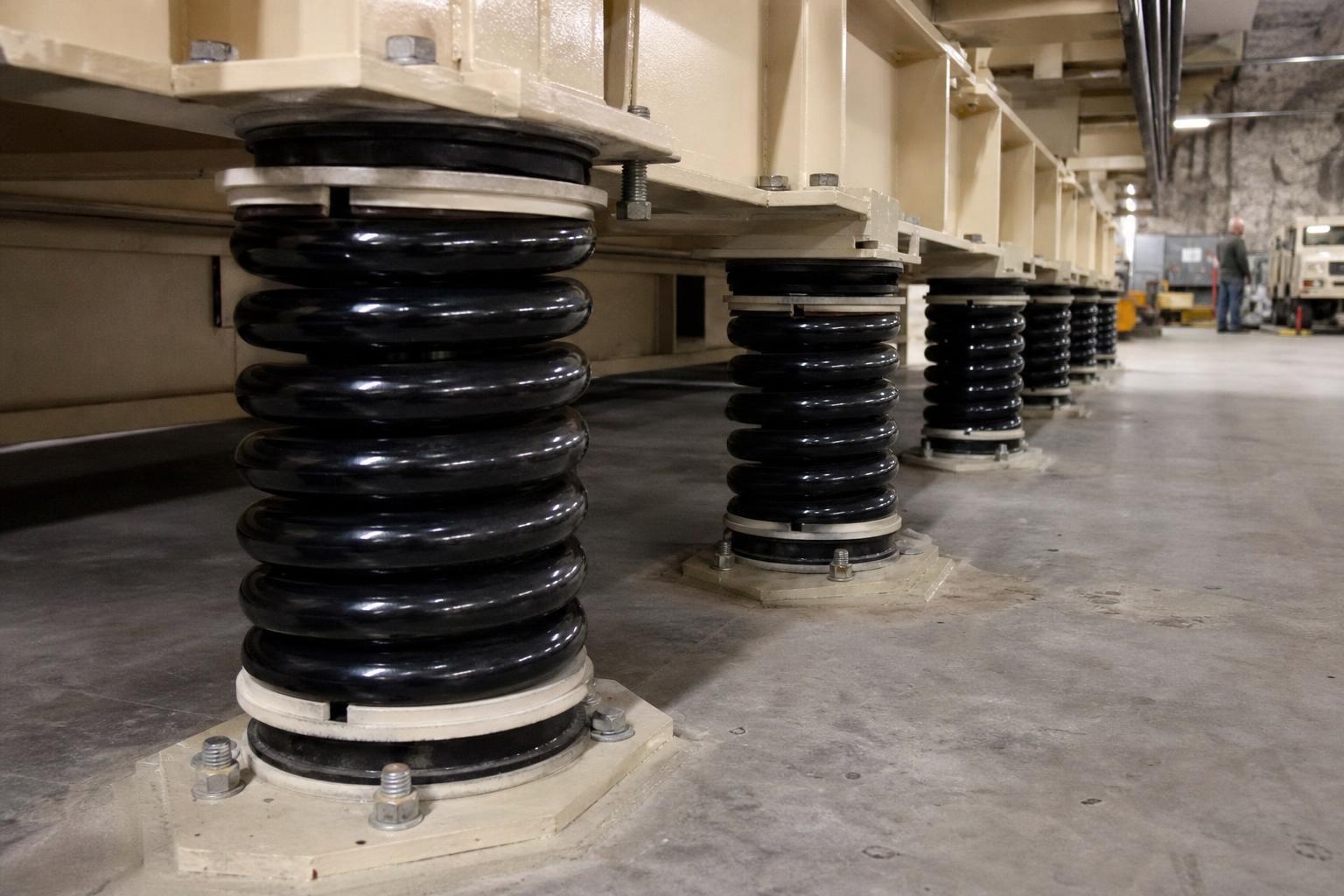
Beneath a hulking slab of Colorado granite, a critical nerve center sits on a bed of more than 1,300 steel springs, isolating mission from chaos. The setting feels part science fiction, part engineering manifesto: a floating command post built so that the mountain can shudder while the work inside does not. In a world of instant communications and fast-moving threats, that quiet resilience remains its defining strength.
Why a mountain needed springs
During the Cold War, planners assumed the ground itself might become an enemy. Shock waves from nuclear detonations, earthquakes, and even near-miss impacts can transmit violent vibrations through bedrock. To keep radars tracking, radios talking, and operators thinking, engineers separated the mission from the mountain.
“The rock can move,” one veteran explained, “but the mission can’t.” That principle—mechanical isolation—still anchors the facility’s design. The goal is simple: keep the critical rooms as still as possible when everything outside is not.
Engineering the floating fortress
Deep inside excavated caverns, a cluster of free‑standing buildings rests on giant coil springs. Each acts like a shock absorber, lowering how much energy reaches floors, racks, and screens. Around them, heavy blast doors, redundant power, and sealed air systems shape a self‑sufficient enclave engineered to ride out the unthinkable.
Key features include:
- Massive steel springs that decouple structures from rock‑borne shocks
- Double blast doors and hardened walls to resist pressure waves
- Independent power, water, and air filtration for extended isolation
- Electromagnetic shielding to blunt high‑energy pulses
“The springs give us time,” a longtime technician put it. “Time to keep our focus, time to keep the picture clear.”
How the springs actually work
Imagine the buildings as one mass and the mountain as another, connected by resilient springs. When a shock hits the rock, the isolation system lowers the natural frequency of the supported structures, filtering out fast, high‑energy vibrations before they reach mission‑critical gear. Add damping, and the system bleeds off energy rather than passing it onward.
In plain terms, the springs make the mission space feel heavier and slower to move. Quick jolts get smoothed; long, rolling motions are managed. That tuning is what keeps delicate electronics and human operators within a survivable envelope when the outside world is anything but stable.
From Cold War to the cyber age
While the strategic context has shifted, the core job—watching skies and space—has not. Today, the center tracks aircraft, missiles, and orbital objects while coordinating with partners across continents. Threats expanded from bombers and ICBMs to hypersonics, cyber risks, and space debris. Yet the logic of hardening endures: if power grids fail or satellites falter, the country still needs a heartbeat.
In recent years, renewed attention to electromagnetic pulse and space‑weather events has underscored the value of deep‑site resilience. Granite, steel, and careful grounding help keep critical circuits quiet when charged particles and EMP try to make them scream. “Hardness isn’t a relic,” a planner said. “It’s a requirement that evolves as threats do.”
The human factor behind steel and granite
Technology sets the stage, but it’s people who keep the picture coherent. Watch officers train to act when seconds matter, drilling procedures until they feel automatic. Inside, the culture prizes calm communication, verified data, and cross‑check discipline—habits designed to outlast surprise.
Daily life can feel both ordinary and otherworldly: routine briefings, buzzing consoles, then the sudden pivot when sensors flag anomalies. “You live in a space built to shrug off a shock,” one operator said, “so you try to be the person who does the same.”
Why it still matters
Distributed networks and cloud tools are powerful, but none replace a hardened, always‑on anchor. In emergencies, continuity happens because critical nodes remain upright—electrically, mechanically, and mentally. Springs, doors, filters, and shielding are not just artifacts; they’re layers of assurance that let decision‑makers trust the picture under stress.
Resilience is rarely glamorous. It hides in heavy steel, quiet bearings, and maintenance logs that read uneventful day after day. But when the ground shakes—figuratively or literally—those choices determine whether vital systems hiccup or hold. The idea is simple enough to state and hard enough to build that it feels almost poetic: let the mountain move, and let the mission stand.
