
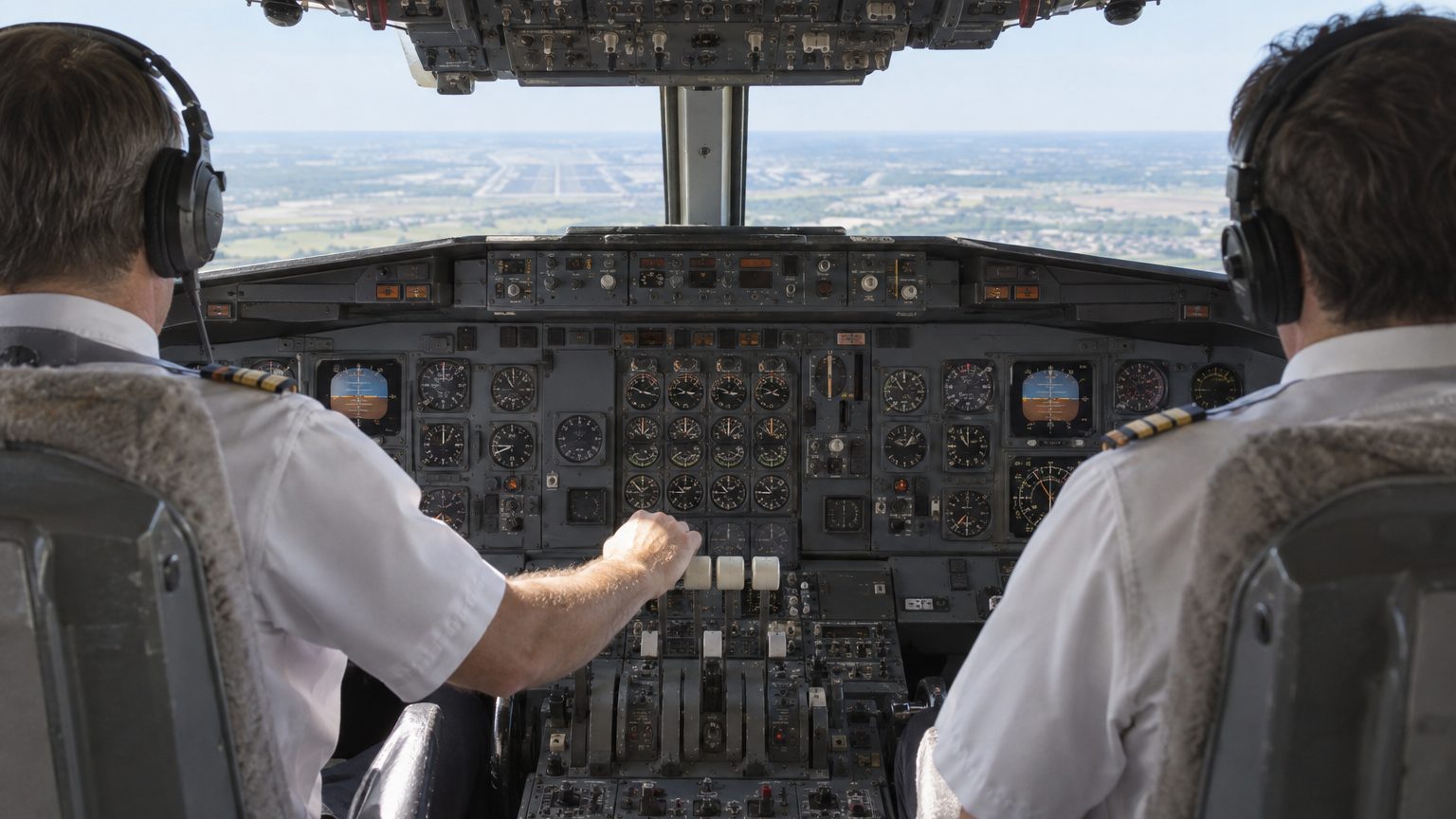
At 3:16 p.m., at an altitude of 37,000 feet (about 11,300 meters), engine No. 2 on United Airlines Flight 232 explodes. Shrapnel cuts through the hydraulic lines of all three systems of the DC-10-10 en route from Denver to Chicago, and the primary flight controls stop responding. To steer the aircraft, the pilots only have thrust from the two engines that remain in operation.
Out of 296 occupants, 184 survived.
- An engine explosion on No. 2 severs the three hydraulic circuits of United 232’s DC-10.
- The pilots steer the aircraft by separately modulating the thrust of the two remaining engines.
- Passenger Dennis Fitch, a DC-10 instructor, takes charge of the throttle levers during the approach.
- Of 296 occupants, 184 survive the emergency landing in a cornfield near Sioux City.
A Tail Engine That Disintegrates
The DC-10 relies on three independent hydraulic circuits, designed so that a single failure would still leave the crew with control. Engine No. 2, mounted in the tail, failed due to a manufacturing defect overlooked in the fan disk. Its fragments struck the pipelines of all three circuits at once. The fluid dumped out, taking with it any ability to move the aircraft’s wings and tail surfaces.
In command were Captain Al Haynes, 57, co-pilot Bill Records, and flight engineer Dudley Dvorak. Haynes had logged 29,967 flight hours with United, including 7,190 on the DC-10, but no procedure or training had anticipated this scenario.
The pilots can try to act on the controls, but nothing responds, and the aircraft rocks slowly, up and down and sideways. They soon realize, however, that by separately varying the thrust of each engine, they can stabilize the plane and give it a rudimentary sense of steerability. The Minneapolis regional control center receives their mayday call. They are advised to attempt an approach to Sioux City, Iowa.
Then Dennis Fitch makes his way into the cockpit.
A Passenger at the Controls
Dennis Fitch, 46, was a United DC-10 instructor, but that day he was traveling in first class, en route from the Denver training center to his home near Chicago. He had chosen this flight over another five minutes earlier, and the explosion had knocked his coffee over. He had more than 23,000 flight hours, including nearly 3,000 on the DC-10, across all three control positions.
Haynes explained to him that he could not fly and manage the throttles at the same time. Fitch crawls between the two pilots to reach the throttle levers.
The maneuver resembles a two-engine boat without a rudder: by pushing more thrust on one side than the other, you rotate the fuselage. On the DC-10, the maneuver is limited because the plane can only turn to the right. He reaches Sioux City through a series of 360-degree turns, which also serve to shed altitude. Between 40 and 44 minutes pass in this manner, Records assisting Fitch on the throttles.
At one point, Haynes asks him to close the throttle levers. Fitch refuses: those levers are what keep the airplane in the turn, and cutting them would cause a loss of control.
The Cornfield
The approach targets Sioux City’s Runway 22, a closed strip. The aircraft arrives too fast and with too steep a descent. On the ground, rescue personnel are already in position.
The right wing strikes the ground first. The DC-10 breaks apart in a cornfield. Of the 296 occupants, 184 survive and 112 perish, including one person who died later as a result of the accident. Fitch sustained multiple fractures and a collapsed lung, requiring nine operations.
He believed that no one should have walked away from it.
In the aftermath, test pilots and instructors attempted to replicate landing the same aircraft in the same state using simulators. None succeeded in a survivable landing. Most simulations didn’t even come close to the ground, according to a United pilot who flew with Fitch. Investigators noted that this approach rested on no established procedure or design for such a case.
What This Accident Changed
McDonnell Douglas subsequently equipped the DC-10 with hydraulic fuse-like valves to prevent a total hydraulic loss from recurring. The accident is also credited with initiating the modern concept of crew resource management. Haynes attributed the outcome to five factors: luck, communication, preparation, execution, and cooperation.
This concept, commonly referred to by the acronym CRM, involves distributing tasks, circulating information, and allowing every crew member to raise a concern, regardless of rank. In the Flight 232 cockpit, the captain delegated the throttles to a passenger he did not know, rather than keeping everything to himself. The way Fitch’s involvement was managed by the crew and the coordinated use of differential thrust became a central study case in training around the world. A four-pilot crew, one of whom was off duty, thus served as a model for an entire profession.
Fitch made this narrative his second career: speaker, aviation consultant, and NASA safety consultant on the Aerospace Safety Advisory Panel. He repeatedly asserted that anyone who can contribute and does not becomes part of the problem.
Dennis Fitch died on May 7, 2012, at his home in St. Charles, Illinois, from brain cancer, aged 69. The diagnosis dated from early 2010. His second wife, Rosa, was a flight attendant on Flight 232.
👉 A small gesture for Space Group? Follow us on Google, add us to your favorites, and find us on Google News so you don’t miss any discoveries.
Sources: aerocorner.com | avweb.com
