
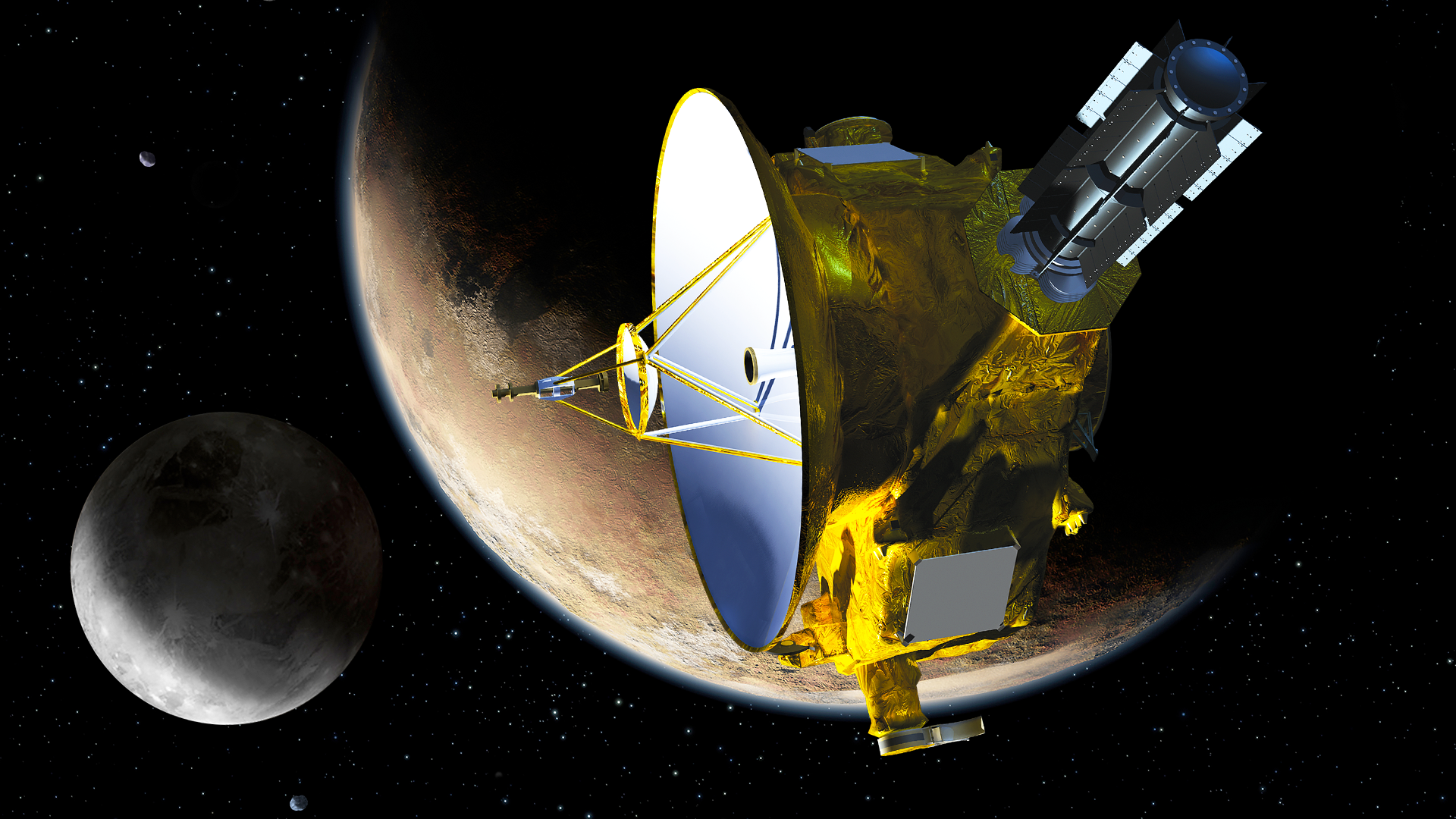
After 321 days of hibernation, NASA’s New Horizons spacecraft woke up on June 23 at a distance of 9.5 billion kilometers from Earth. The confirmation took almost nine hours to reach the Johns Hopkins lab via Madrid. The probe is now resuming its scientific observations in the Kuiper Belt, beyond Pluto.
What you will learn
- Why New Horizons regularly enters hibernation and which instruments continue to operate during those periods
- What the probe will observe first in the coming weeks in the outer heliosphere
- Where New Horizons stands in a space voyage that began nearly twenty years ago
321 days of slumber at 9.5 billion kilometers
On August 7 of last year, the teams at the Johns Hopkins Applied Physics Laboratory (APL) placed New Horizons into hibernation—a standard procedure designed to preserve the spacecraft’s resources during long cruising phases with no immediate scientific objective.
Awakening, however, is not improvised. The commands had been recorded and transmitted to the probe’s main computer as early as July 2024. On June 23, New Horizons carried them out autonomously, with no real-time intervention possible.
At that distance, a radio signal takes 8 hours and 52 minutes to reach Earth via NASA’s Deep Space Network station near Madrid.
Never truly off
New Horizons’ hibernation is not a full shutdown. During these 321 days, three instruments continued to collect and store data continuously: the heliospheric plasma sensors Solar Wind at Pluto and Pluto Energetic Particle Spectrometer Science Investigation, as well as the Venetia Burney Student Dust Counter.
Each week, an automatic status report was transmitted to Earth. Result: 321 consecutive green indicators, with no anomalies detected aboard.
An immediate scientific program
Now awake, the spacecraft enters a phased recovery. Priority is given to health and safety data, followed by the scientific data from the three instruments active during hibernation.
In about three weeks, the ultraviolet spectrograph Alice will take over to map the distribution of gaseous hydrogen in the outer heliosphere — a region that only two other probes, Voyager 1 and Voyager 2, have ever crossed.
The ground team is concurrently applying a software update to the control system, designed to adapt to the gradual power reduction associated with the increasing distance from the Sun and the continuing elongation of communication times.
Twenty years of travel, and still on the move
New Horizons launched in January 2006 with the fastest launch ever recorded for a spacecraft. It flew past Jupiter in 2007, carried out the first close-up survey of Pluto’s system in July 2015, and then visited Arrokoth — the first Kuiper Belt object explored up close — in January 2019.
Since then it has continued to measure the outer heliosphere and to observe dozens of other Kuiper Belt objects, in a region of the solar system that very few instruments have ever reached.
