
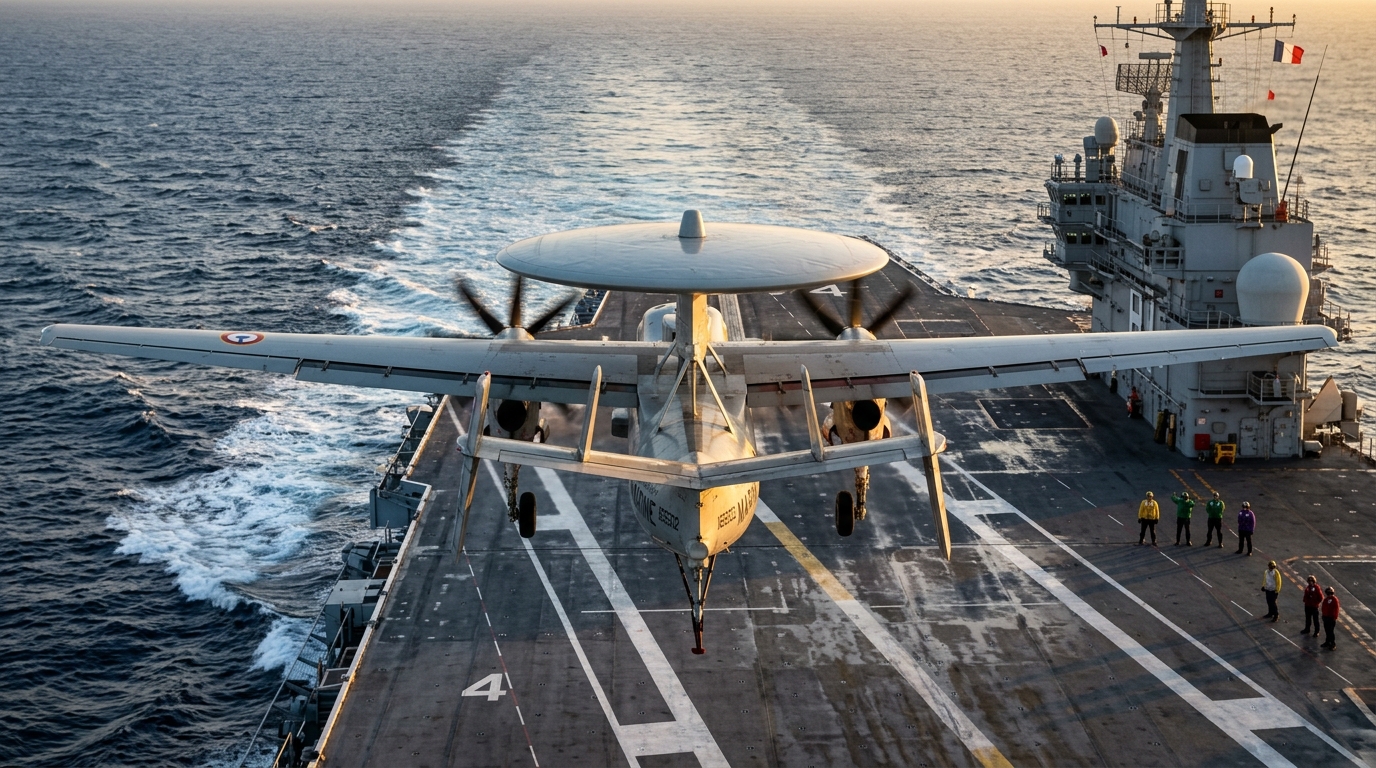
Non, during its very first sea trials, the Charles-de-Gaulle aircraft carrier simply could not safely accommodate its own airborne early warning aircraft, the E-2C Hawkeye. The angled deck, though designed with the precision of a clockmaker, proved too short from the first arrested landings in degraded configuration. An irony for a vessel that would swallow nearly 20 billion francs and that still today represents the flagship of the French Navy. A look back at this little-known episode, where a few metres of flight deck nearly jeopardized an entire naval projection strategy.
A 20‑billion-franc carrier that failed its own test
The Charles de Gaulle is no small vessel. At 261.5 metres in length, 40,600 tonnes at full load, and a flight deck spanning 12,000 square metres, it is the largest combat ship built in Western Europe since World War II. A pharaonic project, whose final price tag reached 20 billion francs, according to reports at the time by AFP. In other words, every centimeter of this sea giant was conceived, calculated, and modeled for years before its first launch.
- During the 1999 trials, the Charles de Gaulle’s angled deck proved too short for a safe arrest landing of the Hawkeye in degraded configuration, due to its 25‑metre wingspan being close to the deck’s width.
- The flight deck had to be extended by 4.40 metres to create a dedicated taxiway for the Hawkeye, at a cost of 5 million francs.
- This correction was part of the six‑month RANAE upgrade conducted from October 1999, before the ship was armed in late September 2000 and entered active service in 2001.
- A 20‑billion‑franc aircraft carrier that could not pass its own test
- The oblique deck, a millimeter-perfect calculation that slipped
- The E-2C Hawkeye, the aircraft that exposed the flaw
- 4.40 metres added at the last minute before commissioning
And yet, when the first sea trials arrived, in January 1999, reality caught up with theory. The vessel, still regarded as a prototype at that stage, was to validate all of its operational capabilities, among the most critical being the arresting of its own aircraft. And it was precisely there that the fault showed, revealing a technical incompatibility between the carrier’s angled deck and one of its most strategic aircraft.
The oblique deck, a millimeter-perfect calculation that slipped
On a aircraft carrier, nothing is left to chance, and the angled deck is one of the most sensitive elements. It is what enables planes to arrest their landings without crossing the paths of aircraft stationed elsewhere on the deck, thanks to an angle calculated to the millimeter. On the Charles de Gaulle, this deck now measures 203 metres long by 20 metres wide, numbers that may seem generous, but reveal surgical precision once confronted with the real constraints of a high‑speed arrest in rough seas, with a pilot who has no margin for error.
The problem was that the original dimensions of this deck had been designed before the Navy decided in 1992 to acquire three new E‑2C Hawkeyes for the tidy sum of six billion francs. A major strategic choice, which made the Charles de Gaulle the only European aircraft carrier capable of carrying this emblematic airborne early warning aircraft, but which also unsettled the rest of the ship’s originally fixed specifications.
The E-2C Hawkeye, the aircraft that exposed the flaw
To understand the scale of the problem, one must pause on the Hawkeye’s distinctive silhouette. Readily identifiable by its enormous radar dome perched above the fuselage, this aircraft has a wingspan of around 25 metres, nearly as wide as the oblique deck itself. A feature that, on paper, poses no issue under normal conditions, but becomes a real headache when arresting gear operates in degraded mode.
Practically, in optimal configuration, the aircraft brakes quickly after its arresting hook and clears the deck without difficulty. But in degraded configuration, the Hawkeye required more distance to come to a stop and then reach its parking area, and its large wingspan would slow its movement toward the parking area dangerously, with a real risk of collision or obstructing the deck for following aircraft. A scenario that engineers apparently had not fully anticipated when drawing up the ship’s plans.
4.40 metres added at the last minute before commissioning
Faced with this finding, there was no alternative but to resume work. According to a Senate report, the flight deck was therefore lengthened by 4.40 metres to add a dedicated taxiway for the Hawkeye’s arresting landings, finally giving it the space necessary to maneuver without risk. An adjustment that might seem trivial on a 260‑plus‑metre vessel, but required a targeted and careful intervention on a structure already completed.
Financially, this correction represented a cost of 5 million francs, barely 0.025 percent of the overall carrier construction budget. A relatively modest sum given the stakes, but revealing of the complexity of such an ambitious program. This intervention was part of a broader post‑trial upgrade, named RANAE, which lasted six months from October 1999 and also addressed other anomalies, such as the abnormal vibration of rudder movements, the upgrading of the electrical system, and the reinforcement of the acoustic insulation in about a hundred compartments. The ship subsequently suffered a second mishap in November 2000, with the fracture of a blade on the port propeller, requiring the installation of a spare blade taken from the former aircraft carrier Clemenceau. The Charles de Gaulle was finally armed by the French Navy in late September 2000, before entering active service in 2001.
This story of a few missing metres perfectly illustrates the insane complexity involved in designing a modern aircraft carrier, a technological object where every component, from the onboard radar to the smallest rivet on the flight deck, must fit perfectly with the rest of the system. The Charles de Gaulle, despite these last-minute adjustments, remains today a formidable tool of naval projection and unique in Europe. It is nonetheless fascinating to note that a ship conceived over decades could, by just a few metres, have nearly failed to safely welcome the very aircraft that serves as its eyes in the sky.
Original article ends with a code-block and an ad tag; we have included the content accordingly.
