
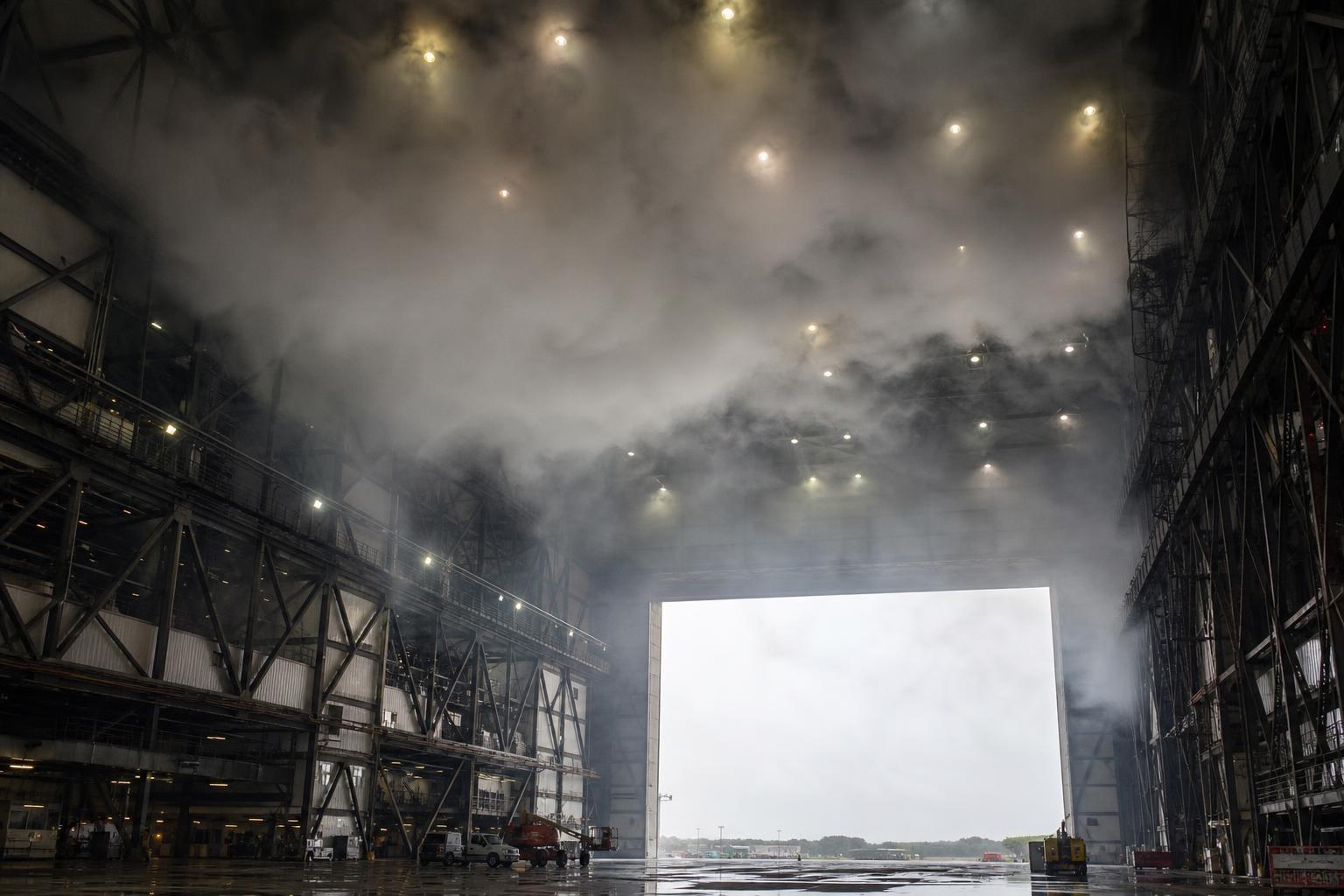
The colossal assembly hall on Florida’s Space Coast feels less like a building and more like a horizon with walls. Step inside, and the air turns hushed, your footsteps sounding small against steel and concrete that climb beyond easy sight. On muggy days the interior can shimmer with humidity, and—so the old joke goes—“you don’t just open doors here, you change the weather.”
A Cathedral for Rockets
From the outside, the structure looks mythic, its flat sides monumental against the coastal sky. The sheer volume is astonishing, a single-story space so enormous that it remains one of the largest enclosed rooms on Earth. Engineers designed it to stack boosters and spacecraft upright, giving rockets the vertical posture they need before rolling to the pad.
- Height measured in hundreds of feet, towering over the marshland
- Multiple high bays with doors so tall they open like cliffs, panel by panel
- An interior volume measured in tens of millions of cubic feet, a figure that feels almost abstract
- Bridge cranes capable of hoisting loads heavier than locomotives, with inch-by-inch precision
- A painted U.S. flag so large that each stripe is wider than a room
“Stand in the center,” technicians like to say, “and the walls feel far, while the ceiling feels like a weather report.”
When Space Meets Weather
The coastal setting is beautiful and brutal—salt air, sea breezes, and a humidity that wraps the skin like warm gauze. In a volume this vast, air behaves like a system of its own. Warm, moist air rises toward the trusses, cools near steel and shaded surfaces, and tiny droplets begin to condense. Under the right conditions, you can see faint, ghostly wisps gathering high above, a preview of cloud physics you’d expect outdoors.
The principle is simple and majestic: humidity plus temperature difference equals condensation, and sufficient condensation equals visible vapor. Building managers learned early that such effects—sometimes jokingly called “indoor weather”—could lead to drips, slick spots, or even a bit of indoor mist. “It’s a building that breathes with the climate,” one veteran remarked, “and on some afternoons you can watch that breath show itself.”
Engineering the Invisible
To tame that indoor microclimate, NASA invested in serious environmental control. Dehumidification systems pull moisture from the air, while carefully planned airflow keeps temperatures more even from floor to ceiling. Massive doors open in stages to prevent sudden gusts, and sensors track dew point, temperature, and pressure like a miniature meteorology lab.
The goal is safety and stability—for hardware, for people, and for the delicate operations that demand millimeter-true alignment. Cranes move in whispers, operators watch for thermal expansion, and the entire choreography is timed to the facility’s breathing. “You don’t just flip a switch here,” someone once said, “you shape the air first.”
Built for Apollo, Evolving for Artemis
This place was born for Saturn V, the moon-bound giant whose stacked segments defined a generation. Those rockets rose in the bays, were joined by cranes and teams, then rolled out like shining cathedrals of machinery toward a flame-torn dawn. Later came the Space Shuttle era, with orange tanks and twin boosters lifted and pinned together in gravity-defying rigging.
Today, the building supports the next wave—Orion, SLS, and a new cadence of moon-to-Mars ambition. Systems have been upgraded, workflows reimagined, and the same towering space now frames a different future. The promise is familiar yet new: assemble, test, and send human hardware toward deep space.
The Human Scale Inside the Superhuman
For all its mass, the experience of working here is intimate. People move in small teams, speaking in clipped, low voices because sound turns to echo and timing matters. You notice the smell of metal, the faint tang of industrial cleaners, the steady pulse of conditioned air. “Keep your pace steady,” a mentor might say, “the building rewards patience.”
What surprises first-timers isn’t just the size, but the sense of care. Cables are dressed like calligraphy, lift plans read like poems, and a day’s work ends with meticulous checklists that keep chaos at bay. The place has moods—sunlit and gleaming one morning, gray and hushed the next—and every mood is logged, managed, and folded into the ritual of flight readiness.
Why It Still Matters
In an age of compact startups and modular fab shops, this megastructure can feel anachronistic—until you remember what it does. Some missions still demand a space this tall, tools this precise, and a climate you can tune like an instrument. It remains a reminder that exploration is both grand and granular: bolts torqued to spec, vapor kept below its threshold, and human resolve gathered beneath a man-made sky.
“Look up,” visitors whisper, “and you feel the room looking back.” In that exchange—between scale and skill, weather and will—our oldest impulse resurfaces: build a shelter so vast that dreams can assemble inside, then open the doors and let them fly.
