
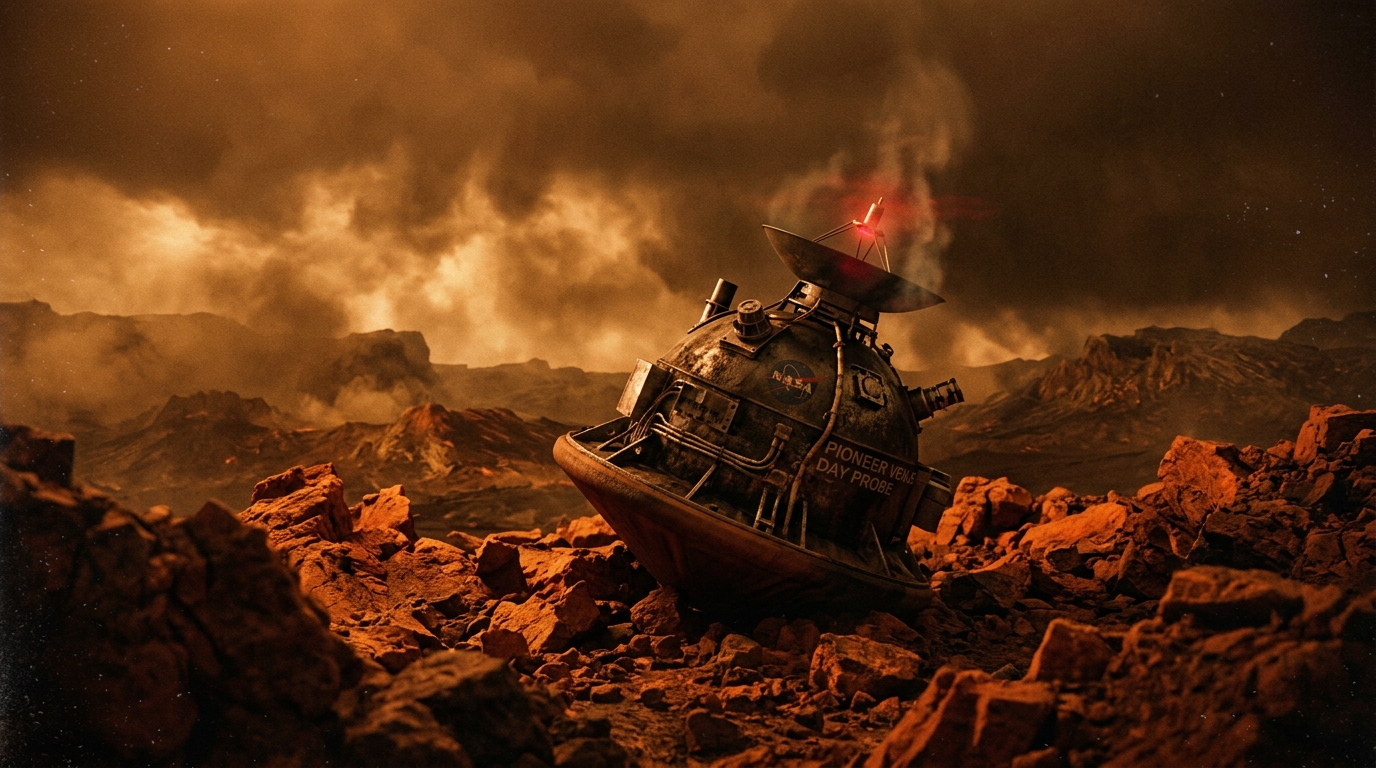
A spacecraft intended to disintegrate within seconds ended up transmitting data for more than an hour from a hell where nothing was supposed to survive. This isn’t science fiction, but a real episode in the conquest of Venus, that neighboring planet so similar to Earth in size, and yet so radically hostile. In the late 1970s, NASA sent four craft toward this furnace shrouded in clouds of sulfuric acid, with a clear objective: collect as much information as possible during descent, before the inevitable crash. What was meant to be a suicide mission with little expectation of survivability turned into a fascinating anomaly that enthusiasts of astronautics still discuss today.
- The Day Probe, one of the four probes in the Pioneer Venus program, was not designed to survive impact on Venus’s surface.
- On December 9, 1978, it continued transmitting for 67 minutes after touchdown, likely thanks to a relatively stable position that limited the shock.
- These unexpected data on temperature, pressure, and soil composition helped refine Venus climate models, particularly regarding its extreme greenhouse effect.
- Four disposable probes for a mission that expected no survivors
- The Day Probe, the one that wasn’t supposed to touch the ground
- Sixty-seven minutes too long: what the Venusian surface revealed by accident
- The unexpected legacy of a signal that should never have existed
Four disposable probes for a mission that expected no survivors
The Pioneer Venus program, orchestrated by NASA, aimed to pierce Venus’s mysteries—the thick, corrosive atmosphere that makes the planet’s surface invisible from space. To achieve this, engineers designed four atmospheric probes, released from a mother ship and tasked with plunging through the cloud layers down to the surface. None of these capsules were intended to withstand the final impact. On paper, their mission would end the moment they struck the surface, crushed by immense pressure and baked by temperatures around 460 degrees Celsius.
Three of these craft, in fact, performed their roles to the letter. After piercing the atmosphere while gathering valuable measurements of Venus’s chemical composition and thermal structure, they crashed and ceased transmission almost instantaneously, precisely as ground teams had anticipated. Nothing abnormal, then, until the fourth probe entered the scene.
The Day Probe, the one that wasn’t supposed to touch the ground
This fourth capsule bore an almost banal name: the Day Probe. Named as such because it was to land on Venus’s sunlit hemisphere, it, like its three sisters, had no vocation to survive the landing. Its shielding, instruments, and power system had been calibrated for a descent of roughly one hour through the clouds, not for a prolonged life on the scorching surface.
And yet, on December 9, 1978, something unexpected happened. After touching Venus’s surface, the Day Probe continued to transmit. Neither the mission scientists nor the control teams had anticipated this scenario. The instruments, expected to be destroyed on impact, stayed intact, and the signal kept climbing back to Earth, tens of millions of kilometers away, like a stubborn whisper from a world where nothing should be able to endure so long.
Sixty-seven minutes too long: what the Venusian surface revealed by accident
For 67 minutes, the Day Probe transmitted data from a spot where no instrument was expected to operate. This completely unexpected extension granted NASA an unforeseen window into the actual surface conditions of Venus: precise temperature, atmospheric pressure, and information about the immediate terrain’s composition. All of these data should never have existed, because the mission scenario simply did not include this phase.
This technical reprieve is largely explained by a fortunate mechanical accident: the lander appears to have settled in a relatively stable orientation, avoiding a shock strong enough to immediately ruin its internal electronics. An alignment of circumstances that, in the scope of a space mission, is almost a statistical miracle. This kind of event reminds us how space exploration, despite ultra-precise calculations, always leaves room for the unexpected, sometimes to the benefit of discovery.
The unexpected legacy of a signal that should never have existed
Those 67 minutes of bonus science left a lasting imprint on our understanding of Venus. They allowed refinement of the planet’s climate models, especially those tied to its extreme greenhouse effect—a phenomenon now regularly cited as an example of possible large-scale climatic runaway. The data gathered by the Day probe fed for decades the work of researchers trying to understand why two Earth-sized planets, Venus and Earth, ended up with such opposite atmospheric destinies.
Beyond the raw scientific data, this episode stands as a powerful illustration of the humility demanded by space exploration. Even the best-prepared missions, designed with stringent safety margins, can hold surprises. Day was not supposed to speak from Venus’s surface. It did so anyway, and that simple fact continues to fuel the curiosity of those interested in the history of space exploration.
This almost anecdotal aside beautifully illustrates the enduring element of uncertainty that underlies even the most accomplished technological feats. As new missions to Venus are regularly discussed by international space agencies, one cannot help but wonder what other surprises the planet closest to Earth still holds, ready to once again challenge engineers’ most rigorous forecasts.
