
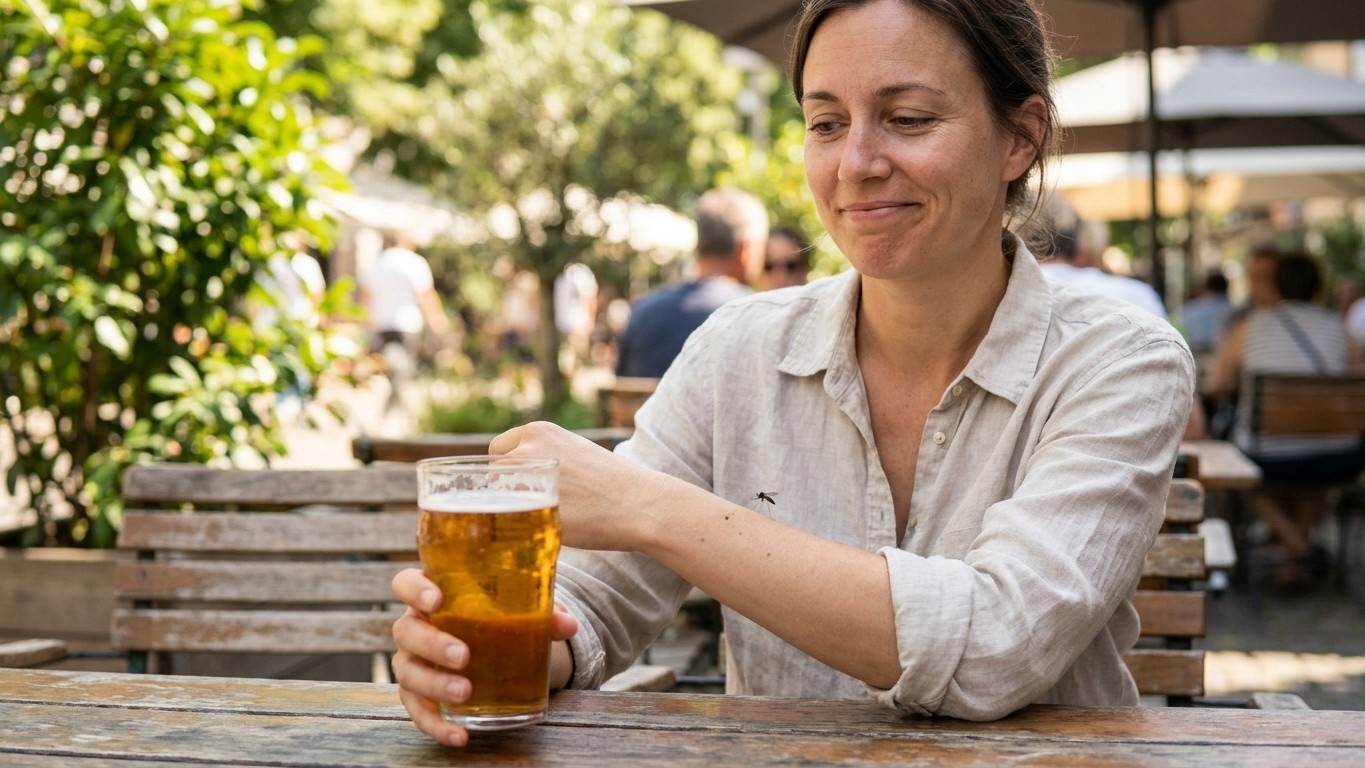
With a beer in hand, on a terrace or at a festival, and the mosquitoes come buzzing back. It’s not just a feeling: a Dutch study conducted under real-world conditions measured that beer drinkers turned out to be more attractive to mosquitoes than those who hadn’t consumed any, with a risk increase approaching 35%. Participants who had drunk beer were found to be 1.35 times more attractive to mosquitoes than those who hadn’t, a finding that could cast a chill over summer after-work gatherings.
Key takeaways
- A real-world festival study scientifically confirms what many people suspected
- Beer acts as an invisible chemical magnet, though not for the reason you’d expect
- Several other festive behaviors dramatically raise your bite risk, while a simple habit provides 48% protection
An improvised laboratory at the heart of a festival
To understand why some people end the night covered in spots while others leave relatively unscathed, researchers from Radboud University in Nijmegen came up with a rather original idea. Instead of locking volunteers in a sterile laboratory, they chose to run an experiment among festival-goers attending the Lowlands music festival in the Netherlands, over three days in 2023. On-site, four shipping containers welded together formed an improvised research station, right in the middle of performances by Billie Eilish and Underworld.
The protocol was simple yet highly effective. Each participant completed a questionnaire about their overall health, diet, and hygiene during the festival, before sliding their arm into a screened cage. Inside, mosquitoes could sense but not bite the arm, with a choice between that arm and a sugar dispenser. A camera then recorded how many times the mosquitoes chose to land on the participant’s arm, cross-referencing these images with the questionnaire responses. In total, 465 festival-goers participated, answering questions about hygiene and behavior during the event, blowing into a breathalyzer, and then placing their left arm against a transparent cage housing 20 to 35 female mosquitoes. A curious detail: the species used, Anopheles stephensi, is a major malaria vector in other parts of the world.
Beer, a chemical magnet more than mere luck
The most striking finding concerns beer. According to the researchers, beer consumption significantly increased mosquitoes’ attraction, a result consistent with earlier work on smaller samples and with much lower levels of alcohol intake. What makes this finding intriguing is that intoxication itself does not appear to be the cause. The scientists noted that the measured blood alcohol concentration had no observable effect on mosquito attraction, suggesting that compounds tied to beer metabolism, or its characteristic smell, act as an olfactory signal rather than the degree of intoxication.
Some researchers even propose a more prosaic explanation linked to the glass itself: a beer glass that’s open releases CO2 at the surface and remains damp, creating an ideal environment for a female mosquito to trace that CO2 plume to the glass, ending up right near the person holding it. This hypothesis would also explain why wine or certain cocktails, which are less carbonated, do not produce the same effect.
The composition of the skin microbiome also comes into play. Analyses showed that bacteria of the genus Streptococcus on the skin were linked to higher attraction scores, and beer drinkers were among those with the highest scores. Alcohol doesn’t just perfume the breath: it subtly alters the overall chemical signature that the skin emits into the air, a cocktail of volatile molecules that mosquitoes can read from a distance.
The real culprit isn’t blood type
The study also dispels a stubborn myth about blood type being protective or attractant. The researchers found no link with blood type, age, gender, diet, or caffeine consumption, debunking several widely held summer-time myths. Instead, other festive behaviors proved far more decisive than expected. Beer drinkers were 44% more attractive than those who avoided alcohol for at least twelve hours, cannabis users were 35% more attractive, and people who had shared a bed the night before were 46% more attractive. Conversely, good news for hygiene enthusiasts: festival-goers who had showered and applied sunscreen were 48% less attractive. Wine, long suspected of the same effect, did not hold up under statistical analysis once other variables were taken into account. Wine drinkers initially appeared more attractive too, but this result did not reach statistical significance once other factors were adjusted.
That said, while the experiment was sensational, it is by no means a definitive verdict. The authors themselves note that their results, posted as a preprint on bioRxiv, have not yet undergone peer review, and the festival’s very particular context (heat, heavy drinking, crowding, short nights) may not generalize to a simple neighborhood apéritif. Still: the next time a mosquito harasses your arm while the person next to you sips a fruit juice calmly, the beer in front of you may not be entirely unrelated to the matter. A cool-down shower and sunscreen, for their part, remain the best documented defense, far more reliable than any legend about sweet blood or blood type.
Sources: bladi.info | futura-sciences.com
