
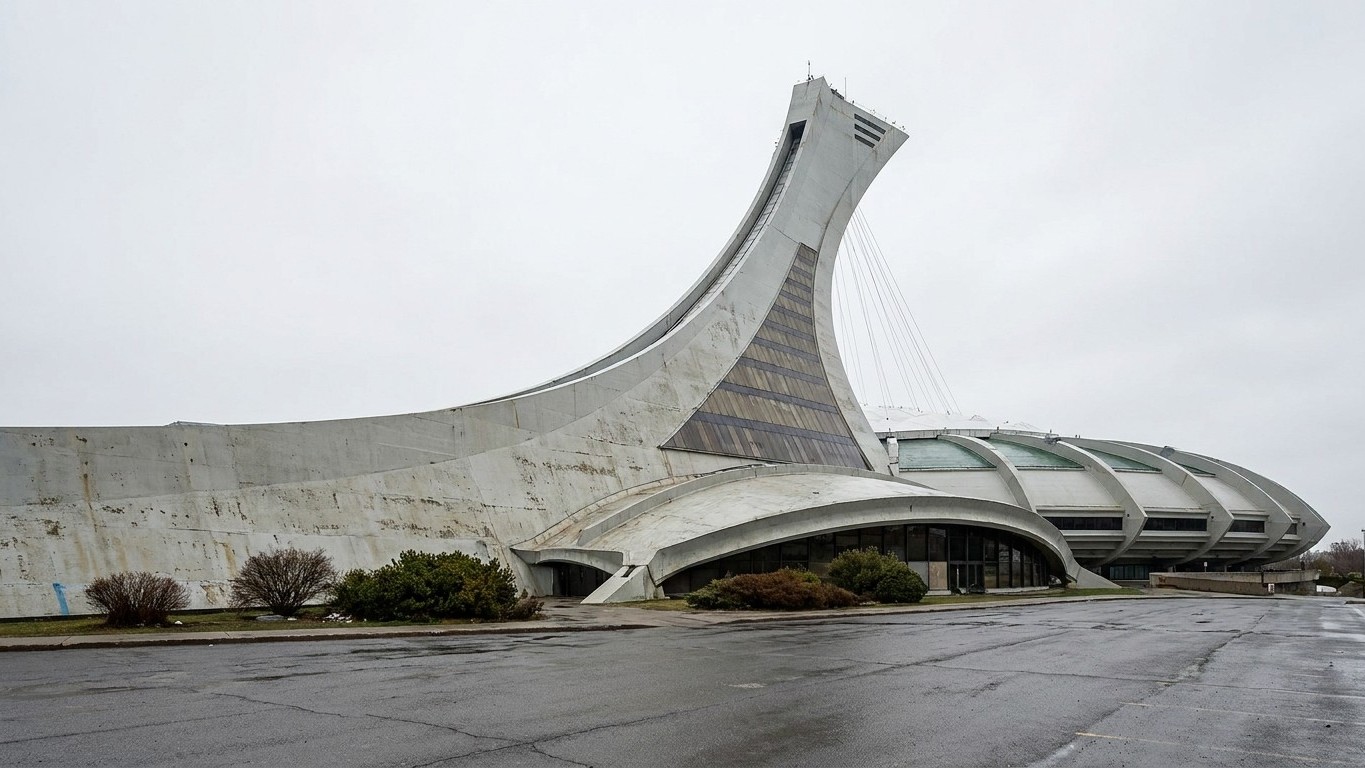
A paid-for stadium… thirty years after the Games it was built to host finally came to fruition financially. The Montreal Olympic Stadium, erected for the 1976 Games, had its debt fully cleared on November 14, 2006, financed notably by a special tobacco tax introduced in June 1976. The final bill stood at 1.35 billion Canadian dollars in 1976 terms, with interest, equivalent to 5.2 billion in 2016 dollars. This is what earned the building a nickname that has clung to its concrete frame for half a century: the “Big Owe.”
À retenir
- A stadium delivered incomplete in 1976, without a roof and with an unfinished tower
- A tobacco tax in place since June 1976 to erase the Olympic debt
- A new bill of 870 million to replace a roof pierced in more than 20,000 holes
A project that spiraled out of control even before the Games opened
The bet was bold from the start: to rise, in the heart of the city, the most expansive athletic complex ever imagined for a summer of competition. Yet the architectural ambitions of the mayor of that era, Jean Drapeau, collided with a chaotic construction reality. The build faced numerous problems: strikes, corruption, significant delays. The result? A stadium delivered incomplete. At the opening of the Games in 1976, the Stadium had no roof, and the tower’s construction wasn’t even finished. It would take until 1988, twelve years later, for the famous leaning tower to finally be completed.
Aside from Wembley, Montreal’s enclosure long held the record for the most expensive stadium ever built, before being surpassed by American infrastructures such as Yankee Stadium or MetLife Stadium. A discussion forum dedicated to the case later posted, at the time of the final repayment, the exact breakdown of the bill: 839 million for the stadium itself, 175 million for the tower, 107 million for parking, 133 million for the velodrome and the future Biodôme, 122 million for the Olympic Village (which has since been sold), and 44 million in miscellaneous expenses, for a total rounded to 1.474 billion dollars, with interest included. The stadium and its tower alone represented the vast majority of this sum: the stadium and its tower accounted for nearly 70% of the total cost, with 57% for the stadium and 12% for the tower.
Thirty years of tobacco tax to erase the debt
How could such a debt be repaid without blowing up everyone’s taxes in Quebec? The government at the time found a solution both simple and effective: make the smokers pay. A precise portion of tobacco tax revenues was allocated starting in June 1976 to the repayment of the Olympic debt, year after year, until the balance was fully extinguished. It’s notably thanks to a share of tobacco tax revenues, earmarked for repaying the Olympic debt since June 1976, that the bill was fully paid on November 14, 2006.
The mechanism rested on a modest but steady levy: about 8% of tobacco product taxes were directed each year to this repayment fund, according to explanations provided at the time by the Régie des installations olympiques. In 2005, just months before the final due date, the question even arose whether this levy would disappear once the debt was extinguished. The answer was no: Finance Minister Michel Audet had no intention of lifting the “Olympic” tobacco tax once the Stadium was repaid; in June 2006 the Quebec government preferred to keep these revenues rather than let them vanish. A neat example of a tax promoted as temporary that eventually became a permanent feature of the fiscal landscape.
The administrative rigor even delayed the official announcement of the end of repayments. According to a exchange reported at the time between the Régie and the Ministry of Finance, the financial comptroller had to draft the final balance before sending a written certificate to the government confirming that the debt was indeed paid, in the same way a bank validates the balance of a mortgage. Ironically, those who had never touched a cigarette in their lives had, technically, contributed to paying for the stadium without ever paying a cent of this particular tax.
A roof with holes in more than 20,000 spots, and a new bill
Paying off the debt did not solve everything. Since its installation, the fabric that crowns the stadium has seen multiple lives and many misadventures. The current roof is in poor condition, pierced by more than 20,000 holes, and damaged each winter by the buildup of ice and snow that makes using the stadium hazardous. An assessment even warned of a looming deadline: within about ten years, the roof could be entirely destroyed and the stadium would have to be closed permanently.
In response to this assessment, the Quebec government decided in 2024 on a radical solution: permanently abandon the fabric for a fixed and rigid structure. Quebec announced an investment of 870 million dollars to replace the roof and the technical ring of the Olympic Stadium, which had reached the end of its useful life. Concretely, a lightweight steel framework bordered by a translucent glass ring will take the place of the current roof, allowing better protection from the elements and more natural light to enter. The project, entrusted to the Pomerleau-Canam consortium, began in spring 2024 with the removal of the old 27,000-square-meter fabric, installed in 1998.
By spring 2026, the work was halfway done: about 390 of the 870 million in public funds had been spent, or 45% of the financing package, with the final bill not yet guaranteed. The government does not hide its economic aims behind this pharaonic project: according to official projections, replacing the roof should generate economic spinoffs of nearly one and a half billion dollars over ten years, increasing the events hosted from about thirty per year to around a hundred. A gamble that, almost fifty years after the fact, echoes the bet Jean Drapeau once made: to turn a symbol of budgetary gigantism into an international showcase. The question remains whether this new bill will meet its deadlines as reliably as the previous one did.
Sources : lapresse.ca | ici.radio-canada.ca
