
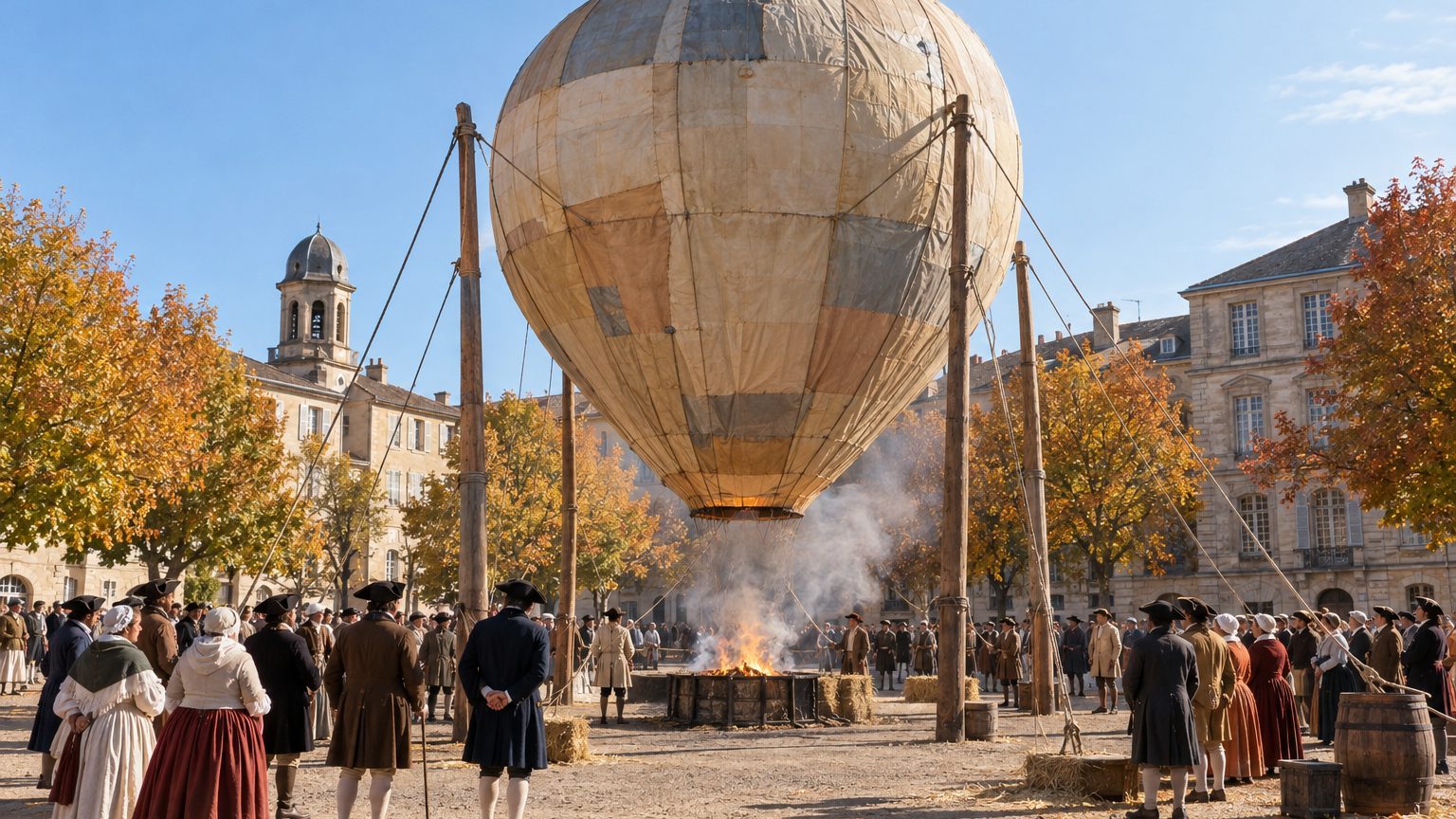
On June 4, 1783, on a square in Annonay, Ardèche, Joseph and Étienne de Montgolfier light a fire beneath a large canvas bag lined with paper. The envelope inflates, lifts off the ground, and the Montgolfier balloon exists, long before the word ballooning became common. The sources speak of the first public flight of an aerostat, mounted by two provincial papermakers with means that a craftsman today would deem paltry.
Cloth, paper, fire: nothing more.
- The first flight of an aerostat takes place on June 4, 1783 in Annonay, led by the Montgolfier brothers.
- The envelope is made of cloth reinforced with paper, assembled by 1,800 buttonholes, for a volume of 800 m³.
- The brothers wrongly believed that smoke lifted the bag, unaware that it was hot air that provided the lift.
A bag of cloth, paper, and 1,800 buttonholes
In the eighteenth century, people spoke of an aerostat or a globe, not yet of a hot-air balloon. As for the Montgolfier name, it honors the family that launched the idea, established for four centuries in the Ardèche region.
Nothing destined Joseph and Étienne for aerostatics. Sons of a paper manufacturer in Vidalon-lès-Annonay, whose family workshop enjoyed a European reputation, they knew fibers, fabrics and their behavior under heat better than many salon physicists. This material culture explains the choice of materials: cloth and paper, that is, their everyday life.
According to the Fondation La main à la pâte, which relies on archives, the aerostat is a cloth reinforced with paper, in triple thickness. The envelope is not a single piece: spindles are held together by 1,800 buttonholes, like a giant garment with countless fastenings. The British Balloon Museum & Library describes, for its part, a taffeta lined with paper, closed by buttons, which shows that the fabric varies according to the accounts without changing the underlying principle. Once inflated, the globe reaches 800 m³.
One thousand eight hundred buttonholes is no small undertaking. At ten seconds per buttonhole (a simple calculation), it would take about five hours to fasten them all.
800 m³ equals roughly five large classrooms sewn into one bag. On a town square, facing spectators who had never seen anything like it, the effect must have been striking. The brothers did not present a reduced model: the public demonstration was conducted at full scale. According to several sources, a miniature balloon, born from an observation of smoke in a chimney, had preceded this demonstration.
Four masts, a burner, and ten minutes
Four masts. The brothers set them up on June 4 on the square in front of the Cordeliers monastery, and one can guess their role: to support the immense bag as it fills with hot air. In the crowd, representatives of the states of Vivarais came to witness the experiment.
The inflation rests on a small burner where straw and wool burn, enough to fill 800 m³. Some accounts refer to a simple straw fire, while wool indeed burned as well: the fuel was double.
According to most sources, the flight lasts about ten minutes.
As for the rest, numbers vary. The altitude reached and the distance traveled differ from one source to another, which makes it impossible to present a precise figure that the narratives do not guarantee. The testimonies, however, agree on the essential points: the date, Annonay, the two brothers, and the takeoff.
An official report before the applause
The day after the flight, on June 5, a report is drawn up in the name of the states of Vivarais. The Academy of Sciences records it on June 18, 1783, thirteen days later. This formality weighs almost as much as the ascent: it turns a public spectacle into a documented fact for Paris to examine. According to an Ardèche notice, the demonstration had a great impact and Louis XVI asked to see a balloon ascend.
This administrative reflex is not trivial. In the eighteenth century, according to historical syntheses, royal academies valued practical demonstrations, and a flight without official witnesses would have remained a local anecdote.
The sequence followed rapidly. According to Earth magazine, Charles soon built Le Globe, launched from the Champ-de-Mars, while the Montgolfiers prepared at Versailles a new experiment for the king and queen. On September 19, 1783, a sheep, a duck and a rooster ascended in a basket fixed to the balloon.
On November 21, 1783, Pilâtre de Rozier and the Marquis d’Arlandes achieved the first manned flight, in a hot-air balloon from the same family. They took off in the western outskirts of Paris, near the Bois de Boulogne.
Five and a half months after Annonay’s square.
A machine that its inventors misunderstood
The brothers, for their part, had not grasped what made their bag rise. According to several accounts, they believed that the smoke, not the hot air, lifted the envelope, and fed the fire with straw and wool. The underlying principle would only be explained later, by others.
That principle did not change: the air heated inside the envelope is lighter than the cold air around it. Only the heat source changed, with the propane burner replacing the straw-and-wool burner.
Annonay did not forget the episode. According to a note dedicated to the brothers, the town celebrates every spring its prodigal children. And near the town, the Canson and Montgolfier paper mill museum retraces both the history of balloons and that of paper.
Sources: montgolfiere-sensation.com | air-journal.fr | leblogcashpistache.fr
