
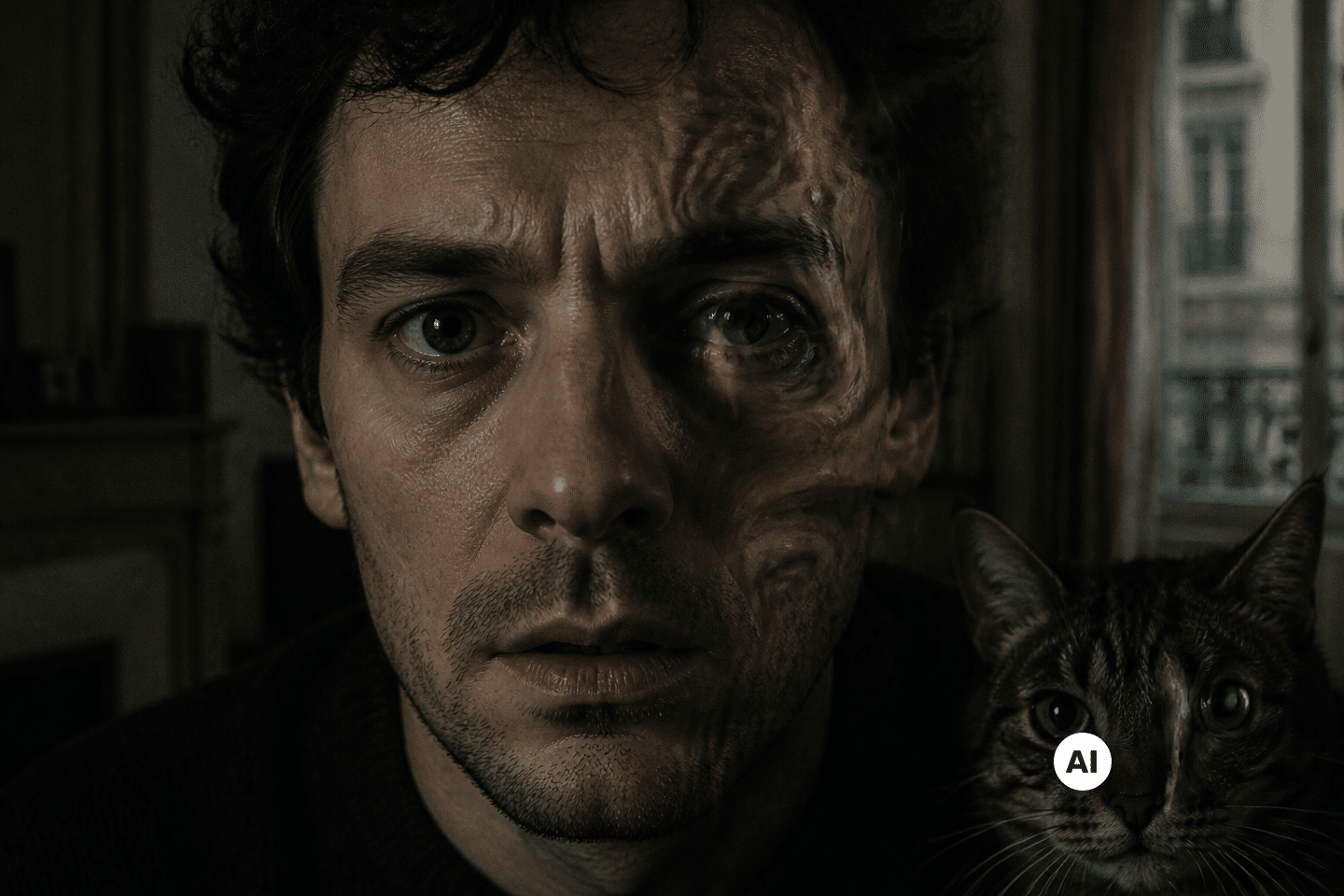
Imagine locking eyes with a loved one and suddenly seeing the eyes of your cat stare back at you. That is the reality for a 28-year-old man following brain surgery. Scientists have described his case: a rare inversion of facial features blending human and feline perception, blurring his view of the world.
When the brain confuses human and feline faces
Credit: © Duchaine et al./Cortex
The case is sufficiently peculiar to have attracted the attention of neuroscience researchers. A man, identified by the first name Karl in the studies published, reports a visually puzzling experience.
When he looks at certain people, it is not their eyes that he perceives, but those of his cat. The phenomenon also works the other way: by observing his animal, Karl sometimes discerns his own features, or those of other humans.
This form of visual exchange between human and feline faces is one of the central symptoms of his condition. The brain, normally responsible for recognizing and differentiating faces, appears to blur the lines between two categories that are otherwise clearly distinct.
A brain ablation with unexpected consequences
The origin of this disorder traces back to a surgical operation Karl underwent. Doctors performed a partial removal of his right temporal lobe, a region of the brain.
It is after this operation that Karl’s perception became altered. His brain now seems to associate certain features characteristic of a feline face with those of a human face, and vice versa.
A brain scan, conducted as part of the study, allows precise visualization of the area affected by this ablation. An AI-generated render was also produced to attempt to depict what Karl perceives concretely.
A disorder so rare that it challenges science itself
Karl’s case has been documented by the research team of Duchaine and colleagues, in a publication in the scientific journal Cortex. Its rarity makes it a valuable object of study to better understand the mechanisms of facial recognition.
Such a dysfunction, where the brain blends visual categories as distant as a human face and an animal face, remains exceptional in medical literature. It raises questions about how our brain builds, sorts, and stores the faces we encounter.
For now, neither the exact neurological mechanism behind this inversion nor any potential evolution of the disorder since the operation has been specified by researchers. Karl’s case illustrates how certain areas of the brain, when perturbed, can produce effects as specific as they are unexpected.
This testimony, once again, underscores the complexity of the human brain and its capacity to generate perceptual alterations that sometimes defy our most fundamental understanding of reality. Between scientific curiosity and the unsettling lived experience of the person involved, Karl’s story continues to fuel reflections on the many mysteries still surrounding our visual perception.
The study is published in Cortex.
Article prepared with the help of AI · Our method
