
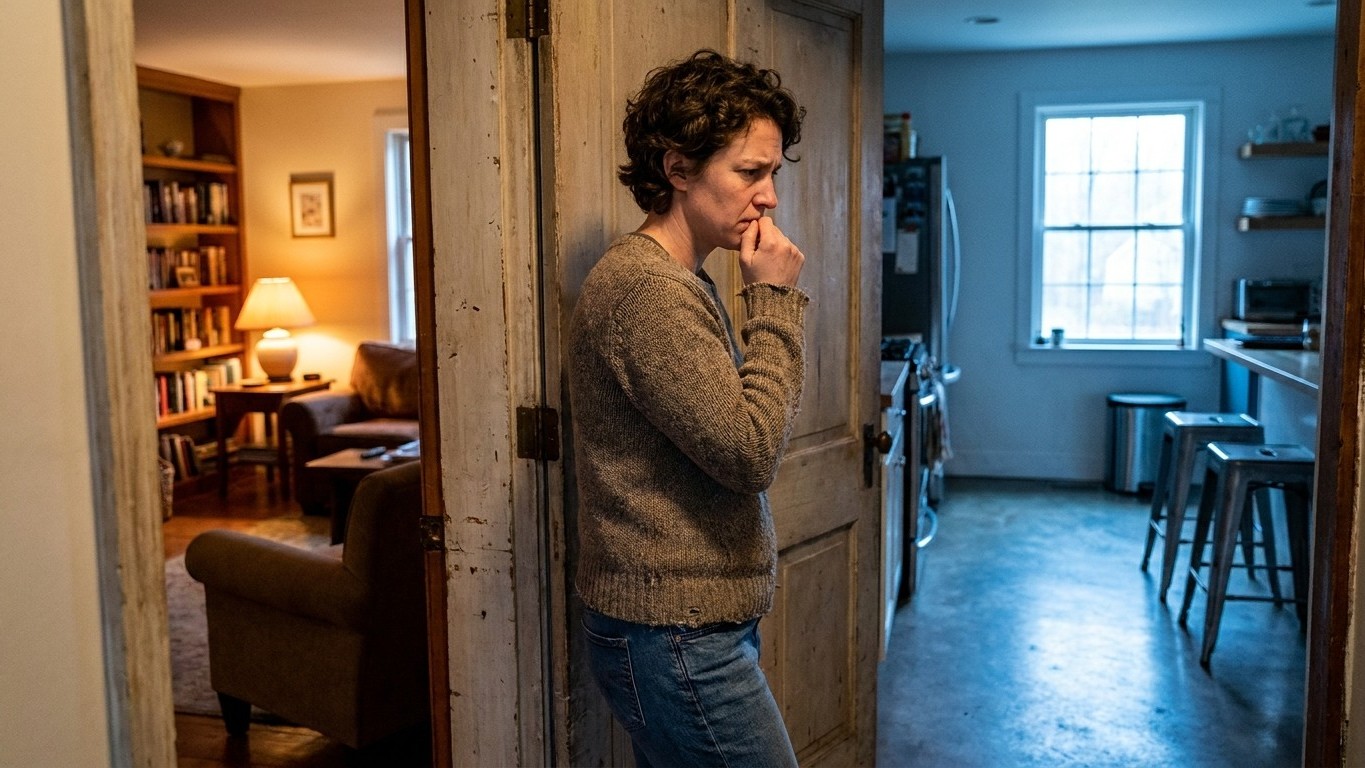
It isn’t fatigue. It’s the doorway. For almost two decades, cognitive psychology researchers have shown that a simple pass from one room to another can erase an intention that was clearly formed just seconds earlier. The phenomenon has a scientific name: the updating-location effect, more commonly known to the general public as the doorway effect. And it isn’t merely a feeling: laboratory experiments, some replicated in entirely virtual environments, demonstrate that the brain literally closes a mental file the moment you step through a doorway.
Key Takeaways
- Doorways aren’t just passageways: they trigger a mental reset that wipes out intentions
- This phenomenon works even with virtual or imagined doors—the perception of change is what matters
- Recent studies nuance the initial effect: it only appears when the brain is already overloaded
The experiment that put researchers on the trail
Everything starts with the work of Gabriel Radvansky, a psychologist at the University of Notre Dame in Indiana. His team had participants navigate a virtual environment filled with rooms connected by doors, each containing a table with an object to move to the next room. In the original setup, participants played a video game in which they moved freely through a 3D environment made up of a sequence of rooms, each with a table bearing an object, and had to transfer each item from one table to the next, either into the adjacent room connected by a door or within the same room. The result? Disappointing but rich in insight: memory declined as soon as people moved from one location to another, even though the path traveled was exactly the same in both conditions.
The detail that intrigued researchers was that physical distance or elapsed time didn’t explain anything. Studies reveal that the drop in memory performance isn’t due to the distance traveled or the time elapsed, but to the mere fact of changing “scenes.” It isn’t the effort of walking that empties the head; it’s the change of scenery itself that acts as a reset signal. The brain seems to treat each room as a distinct chapter of a story, and turning the page wipes out part of the content of the previous chapter, including the intention that had been formed there.
Even without a real door, the brain erases
The most troubling part is that this mechanism doesn’t even require a real door. Radvansky reproduced the effect with mere computer windows or by asking participants to imagine moving. Earlier research suggests that such forgetting can occur at physical boundaries, like moving from one room to another through a door, and at metaphysical boundaries, such as imagining crossing a door, or even moving from one window to another on a computer. It’s there that the reasoning becomes dizzying: if the location doesn’t actually change, but the mind believes it does, forgetting still occurs.
This robustness has been tested from several angles. In a variant using a real physical environment rather than a simulation, to maximize immersion, localization-updating effects were observed in both virtual and real conditions. The decisive factor is therefore not the degree of realism of the setting, but the perception of a transition between two distinct mental contexts. A door may be made of cardboard or exist only in the imagination; the brain responds in the same way: it archives the old episode and opens a new drawer, even if it means letting go of what had been stored there.
A real effect, but not universal
However, the most recent work adds a crucial nuance. A study published this year in the journal BMC Psychology, led by Oliver Baumann, a psychologist at Bond University in Australia, initially failed to reproduce the doorway effect under standard conditions. The team’s early results were surprising: at first they found no doorway effect, and they suspected participants might be performing too well, remembering everything. It was only by deliberately taxing participants’ working memory—asking them to count backward while moving—that forgetting reappeared. The study confirms that this effect indeed exists, but only when the brain is occupied, and in a way that is less pronounced than earlier work suggested.
Other teams, notably at the University of Edinburgh, pushed the question further by testing the effect across four protocols that combined immersive virtual reality with real movements. Across all these experiments, no significant effect of doors on forgetting was observed under normal conditions; the effect reappeared only under cognitive load. This mixed result does not negate the phenomenon, but it clarifies its boundaries: the doorway effect may be less a universal flaw of human memory and more a vulnerability that reveals itself mainly when the mind is juggling several tasks—a scenario most of us experience constantly, between notifications, kids calling, and mental grocery lists.
What it means in practical terms
A January 2026 study from Radvansky’s lab, published in Memory & Cognition, adds another layer of complexity. Event boundaries can sometimes improve memory for information encoded just around them; items learned near a transition are remembered better than those learned in the middle of an episode. The doorway effect is therefore not uniformly detrimental; it reflects a broader episodic-organization process that can operate in either direction. The threshold isn’t merely an aisle for wiping memories clean—it’s paradoxically a marker that can strengthen certain memories located right at its edge.
Practically, the take-home message researchers repeat is simple: form a clear and specific intention before crossing a threshold, rather than relying on ambient memory, which reduces the risk of losing it at the boundary. The next time you head to the kitchen to grab something, say it aloud before you walk through the door. It isn’t a superstitious tic; it’s a way to lock the intention into a format that the brain won’t archive as quickly as the rest.
Sources: atlantico.fr | envol-descamps.fr
