
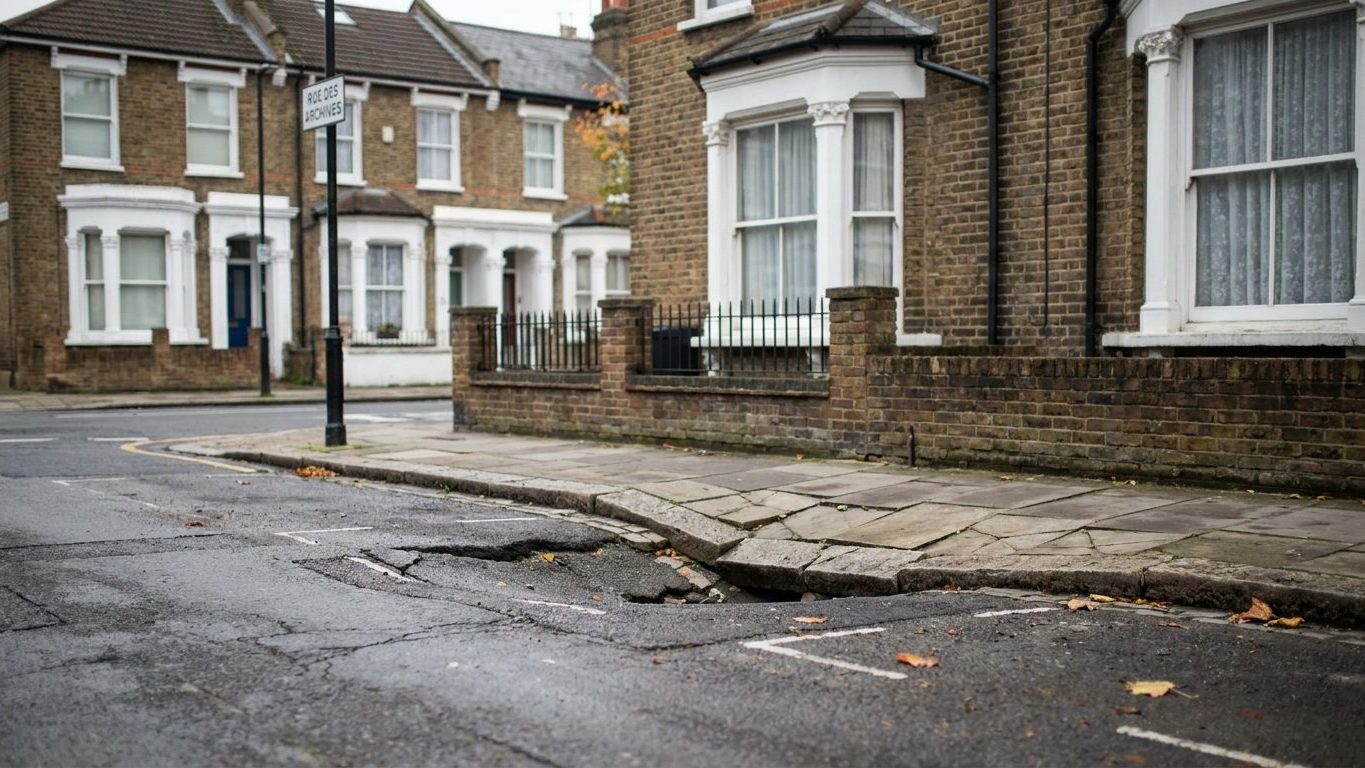
A whole street sinking by several centimeters overnight, with neither earthquake nor visible construction in sight: that is what alerted the technical services of a London district. While digging beneath the cobbles to understand the origin of the subsidence, municipal workers uncovered a network of tunnels not shown on any map. Its author? A local resident who had been digging under his own house for decades, with a shovel and a bucket, without ever seeking any permit.
The case swept through the British press.
The man had excavated a vast tunnel network beneath his property and the surrounding public and private lands, between the 1960s and the 2000s. He had inherited the house in the 1960s and had set to work alone, without engineers or any shoring plan, dumping the excavated earth directly into his garden year after year. The result: an underground labyrinth that extended well beyond the boundaries of his plot, slipping under the roadway and under the foundations of neighboring houses.
- A Londoner dug clandestine tunnels beneath his house between 1960 and 2000 without any shoring structure.
- The underground network extended beneath neighboring properties and the public road, leading to the collapse of the sidewalks in 2001.
- The municipal services used ultrasound scanners to map the cavities before filling them with cement.
A subsidence that betrays decades of clandestine labor
For years, neighbors joked about this eccentricity. Some said they expected to see him surface one day through the kitchen floor. But the joke ended when the sidewalks above the tunnels began to collapse in 2001, and the hole thus formed was wide enough to extend into the street.
The alarm was not merely cosmetic.
The man had already cut the electricity for his entire street by accidentally touching an underground 450-volt line during his works. Neighbors had complained to the council for years without receiving a clear answer. A female resident recalled having alerted the town hall for six years, before being told, six weeks before the incident, that the house was structurally sound. The basement, in contrast, told a very different story.
Digging without shoring: the mechanics of a disaster foretold
Technically, this kind of situation illustrates a simple yet ruthless principle of construction: a house rests on soil whose strength is calculated to bear its foundations, not to absorb cavities dug by hand. Removing earth beneath a structure removes the support on which the building’s loads are normally distributed. The weight does not vanish: it is transferred to the remaining intact soil, which ends up settling more than the rest.
This phenomenon has a name in geotechnics: differential settlement. It manifests as stair-step cracks on facades, doors that no longer close, floors that tilt gradually. Under the road, the same logic applies to pipes and to the pavement, which eventually yield when the void beneath becomes too large.
No one can predict the exact moment of failure.
Survey, evacuate, backfill: the municipality’s emergency protocol
Faced with an unpredictable subterranean space, the technical services had no option but to map the unknown. After years of complaints, the council finally turned to ultrasound scanners to gauge the scale of the problem. The technique allows for locating cavities without full excavation, by sending waves into the ground to detect voids.
The diagnosis confirmed what engineers feared: active ground movement that could worsen at any moment. The council therefore carried out a temporary eviction of the occupant, while the tunnels were filled with cement. An inspector summed up the situation with a line that stuck in locals’ minds: the man had “the luck that a London bus wasn’t in his garden.” The image, perhaps exaggerated, spoke volumes about the level of risk faced by the neighbors.
Who pays the bill when a private individual weakens the public right of way?
The cost allocation in this type of case follows a fairly standard logic in British law as in most European countries. The portion of the underground network that lies under private property remains, in principle, the owner’s responsibility, who must finance the safety works for his own property. The municipality intervenes and finances the repairs whenever the danger affects the road, public networks, or third-party safety, and then may seek reimbursement from the responsible party for all or part of the expenses.
In practice, this reimbursement often remains partial. A homeowner whose house has already been weakened by decades of digging rarely has the means to reimburse the entirety of a major stabilization operation, and home insurance typically excludes damages linked to unreported works.
The house did not simply vanish, however. It was purchased and restored later with the help of an architect, and it even won the Best Home prize at the New London Awards 2021, its former tunnels transformed into a habitable basement. A reminder that a clandestine construction can, years later, become an architectural asset rather than a mere disaster.
