
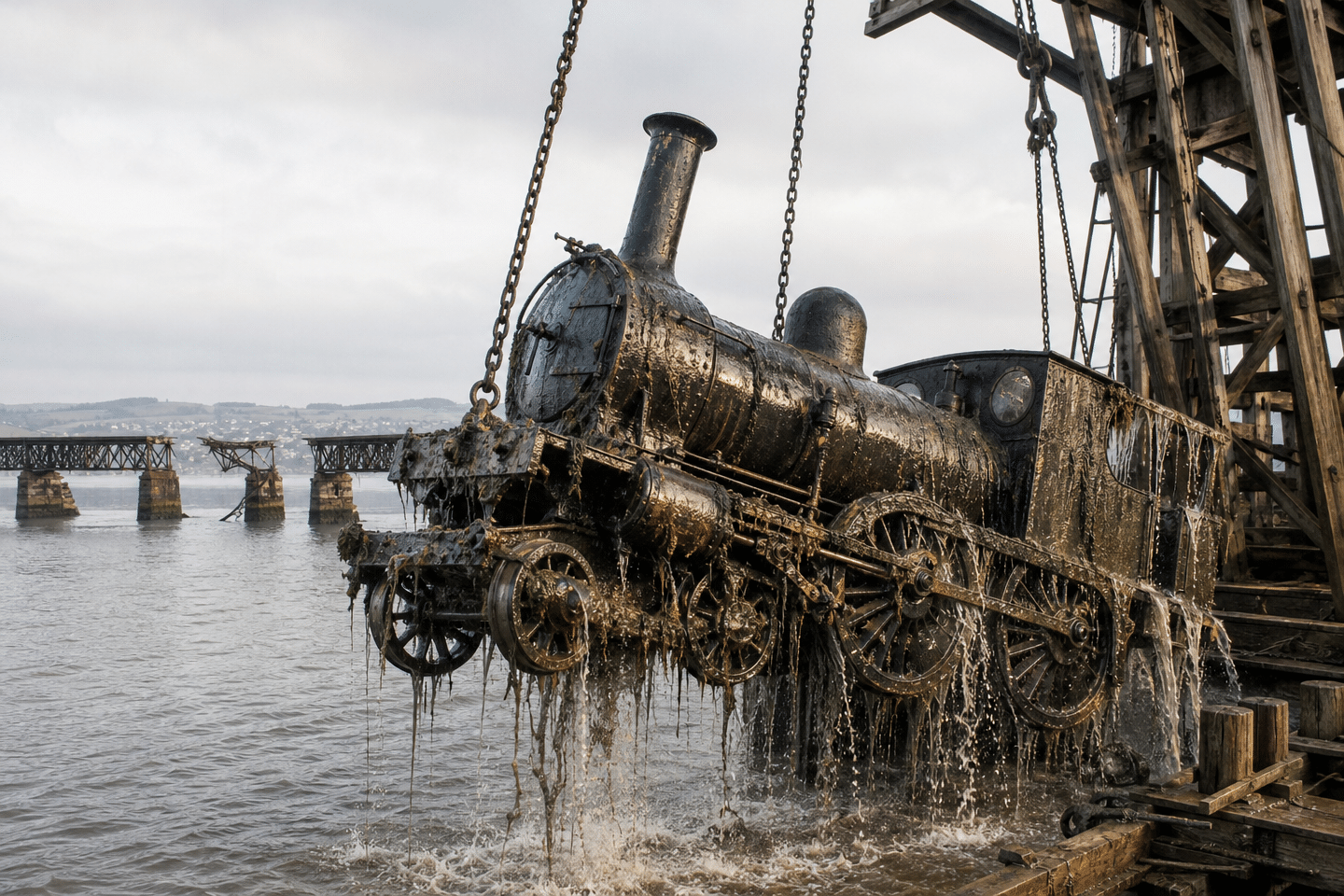
Imagine a bridge as long as thirteen football fields, swept by winds of over 100 kilometers per hour, that suddenly collapses beneath the weight of a train. This is precisely what happened in Scotland on a December evening in 1879. The toll was grim: there were no survivors. Yet the story does not end there, for the locomotive itself faced a fate that bordered on the improbable.
- On 28 December 1879, the central span of the Tay Bridge collapsed under a violent gale, sending a train into the icy waters and causing between 59 and 75 deaths
- Protected by the fallen girders as it fell, locomotive 224 was recovered after several attempts, repaired and returned to service by August 1880
- Called “The Diver,” the locomotive continued to operate until 1919 before ending up scrapped, like its sister 264, with no preservation
- A storm of the century turns a brand-new bridge into a deadly trap
- At the bottom of the Tay, a catastrophe that shakes Victorian railway engineering
- Recovered from the icy depths, locomotive 224 defies death for four decades
A Storm of the Century Transforms a Brand-New Bridge into a Deadly Trap
The Tay Bridge had existed for only nineteen months when tragedy struck. Designed by engineer Thomas Bouch, the structure spanned the Tay estuary for nearly three kilometres, linking the two banks near Dundee. At the time it was the longest railway bridge in the world, celebrated across Victorian Britain as a testament to technical progress.
That Sunday evening, a rare gale battered the region with extraordinary force. Contemporary observers estimated the wind at 10 to 11 on the Beaufort scale—a violent storm. The wind blew almost perpendicularly to the bridge, placing a heavy lateral load on its metal framework.
At 19:13, a North British Railway train set off across the bridge, connecting Burntisland with Dundee. Those on the banks watched as the train’s lights vanished abruptly, swallowed by the darkness. The central span had collapsed, taking the locomotive and carriages into the icy waters of the Tay.
At the Bottom of the Tay, a Catastrophe That Shook Victorian Rail Engineering
The human toll remains, even today, shrouded in a degree of uncertainty. Official records fix the death toll at 59, while some estimates place it as high as 75. This ambiguity stems from the exact number of passengers aboard—never fully confirmed—and from bodies that were never recovered from the river’s depths.
The inquiry that followed blamed a structural flaw in the bridge. The metallic pillars, ill-suited to resist such lateral stresses, lacked the robustness required to withstand a storm of this magnitude. The finding shook public confidence in Victorian railway engineering, long regarded as the pinnacle of technical advancement.
Even today, the remnants of the original piles rise above the Tay’s surface, beside the current bridge. In 2013, two identical gray granite memorials, each two metres tall, were unveiled in Dundee and Wormit, bearing the names of the 59 officially recorded victims.
Pulled from the Icy Depths, Locomotive 224 Defies Death for Four Decades
That night, locomotive no. 224 should not have been aboard that train. This 4-4-0, designed by Thomas Wheatley and built at the Cowlairs works in 1871, happened to be in reserve at Dundee. It was only recalled to haul the posted mail service after the usual engine from Ladybank failed.
Paradoxically, it was the very structure of the collapsed bridge that saved the locomotive. As the iron beams gave way, they formed a protective cavity around the falling train. An examination of the wreckage revealed that the brakes had never been applied and that the regulator was left open, suggesting the driver had not anticipated the impending disaster.
The salvage operation was far from straightforward. In April 1880, an initial effort failed when the lifting chains gave way under the weight. Two days later, a second attempt ended with the failure of the lifting gear. It took another week to finally raise the locomotive from the river, after which it was brought back to the Cowlairs works on its own wheels.
Repaired, No. 224 returned to service in August 1880 on the Edinburgh–Glasgow line, earning the evocative nickname “The Diver.” A curious crowd gathered in Edinburgh to witness its homecoming. Many fitters, superstitious by nature, refused to run it on the rebuilt Tay Bridge. Nevertheless, the locomotive continued to operate until 1919, nearly forty years after its plunge into the river.
Neither No. 224 nor its sister locomotive, No. 264, were preserved for posterity. They were scrapped after decades of loyal service, like many other engines of the era. All that remains are the stories and the archives, yet their saga continues to fascinate: a machine that survived one of the nineteenth century’s greatest rail disasters and returned, again and again, to the rails of Britain.
Sources :
- Remembering the ill-fated engine which plunged twice into the icy depths of the River Tay (The Courier)
- 224 class (steamlocomotives.org)
