
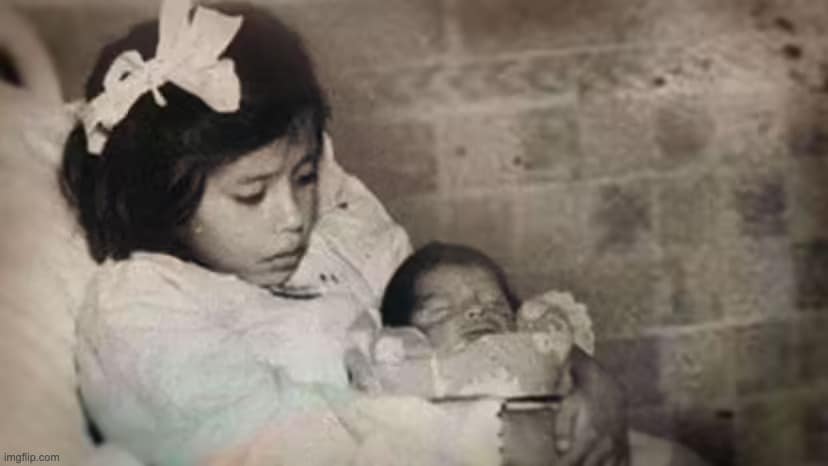
It was March 1939. A five-year-old Peruvian girl from a small village was brought to a local hospital because of a swollen belly. Her parents feared the diagnosis and quickly imagined a tumor. The reality would be far more surprising. After subjecting Lina to a full examination, the doctors announced the news: the little girl was seven months pregnant. Two months later, on May 14, 1939, she would give birth by cesarean to a healthy three-kilogram baby boy. She is the youngest mother in history.
“I’ve never seen anything like this”
Normal puberty typically begins between eight and thirteen years of age in girls, and between nine and fourteen in boys. However, in the case of precocious puberty, signs of sexual development can appear before these ages. Generally, they manifest before eight in girls and before nine in boys. It is a rare pediatric condition, affecting roughly one child in 5,000 to 10,000 people.
Even considering this rarity, Lina’s case represents an exceptional instance of extremely early puberty. “ Over the past decade, our hospital has encountered precocious puberty in four children aged 2 years or younger, but nothing like this notorious case,” remarks Dr Erica A. Eugster, pediatric endocrinologist at Indiana University School of Medicine. ” Here, according to a report, Lina would have started her periods at eight months old. This would be the earliest case of precocious puberty ever recorded. I have never seen anything like it,” the doctor continues.
Dr. Gerardo Lozada, who first examined Lina in the city of Pisco, had reported the case to the Lima Academy of Medicine. The girl’s case was later confirmed by Edmundo Escomel, a member of the French Academy of Sciences, and then by the Deputy Surgeon General of the United States Public Health Service. According to him, the little girl, who reveals the most astonishing case he had ever encountered in his career, appeared to be more interested in playing than in having a child.
How can her case be explained?
Most instances of precocious puberty are “idiopathic.” This means there is no known cause.
However, rarer cases of extraordinarily early puberty have been linked to a benign brain tumor known as a hypothalamic hamartoma. This type of tumor develops in the hypothalamus, a region of the brain that controls the pituitary gland. The latter is responsible for producing and releasing a wide range of hormones, including those that regulate sexual development.
The hard question: who is the father?
Once this case became public, several media outlets asked Lina to identify the father of her baby. However, she was never able to provide precise answers. Her own father was briefly detained on suspicion of incest, which he vehemently denied, but he was released. Nevertheless, one thing is certain: the young girl was clearly a victim of sexual abuse.
The Medina family eventually returned to their village to escape the press and medical authorities. An American pediatric psychologist was able to examine Lina briefly two years later. He noted “a superior intelligence” in the girl, while her baby, named Gerardo in honor of the physician who treated him, grew up entirely normally.
At the time, she also regarded her son as a little brother. According to some accounts, he would not have learned that Lina was his mother until the age of 10, following the taunts of his classmates.
In adulthood, she is said to have worked as a secretary for Dr. Gerardo Lozada, who had delivered her. She is said to have later married and welcomed a second child in 1972 at the age of 38. Finally, her first son, Gerardo, is said to have died in 1979 from bone cancer at the age of 40. It is not known whether his mother is still alive today.
In conclusion, the story of Lina Medina, the youngest mother in history, remains one of the most enigmatic and troubling medical cases ever documented. This extraordinary instance of extreme precocious puberty not only challenged the medical knowledge of its time but continues to arouse curiosity and emotion. If this situation reveals the harsh reality of sexual abuse, it also underscores the limits of our understanding of biological anomalies. Lina Medina’s life, marked by extraordinary events from a very young age, stands as a poignant reminder of the mysteries and injustices that can occur, even in the most unexpected corners of human life.
