
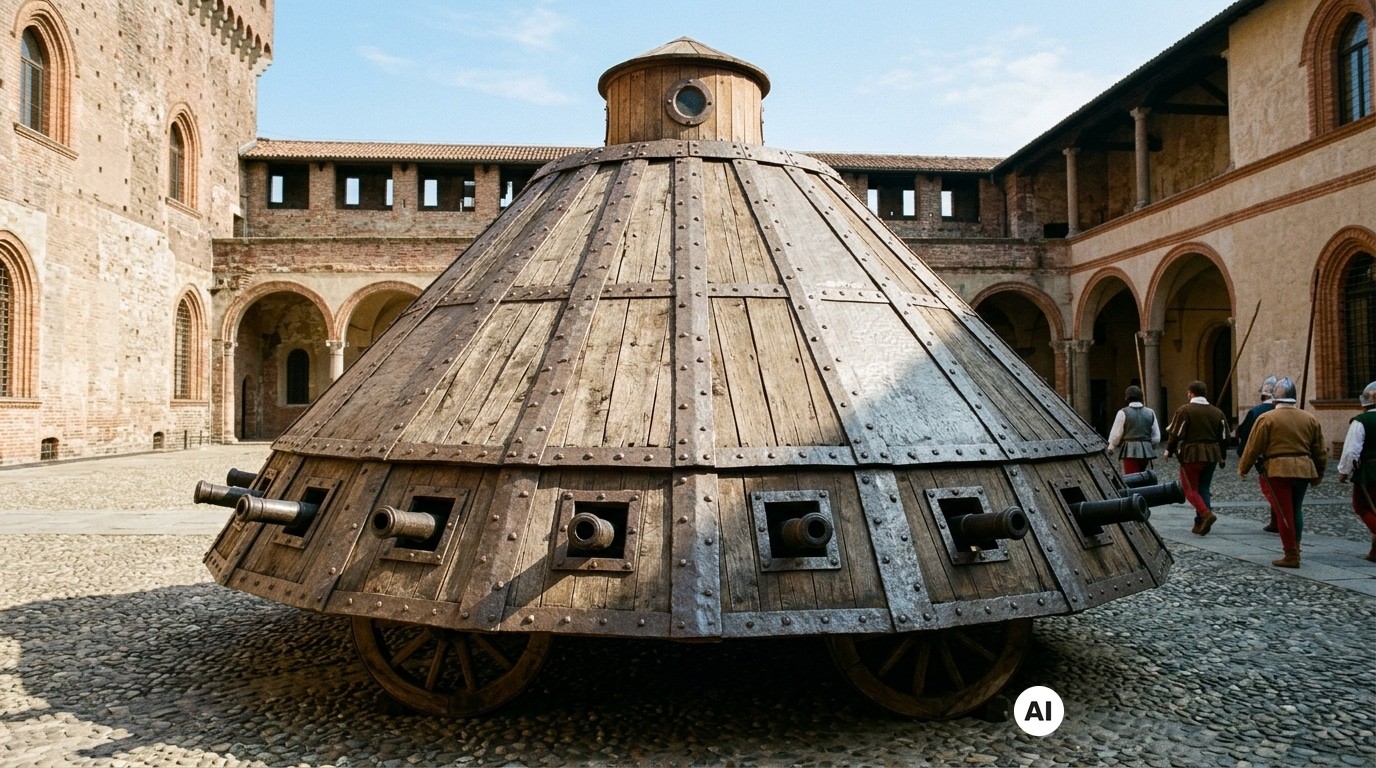
Imagine an armored assault tank designed by one of history’s greatest geniuses, only to discover that it could never move more than a single inch: that is the paradox hidden in a drawing that is over five centuries old. Leonardo da Vinci slipped a technical detail into it that continues to intrigue historians and engineers.
A crank-powered tank that could never roll
We are around 1487. Leonardo da Vinci then works under the patronage of Ludovic Sforza, regent of Milan, who hires him, among other tasks, to conceive war machines. It is within this framework that he sketches in brown ink an unusual armored vehicle shaped like a shell, intended to sow terror on a battlefield.
The drawing is today housed at the British Museum, under inventory number 1860,0616.99. The sheet shows several studies of tank-like machines, including a version drawn by horses and equipped with fake rotor blades at the front. A formidable sketch on paper, designed to terrify the enemy ranks.
Leonardo had even considered using the power of horses to move the contraption. He ultimately abandoned this path, fearing that the animals would panic once confined inside such a cramped and armored space. A fairly logical worry when one imagines the racket and the darkness reigning inside a hull like this.
The final solution relied on human strength. According to the French reference sheet devoted to this invention, eight men placed inside the tank were to operate a crank system connected by gears to the four wheels. An ingenious principle, at least on paper.
The detail of the gears that betray Leonardo da Vinci
It is by studying the mechanism in detail that the problem becomes apparent. In the plan, the gears linking the front wheels to the rear wheels are arranged in the reverse order. The concrete result: the front and rear wheels would turn in opposite directions relative to one another.
Imagine pushing a car whose front wheels want to move forward while the rear wheels strive to go backward. The vehicle would simply be stuck in place, regardless of the energy exerted by the eight men tasked with turning the crank.
An article published by The Conversation in 2025 cites precisely this case among Leonardo’s projects that fail when attempted to be reconstructed identically. The author points to the gears of the armored vehicle, which would spin the front and rear wheels in opposite directions.
The American museum The Henry Ford concurs. Its analysis adds a second obstacle: the machine would have been far too heavy to be moved by only eight men, even with a correctly arranged gear system.
Why some historians speak of deliberate sabotage
Faced with an error this blatant, it’s hard to believe it results from mere carelessness. Leonardo da Vinci was a technical draftsman of astonishing precision, capable of representing far more complex mechanisms without error.
On the drawing kept at the British Museum, the arrangement of the gears indeed blocks the vehicle when cranked. Some historians see a deliberate mistake, intended as protection against theft of the invention or its misuse by an unscrupulous rival.
This interpretation is far from trivial. Leonardo regularly wrote in mirror in his notebooks, making his notes difficult to decipher for an untrained eye. Embedding a technical flaw in a military plan would fit the same logic of safeguarding his ideas.
The proof that the flaw was not insurmountable came much later. In the documentary The Machines of Leonardo da Vinci, broadcast in 2009, a team of engineers and craftsmen rebuilt the armored tank by simply correcting the order of the gears. The vehicle then rolled with ease.
This case perfectly illustrates Leonardo da Vinci’s personality, as brilliant a engineer as a wary strategist. For enthusiasts who want to delve into such mysteries, the Leonardotheka platform, launched recently after ten years of work between the Museo Galileo in Florence, the Royal Collection Trust, the Biblioteca Ambrosiana and the Biblioteca Leonardiana, now gathers a large portion of his writings and drawings for free consultation.
Sources: From Sketch to Sky: How Leonardo da Vinci Thought Like an Inventor (thehenryford.org) | Model-Leonardo da Vinci’s Armored Vehicle (leonardodavinci.stanford.edu)
Article prepared with the help of AI · Our method
