
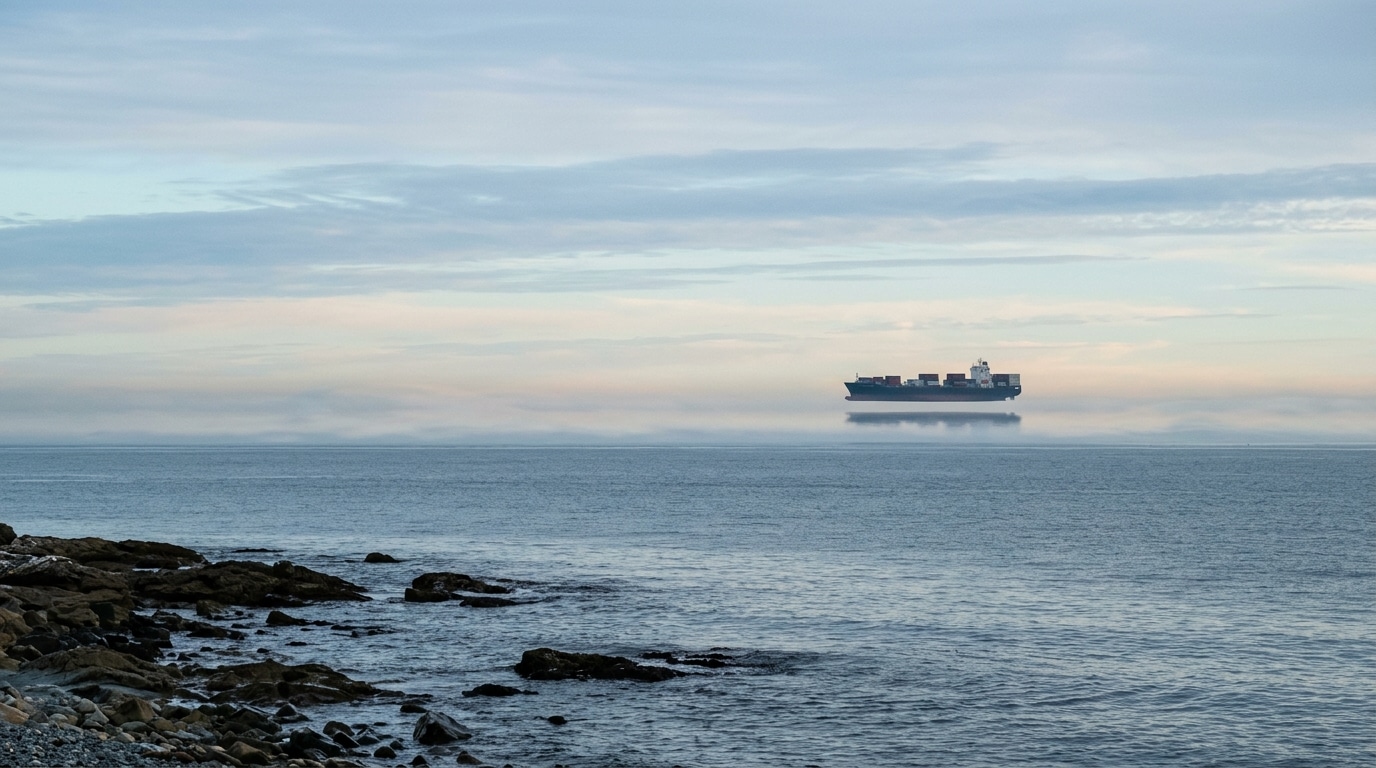
A ship seems to float above the sea, as if suspended in the air. No editing, no effects from waves or camera tricks: this strange scenery has a precise name, the superior mirage. It happens when air layers near the surface and higher up display markedly different temperatures. Light, instead of traveling in a straight line to our eyes, curves and distorts the image of distant objects. This optical phenomenon is far from supernatural; it obeys well-known physical laws, but it remains as striking to observe as ever, especially when we don’t know what lies behind it.
- The superior mirage occurs when a layer of cold air near the ground is topped by warmer air, bending light and making distant objects appear suspended above the horizon.
- This phenomenon is typically observed over frozen lakes, seas, or snowy terrain, and not on hot roads.
- The inferior mirage, more common, happens in the opposite way on hot ground and creates the illusion of a puddle on the road by refracting light.
- Light bends when the air abruptly changes temperature
- Cold air near the ground makes ships appear to float above the horizon
- The inferior mirage also deceives our eyes, but in the opposite sense
Light bends when the air abruptly changes temperature
To understand a mirage, one must first accept a simple idea: light does not always travel in a straight line. When the air near the ground has a temperature very different from the air just above it, the light rays alter their path. This bending creates distorted or displaced images of distant objects, which then appear to float, stretch, or split. It is a purely optical phenomenon, tied to the density of air, which varies with temperature. A mirage is never an illusion created by the camera or by trickery, it is light itself that takes an unusual route before reaching our eyes.
Cold air near the ground makes ships appear to float above the horizon
The superior mirage appears in a very specific setup: a layer of cold and dense air remains near the surface, while warmer air lies above. This temperature inversion bends the light so that distant objects, such as ships, coasts, or buildings, look stretched, stacked, or literally suspended above the horizon. It’s not the object that moves, but its image that reaches the observer in a different way. The World Meteorological Organization notes that this kind of mirage can appear over a cold surface topped by warmer air, making certain elements appear distorted, doubled, or even visible when they would normally lie beneath the horizon line. These cold mirages are typically observed over frozen lakes, oceans, or snowy terrains, far from the hot roads often associated with the word mirage.
The inferior mirage also deceives our eyes, but in the opposite direction
If the superior mirage captivates with its unexpected side, the inferior mirage remains the most common and familiar. It is seen on hot roads or in deserts, where the ground strongly heats the air just above it. This hot, less dense air curves the sky’s light upward, creating the illusion of a shimmering puddle on the pavement. This water, however, does not truly exist, it is only refracted light that disappears as you approach. The mechanism is therefore inverted compared to the superior mirage, but the result is the same: our eyes perceive an image that has no real counterpart at that exact location. These two phenomena illustrate how much the air’s temperature shapes our visual perception of the world around us.
Understanding these two types of mirages allows us to look at the sky and the horizon with a more attentive eye. The next time a ship seems to lift off above the sea or a road appears wet under the sun, it will suffice to remember that the air’s temperature, and not some trick, is the source of this illusion. Weather indeed holds many visual surprises, and these plays of light remind us that the atmosphere around us is far from as transparent as we might think.
👉 A small favor for Space Group? Follow us on Google, add us to your favorites, and find us on Google News so you don’t miss any discoveries.
