
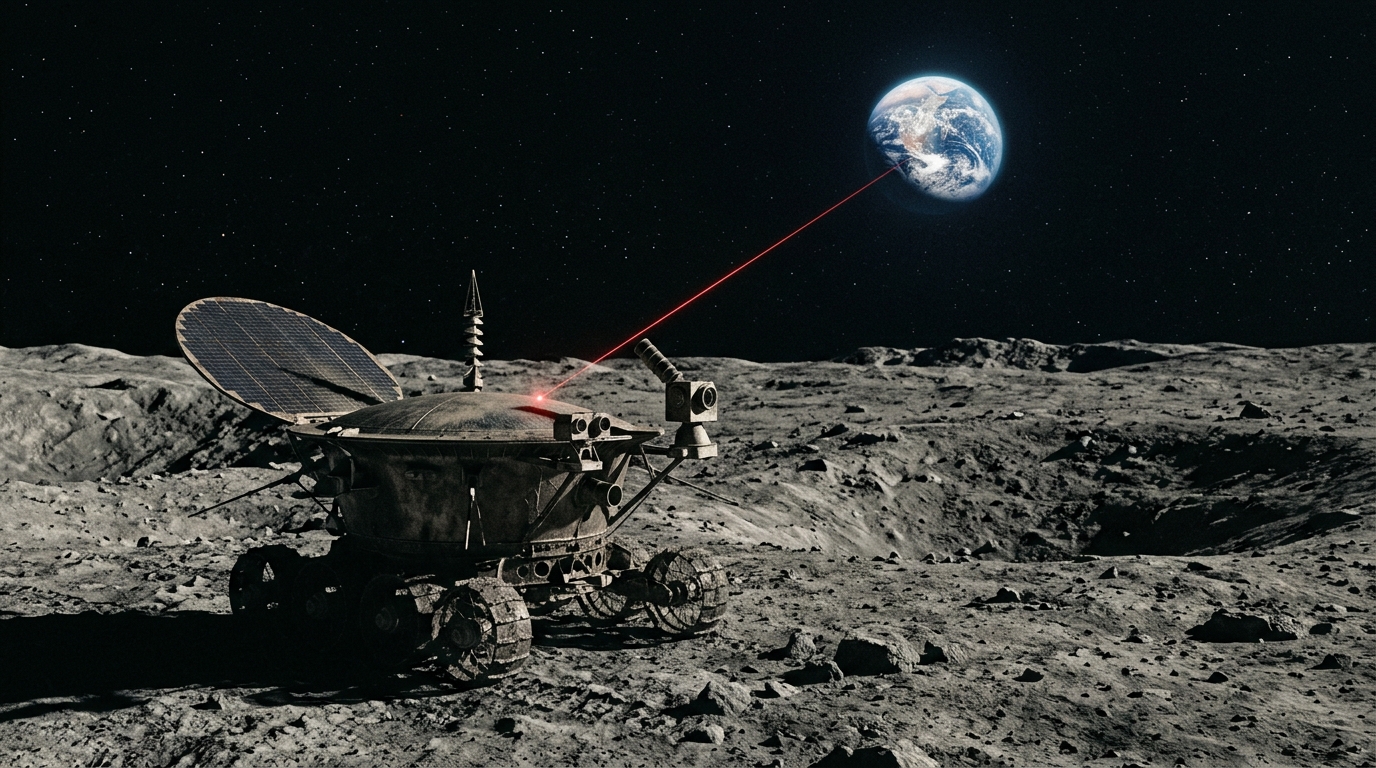
Eight hundred and forty kilograms of Soviet metal lie motionless on the Moon for more than fifty years, and yet researchers keep firing laser beams from Earth. The idea may seem almost ridiculous: why bother aiming at a dead craft abandoned in the Sea of Showers since 1971? The answer rests on a detail that almost no one anticipated at the time—a small accessory attached to the rover’s front, which, without ever needing electricity, continues to respond whenever it is probed from our planet.
- The Lunokhod 1 rover, immobilized since 1971 in the Sea of Showers, carries a French fourteen-prism retroreflector that still works without electricity
- Lost for nearly forty years, the device was relocated in March 2010 thanks to imagery from the Lunar Reconnaissance Orbiter, enabling a successful laser shot in April from the Apache Point Observatory
- This reflector, better preserved than Lunokhod 2’s, now serves as a precise Earth–Moon distance reference and a test for general relativity
- A Ghost Robot That Has Never Truly Stopped Serving
- The Mystery of Its Location Lost for Decades
- The Reflector Technology, a Mirror That Defies Time
- What Science Is Still Learning Today from a Silent Machine
A Ghost Robot That Has Never Really Stopped Serving
Lunokhod 1 touched down on the Moon in November 1970, deployed by the Soviet Luna 17 lander into a vast gray plain named the Sea of Showers. This six-wheeled rover, conceived during the heat of the space race, travelled roughly ten and a half kilometers across the lunar surface before radio silence settled in after the Moon’s sunrise in September 1971. Officially, its mission ended in early October of that same year, after attempts to recontact it following the long lunar night proved unsuccessful.
One might think the story was finished—a static relic of the space era, frozen in lunar dust for eternity. Yet Lunokhod 1 did not entirely vanish from scientists’ attention. The rover carried, in fact, a discreet device—a small glass plate composed of fourteen cube-corner prisms—capable of reflecting light precisely back toward its source. This retroreflector, by design, never required power to function.
The Mystery of Its Location Lost for Decades
There was, however, a major snag: knowing where to aim. For nearly forty years, Lunokhod 1’s exact position remained a mystery. The rover hadn’t been destroyed, nor forgotten in the strict sense, but pinpointing it with the precision needed to hope for a laser return from Earth proved effectively impossible. A gray needle in an even greyer haystack.
The turning point came in March 2010, when a researcher identified both the Luna 17 lander and the rover in images captured by NASA’s Lunar Reconnaissance Orbiter. A mere month later, in April of the same year, an American team based at Apache Point Observatory in New Mexico attempted the shot—aiming at that gray plain with no certainty of success. The pulse hit the target on the first attempt, returning nearly 2,000 photons, a result so clear that it surprised the researchers themselves.
The Reflector Technology, a Mirror That Defies Time
What makes this tale especially delightful is the origin of this providential little mirror: it was made in France, then mounted on a Soviet rover amid the Cold War of technology. A detail that gains extra resonance when you consider that a second reflector, affixed to Lunokhod 2 a few years later, has degraded more over time—likely due to the buildup of lunar dust and the repetitive cycles of extreme heat and cold that sweep the Moon’s surface.
The Lunokhod 1 reflector, having remained more shielded from these thermal swings, withstood the decades better. It is, in fact, the older of the two Soviet mirrors that has proven to be the more effective today. A member of NASA’s laser-altimetry team even described the achievement of recovering so many photons from a location that had remained unknown for so long, at a distance nearing 384,000 kilometers, as a remarkable feat.
What Science Is Still Learning Today from a Silent Machine
Since its rediscovery, Lunokhod 1’s reflector has served as a precise reference point for measuring Earth–Moon distance to the one-centimeter level, giving scientists a fifth reliable landmark on the lunar surface. These ultra-precise measurements continue to enable tests of general relativity, the theory formulated more than a century ago by the German-born physicist who needs little introduction.
So the situation reads almost like a novel when you reflect on it: a rover built by the Soviet Union in the late 1960s, equipped with a French mirror, silent for half a century, now functioning as a precision instrument for American physicists stationed at a New Mexico observatory. The rover itself has never revived—no signal, no movement since its last lunar night. Only its reflector, this purely optical and passive component, endures, patiently and silently responding to every laser pulse sent from Earth.
There is something vertiginous about this involuntary collaboration among three nations and two eras, gathered around a simple, immobile mirror resting on a lunar plain for decades. Lunokhod 1 will never roll again, but as long as a laser can still strike its fourteen tiny prisms, a part of it remains in dialogue with the Earth. It invites us to wonder how many other technological relics scattered across our solar system might also be waiting to be found one day.
