
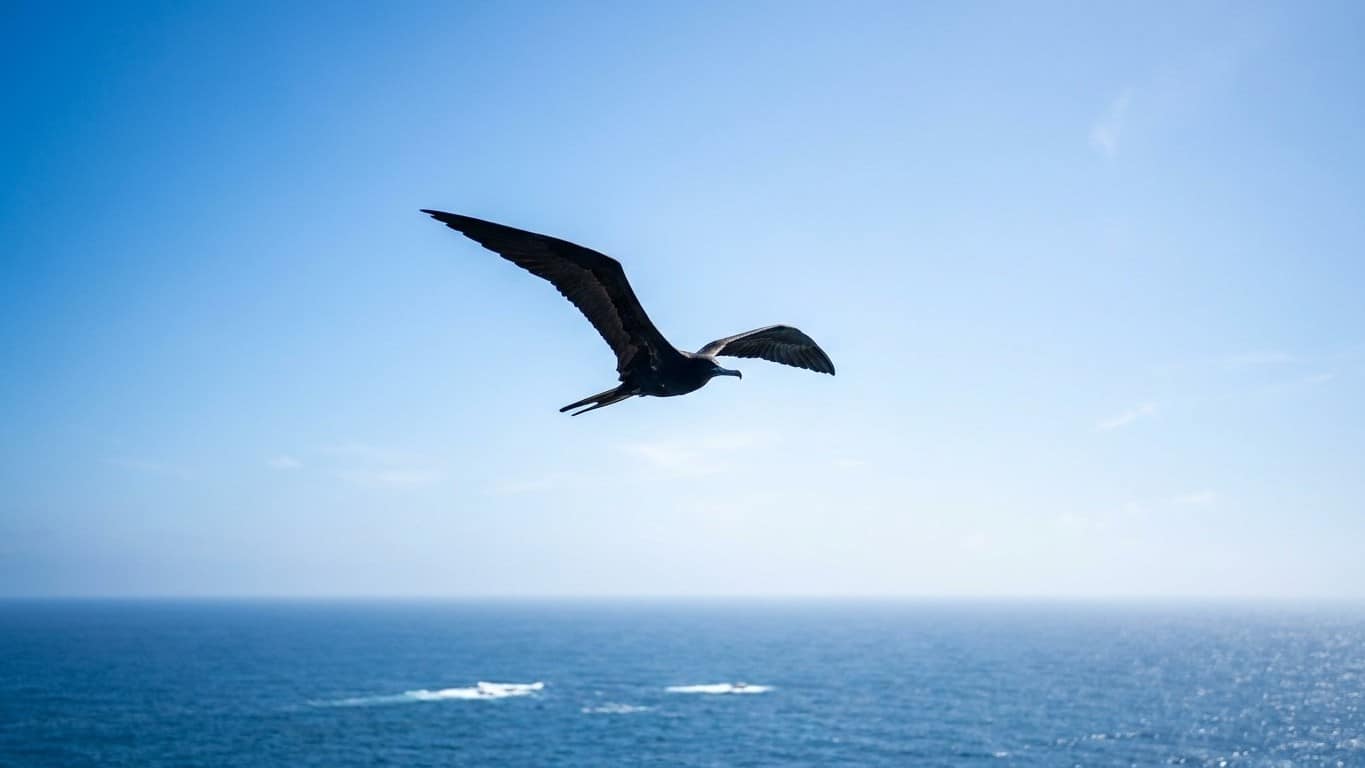
Forty-two minutes. That’s all the Pacific frigate—also known as the Pacific frigatebird—gives itself in a full day of flight, even though it can glide for weeks without touching water or land. Using miniature electroencephalograms placed on wild birds, researchers at the Max Planck Institute for Ornithology have finally pierced the mystery of one of the strangest behaviors in the animal kingdom: how an animal can fly for months without truly sleeping, and above all, what the brain is doing during that time.
Key takeaways
- How can a bird stay aloft for months while sleeping barely an hour a day?
- Its brain splits in two: one half sleeps deeply while the other steers the aircraft
- Researchers find that some animals completely ignore sleep rules that ought to kill them
A brain that splits in two to survive in flight
The Fregata minor, or Pacific frigatebird, belongs to that small group of seabirds capable of staying in the air for extreme stretches, feeding on flying fish and squid hunted at the ocean’s surface. Pacific frigatebirds are renowned for their ability to fly for weeks without alighting, soaring across thousands of kilometers while minimizing wing beats to conserve energy, allowing them to endure more than two months during transoceanic migrations. A prolonged flight that raised a superficially simple question, but one that remained unanswered for decades: do these birds actually sleep while midair?
To answer, a team led by Niels Rattenborg, at the Max Planck Institute for Ornithology, traveled to the Galápagos Islands. The researchers tracked the brain activity of 15 frigatebirds over ten days and nearly 5,000 kilometers, using sensors so light they did not hinder the birds’ flight. The measurement device, including its batteries, weighed just twelve grams—barely a fraction of the birds’ body mass, which can reach about 1.5 kilograms. This technical feat enabled, for the first time, the direct recording of activity from both cerebral hemispheres of a bird in flight above the sea.
The results, published in the journal Nature Communications in 2016, confirmed what scientists had long suspected but never proven: frigatebirds can sleep with only one hemisphere at a time, or with both hemispheres simultaneously. Concretely, while half the brain drops into slow-wave sleep, the other half remains awake, connected to the eye that monitors the flight direction. When the birds turned in rising air currents, the hemisphere linked to the eye oriented toward the turn tended to stay awake while the other slept, suggesting the animal literally keeps looking where it’s going even while halfway asleep.
Twelve-second micro-naps slipped into the updrafts
Midair sleep is nothing like a night’s rest. On average, frigatebirds sleep only about 42 minutes per day, in episodes averaging 12 seconds, the longest uninterrupted spell lasting just under six minutes. Essentially, these are more like eyelid blinks than true rest phases. These micro-naps occur almost exclusively during gliding flight when the bird circles within a thermal lift and does not need to flap its wings.
Even more surprising: sleep doesn’t stop at a one-hemisphere version. Frigatebirds have also exhibited bilateral sleep, in which both brain hemispheres sleep at the same time, the bird literally flying blind with both eyes closed. This finding surprised the researchers themselves, who had thought that only unihemispheric sleep could preserve aerodynamic control in flight. The presence of sleep on both sides at once shows that this mechanism is not a prerequisite for staying aloft without crashing.
Another unexpected discovery: these birds occasionally experience brief episodes of REM sleep, lasting only a few seconds. REM sleep—a stage in mammals associated with dreams and a near-total loss of muscle tone—also appears in a bird gliding hundreds of meters above the sea with wings outstretched. How the frigatebird avoids losing control during these brief moments remains, for now, largely unclear.
The great catch-up upon returning to land
The contrast becomes almost comic once the bird returns to land. On the ground, the animals slept more than 12 hours, with longer, deeper sleep phases (an average of 52 seconds). Moreover, they paid back the sleep debt accumulated at sea, much like a human compensating for a sleepless night with an extended snooze the following morning. The birds seem to repay the sleep they’ve forfeited at sea, just as we do, humans.
Yet this chronic sleep deficit in flight is not without consequence. Frigatebirds sleep in flight for only 0.69 hours per day, or 7.4% of the time that they devote to sleep when perched, indicating that the ecological demands on attention far exceed what a unihemispheric sleep can provide. Staying vigilant for obstacles and opportunities for feeding is so costly in terms of attention that the bird would rather sacrifice rest than its safety. A choice that, in any mammal, would result in cognitive decline within a matter of days.
That is precisely the puzzle that captivates sleep neuroscience researchers today. Laboratory studies have shown that pigeons can remain awake for weeks without obvious health issues, unlike rats that perish under similar conditions, suggesting that some birds clearly escape the brain’s typical sleep-deprivation syndrome. Understanding why a frigatebird endures weeks of fragmented sleep without apparent harm—where a few sleepless nights can derail memory and mood in humans—could redraw what science believes about the real functions of sleep and what happens in our own brains when we close our eyes.
Sources: slate.fr | nature.com
