
Imagine having to install an ultra-sensitive scientific instrument more than a kilometer beneath the surface of a lake, in one of the coldest regions on the planet. The problem is that open water makes this operation nearly impossible: no ship can stabilize tons of cables and sensors at such depths without an endless, costly logistical ballet. The solution found by Russian physicists hinges on one word: ice. For several years, a team of researchers has taken advantage of the ice covering Lake Baikal to lower, each winter, clusters of glass spheres designed to hunt down the most elusive particles in the Universe, neutrinos. As autumn settles in this 2026 season, teams are already preparing the next winter campaign, the one that will further enlarge this one-of-a-kind telescope, nestled in the Siberian depths.
- Each winter, Baikal Lake’s ice serves as a stable platform for submerging glass spheres that detect neutrinos via Cherenkov light
- After the 2025 campaign, Baikal-GVD comprises 14 clusters, 117 cables and 4,212 optical modules, for an effective detection volume of about 0.7 km³
- The telescope has confirmed a diffuse flux of astrophysical neutrinos and provided clues about a galactic origin as well as about the blazar TXS 0506+056
- Why ice is the only viable ally for this project
- Glass spheres to capture the invisible
- A neutrino telescope larger than stadiums
- What Baikal already reveals about the universe
Why ice is the only viable ally for this project
Lake Baikal, in Siberia, is the deepest and largest freshwater lake on the planet. Each winter, from February to April, its surface becomes a true ice highway, thick enough to bear the weight of trucks, winches, and kilometers of cables. It is precisely this window of time, and only this window, that scientists of the Baikal-GVD project have been eagerly awaiting. Drilling a hole in this frozen ice allows lowering equipment directly from a stable natural platform, without resorting to specialized ships or open-water operations, which are far more complex and costly.
This window of opportunity is extremely short on the scale of a project of such magnitude. Outside these few icy weeks, any intervention becomes impossible, which explains why the telescope has expanded in annual increments since 2015, the year of the first immersions. The very first complete set of sensors, nicknamed Dubna, was deployed in 2016, paving the way for a methodical expansion of the network, cluster after cluster, winter after winter.
Glass spheres to capture the invisible
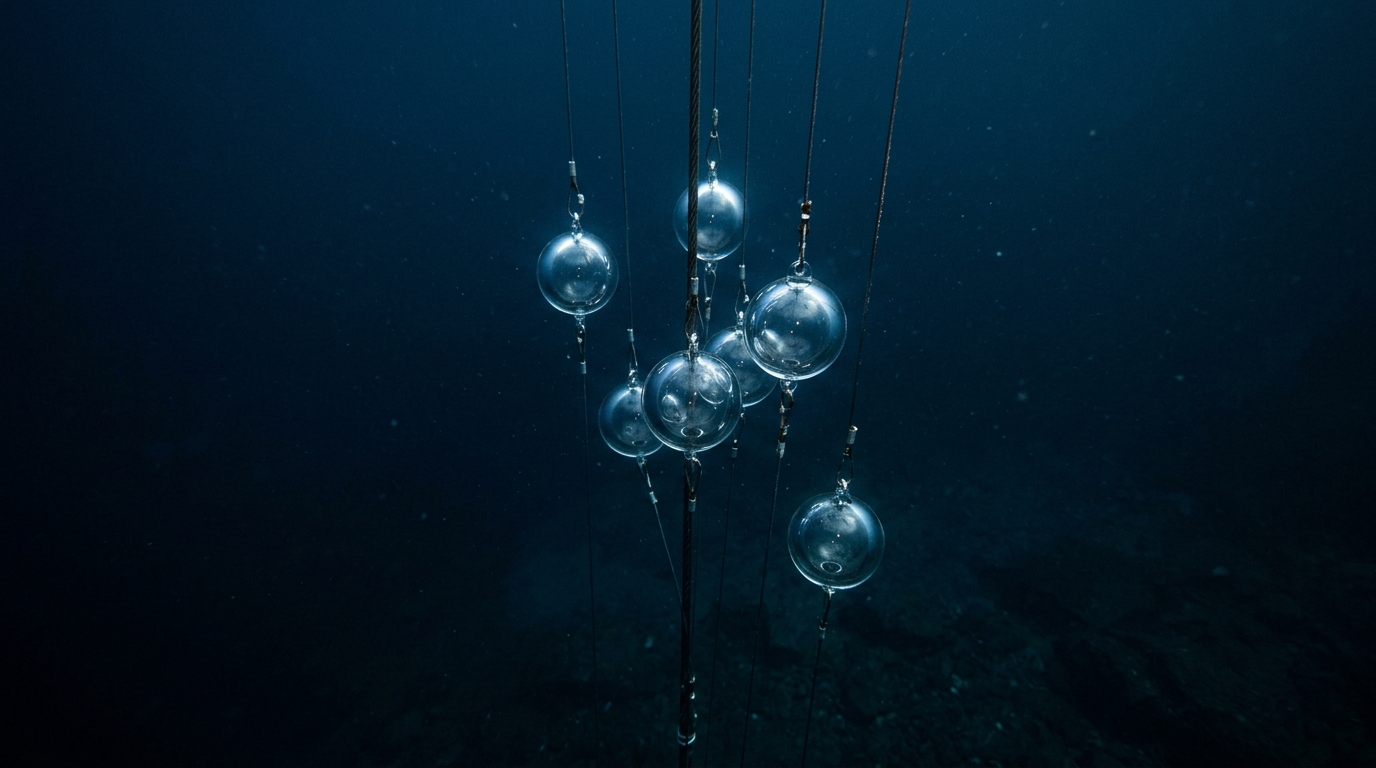
At the heart of this setup lie the optical modules, real glass spheres housing extremely sensitive light detectors. Their mission is to detect a phenomenon nearly imperceptible, Cherenkov light, a blue flash produced by charged particles resulting from a neutrino’s interaction with the lake water. These particles, rightly nicknamed ghost particles, traverse the Earth with virtually no obstacle, which makes their detection extraordinarily challenging.
These spheres are mounted along vertical cables, plunging between 750 and 1,275 meters depth, with a regular spacing of 15 meters between each module. Each independent unit, called a cluster, comprises 288 optical modules spread over eight cables, seven peripheral cables surrounding a central cable within a 60-meter radius. It is this repeated and tightly calibrated architecture that allows reconstructing, from the captured light flashes, the trajectory and energy of neutrinos arriving from the depths of the cosmos.
A neutrino telescope larger than stadiums
The official launch of what is now regarded as the largest neutrino telescope in the Northern Hemisphere took place in March 2021, a symbolic milestone for a project designed to last for many years. Since then, the installation’s growth has not slowed: after the 2025 winter campaign, Baikal-GVD consisted of 14 clusters linked by 117 cables and equipped with no fewer than 4,212 optical modules, for an effective detection volume of about 0.7 cubic kilometers.
To give a sense of scale, such a volume is the equivalent of hundreds of football stadiums stacked underwater, all instrumented to monitor the passage of invisible particles. The project’s final goal remains ambitious: to reach the symbolic threshold of one cubic kilometer of detected volume, a size that would place Baikal-GVD firmly among the world’s leading neutrino observatories dedicated to high-energy neutrinos, alongside its American cousin IceCube, installed at the South Pole beneath Antarctic ice.
What Baikal already reveals about the universe
This winter project, though discreet in the media, has already produced concrete scientific results. Baikal-GVD has confirmed, with a statistical significance greater than 3 sigma, the existence of a diffuse flux of astrophysical neutrinos, a phenomenon already detected by the IceCube telescope. This independent confirmation, obtained from the depths of Siberia, greatly strengthens the robustness of this discovery on a global scale.
Even more, the data collected have provided new clues in favor of a galactic-origin neutrino flux, i.e., produced by sources located within our very Milky Way. The telescope has also reinforced the suspicions surrounding the blazar TXS 0506+056, a particularly luminous active galactic nucleus, suspected of being one of the cosmic sources capable of generating these ultra-high-energy particles. All of these pieces, winter after winter, add to a scientific puzzle that remains far from complete.
This project beautifully illustrates how constraints can become a driving force: where others might have seen an insurmountable obstacle, Russian physicists turned the Siberian ice into a unique construction tool. Each new sphere submerged beneath Baikal’s ice brings researchers a step closer to a deeper understanding of the universe’s most violent phenomena, whether black holes, gamma-ray bursts, or active galaxies. It remains to be seen how many more winters will be needed before this giant of glass and water finally reaches its target volume of one cubic kilometer.
