
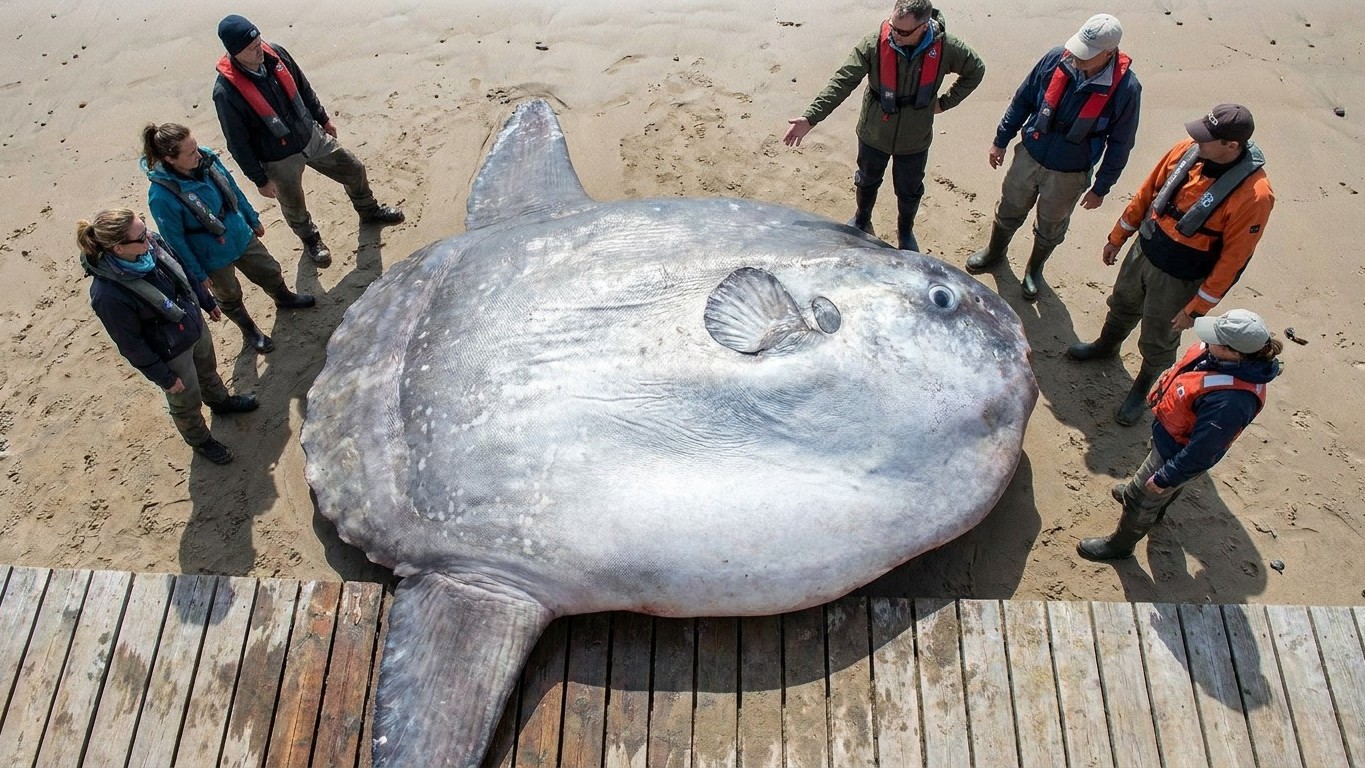
2,744 kilograms. The crane-scale used by researchers from the Atlantic Naturalists Association did not budge: this humpbacked sunfish stranded off the Azores in December 2021 is indeed the heaviest vertebrate with a bony skeleton ever measured. A record shattered with brutal force, since the previous champion weighed 2,300 kilograms, captured in Japan in 1996. Not a minor advance: a lead of more than 400 kilograms, the equivalent of an adult draft horse.
Key takeaways
- A bony-vertebrate record shattered by more than 400 kilograms
- A taxonomic muddle that has obscured the species’ true performance for decades
- The enigmatic traces of red paint on the carcass hint at a collision with a vessel
A floating carcass off Faial
In December 2021, José Nuno Gomes-Pereira and colleagues from the Atlantic Naturalists Association in Portugal spotted the carcass of a massive sunfish drifting near the coast of Faial island. The Azores archipelago, set in the middle of the North Atlantic, serves as a migratory corridor for countless forms of marine megafauna. Yet a creature of this size simply adrift at the surface is a rare sight. Members of the association dragged the carcass to shore to examine and weigh this impressive specimen.
The fish was weighed with a crane; the ventral area was dissected, and samples of skin with scales, muscle tissue, and the digestive tract were collected for deeper analysis. The measurements of this marine giant—3.25 meters in length and a mass of 2,744 kilograms—make it the heaviest bony fish ever found. The finding was confirmed and published in the Journal of Fish Biology. The researchers initially doubted their preliminary estimates; fishermen had spotted it in December, but the team did not initially trust their measurements. After weighing and measuring with a cargo-scale, they confirmed that this humpbacked mola discovered dead in the North Atlantic is indeed the heaviest bony fish ever observed.
Mola alexandrini, a species long confused with its cousin
There are three species of sunfish: Mola mola (the ocean sunfish or “crapet de mer”), Mola alexandrini (the humpbacked sunfish, or southern sunfish), and Mola tecta (the trompeur sunfish). For decades, the Mola alexandrini was filed away with the more common Mola mola—the species most divers encounter in the Mediterranean or the Bay of Biscay. The southern sunfish, also known as Ramsay’s sunfish or the southern ocean sunfish, belongs to the Molidae family. It was only recognized as a distinct species in 2018, but it remains closely related to the better-known Mola mola.
This taxonomic mix-up produced a direct consequence for records: earlier size records were frequently attributed to Mola mola, when in fact they were individuals of Mola alexandrini. The previous record was held by another fish of the same species, captured in Kamogawa, Japan in 1996, weighing 2.3 tons and measuring 2.7 meters in length. Two specimens of the same species, separated by 26 years and two oceans, have traded the title of the heaviest bony fish in the world. This discovery shows that Mola alexandrini can exceed twice the weight of its congener, the Mola mola, whose heaviest known specimen weighs 1,320 kilograms.
A behemoth without a tail or a true heavy skeleton
What astonishes about this fish is the persistent paradox between its weight and its biology. Far from being a freak of nature, it represents a sophisticated biological solution to the challenges of pelagic life: achieving colossal size, exploiting dispersed and deep-sea food resources, and reproducing massively, all without a heavy skeleton or a swim bladder. The Mola does not possess a true tail in the conventional sense. All species in the genus have a rounded body shape with a highly developed dorsal and anal fin used for locomotion. The tail fin is reduced to a simple band that links the dorsal and anal fins.
Moreover, the female holds the record for the number of eggs laid by a vertebrate at one time: 350 million. Three hundred fifty million eggs per brood. A number that seems staggering given that the same animal can reach nearly three tons. It is also the only known fish that seeks help from birds to help remove parasites. Lying at the surface, it attracts seagulls that peck at its skin parasites. This basking-at-the-surface behavior, on its side, is also linked to thermoregulation after dives into cold waters, and may help recharge oxygen reserves.
The diet of Mola alexandrini also challenges common assumptions. It is often imagined that it gorges on jellyfish as it drift-feeds, but the reality is more nuanced. The sunfish has a diet broader than previously thought: small fish, crustaceans, cephalopods… Jellyfish and salps account for only about 15% of its diet in the end.
The trace of red paint and the unanswered question
Scientists wanted to know how this animal died. The examination of the body revealed a large contusion, about 12 centimeters deep, on the right anterior side of the hump. Around this depression, the thick layer of subcutaneous collagen was soft for more than 20 centimeters, suggesting a fairly significant impact. The skin around the injury bore traces of brick-red paint, similar to that used on the hulls of ships. Was it a merchant vessel, a ferry between two islands, or a cargo ship? The team cannot determine whether the impact occurred before or after the animal’s death.
This mystery encapsulates the state of Mola alexandrini in our understanding of the oceans: a creature of exceptional size, only recently being distinguished taxonomically, whose causes of mortality remain unknown, and whose presence in the North Atlantic remains difficult to explain. Weighing 2,744 kilograms, this new world record among fish had previously been exceeded only by cartilaginous giants like the whale shark. The heaviest animal on Earth remains the whale shark, which can surpass 20 tons. That is about seven times the Azores giant. The hierarchy of oceanic giants still keeps a lead on our scientific certainties.
Sources: dailygeekshow.com | trustmyscience.com
