
There is a difference between a geological glacial period, lasting millions of years, and what people commonly call an ice age, with mammoths and smoke-filled caves. We are precisely living within a gentle interlude inside a glacial period. And according to a study published in Science, this interlude should have closed long ago.
- The next glaciation began about 2,000 years ago with the growth of the Barnes Ice Cap, a vestige of the Laurentide.
- The ice cap reached its maximum around 1960 before it suddenly tipped into a loss of mass due to the warming of summers.
- According to researchers, human-caused climate warming interrupted this natural glacial cycle and dooms this glacial vestige to disappear.
- A Glaciation Stopped Abruptly Two Thousand Years Ago
- Three Kilometres of Ice Vanished: The Geologists’ Investigation
- Climate Warming, a Phenomenon That Changed the Course of Geological Time
A Glaciation Stopped Cold Two Thousand Years Ago
Earth has never ceased to alternate between deep cold and tempered respite. Since the planet’s very ancient origins, at least five glacial periods have succeeded one another, with occasionally episodes of extreme glaciation that covered entire continents.
We are, technically, still within a geological glacial period. But for about 11,700 years, we have enjoyed a milder interglacial, the very one that saw the demise of a large portion of the fur-bearing megafauna.
That is where the study published in Science comes to shake our certainties. According to Nicolás Young, a geochemist at Columbia University and the lead author of the work, the next glaciation had indeed begun about 2,000 years ago.
“It had only just begun, everything looked normal—the next glaciation was about to occur, and yet it stopped,” summarizes the researcher. A sudden, and especially unexpected, brake in a mechanism that we believed to be perfectly cyclical.
Three Kilometres of Ice Vanished: The Geologists’ Investigation
To understand what happened, researchers turned their attention to the Laurentide Ice Sheet, nicknamed LIS. It was the largest glacial structure of the Pleistocene, ruling the northern part of the North American continent about 95,000 to 20,000 years ago.
At its height, this ice mass stretched from the Arctic Circle to Illinois. Its thickness could reach 3 kilometres, a figure that shows the colossal scale of what today remains only as a vestige.
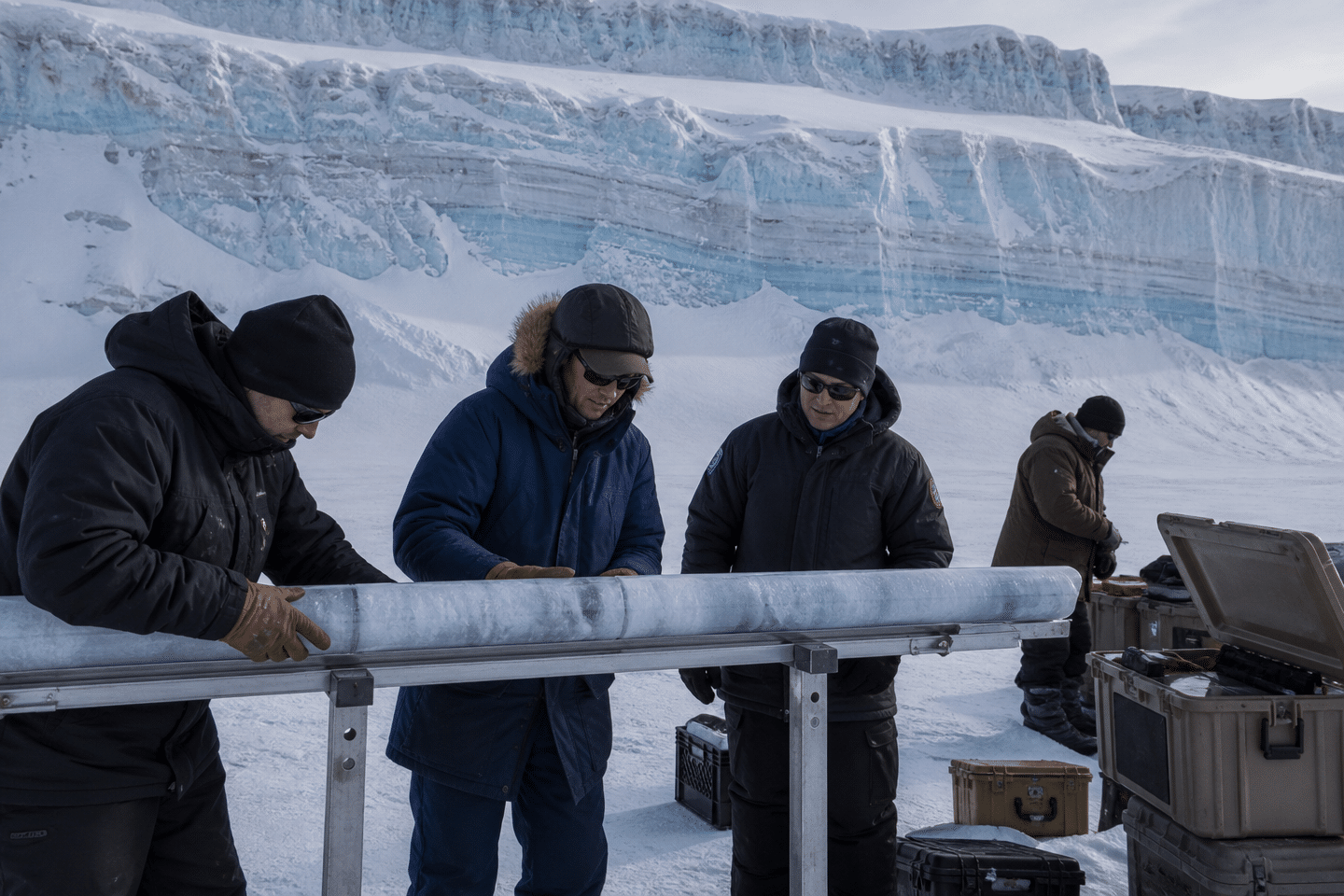
This vestige is the Barnes Ice Cap, or BIC, the last beating heart of this vanished glacial era. Its underlying rocky substrate was only exposed in the last decade, giving geologists an unprecedented window into the past.
To date this story precisely, the team cross-referenced two natural clocks. On one side, beryllium-10, an isotope that accumulates in rocks exposed to cosmic radiation and stops forming once ice covers them.
On the other, carbon-14, measured in the ancient vegetation revealed by the glacier’s retreat. A plant buried beneath the ice stops absorbing carbon, which allows us to know exactly when it disappeared under the advancing glacier.
By combining these two methods, the researchers reconstructed a precise chronology. The minimum extent was reached 3,600 years ago, a level lower than today, held until about 2,000 years ago.
Climate Warming, a Phenomenon That Changed the Course of Geological Time
It is precisely at that moment, 2,000 years ago, that the ice began to advance again. A signal which, according to the researchers, marks the theoretical starting point of the next glacial period.
This growth continued for centuries, in the wake of the cooling trend that has persisted for several millennia in the Northern Hemisphere.
The Barnes Ice Cap reached its historic maximum around 1960. Then, abruptly, the trend reversed. The warming of summers tipped the glacier into a negative mass balance: it now loses ice faster in summer than it reconstitutes it in winter.
This shift is not a matter of calendar happenstance. It coincides with the increasing accumulation of greenhouse gases in the atmosphere, a phenomenon begun with the Industrial Revolution, around 1750.
There is a striking paradox here. This industrial pollution began in the midst of the Little Ice Age, the coldest century of the coldest and most arid period in recent history, whose harshest episode stretched from 1450 to 1850.
According to researchers, the ice losses observed since 1960 can be explained almost entirely by higher summer temperatures. A mechanism that also affects other ice caps in the Canadian Arctic and the North Atlantic.
As for the future, models are unequivocal. Under current climate profiles, the last vestige of the Laurentide is doomed to disappear. “They will be the very last vestiges of the Laurentide, disappearing for good,” concludes Nicolás Young.
He sums up the magnitude of the observed shift this way: “What was an extremely natural and predictable phenomenon has now disappeared.” A natural cycle, interrupted by a single species.
This study, with rare precision, reminds us how human influence on the climate now exceeds the planet’s major natural rhythms. We have not only warmed the atmosphere: we seem to have erased an entire glaciation before it could take hold for good.
