
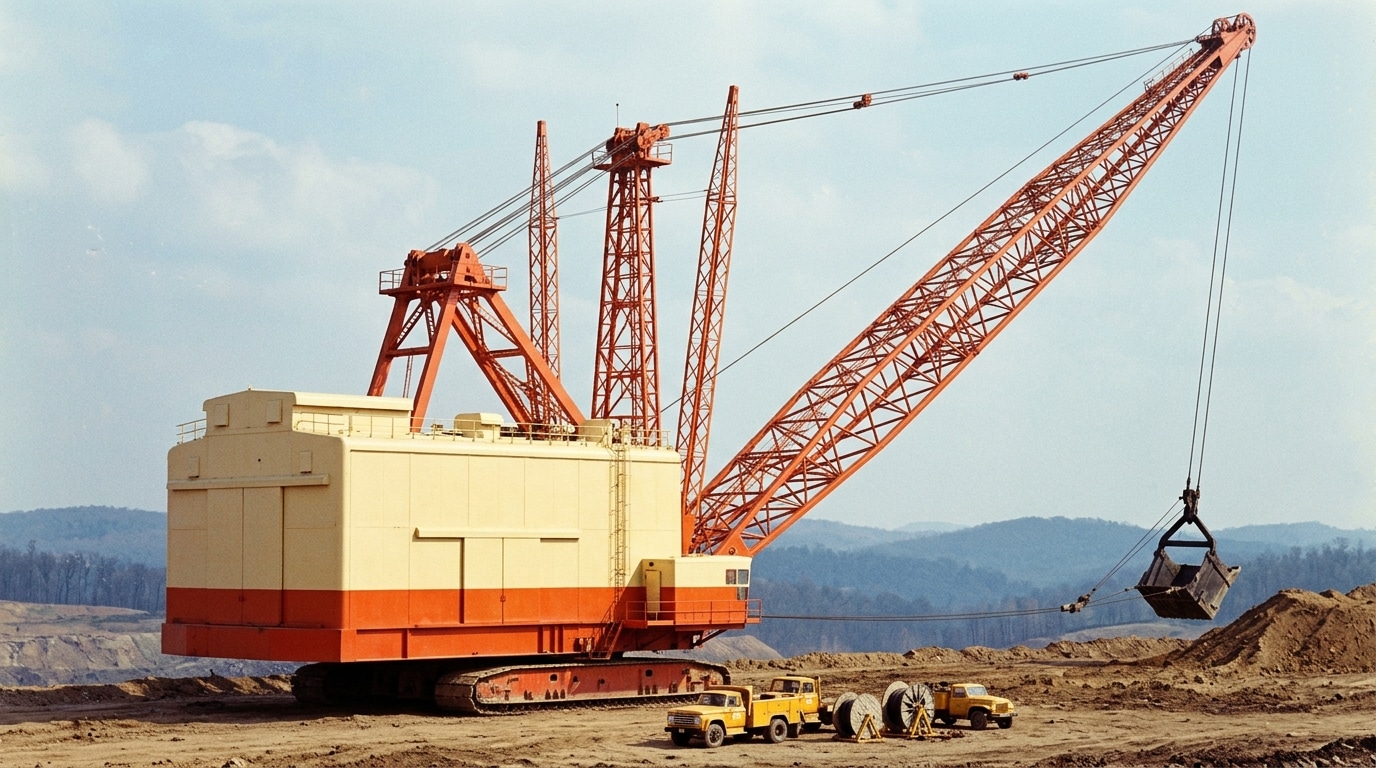
Big Muskie was a 13,500-ton walking dragline, built by Bucyrus-Erie and commissioned in 1969 in Ohio. This steel behemoth did not yield to wear: it was ultimately undone by an environmental law two decades later.
- Big Muskie, a 13,500-ton dragline built by Bucyrus-Erie, went into service in 1969 for the Central Ohio Coal Company in Ohio.
- The machine was halted in 1991 not due to wear but because of the 1990 amendment to the Clean Air Act, which rendered the sulfur-rich coal it mined obsolete.
- Dismantled after a failed museum project, only its 220-yard-cubed bucket was preserved and displayed at McConnelsville’s Miners’ Memorial Park.
- 13,500 Tons of Steel: The Industrial Bet of 1969
- Sulfur-rich Coal, the Real Reason for the 1991 Shutdown
- A 220-yard-cubed Bucket, the Sole Survivor at McConnelsville
13,500 Tons of Steel: The Industrial Bet of 1969
Big Muskie was not just any dragline. Model 4250-W from Bucyrus-Erie, it remains to this day the only unit ever produced of its kind. A one-of-a-kind machine, designed for a very specific need: to uproot the earth covering Ohio’s coal seams.
The figures are staggering. The machine measured 148 meters in length, 151 feet in width, and rose to 222 feet in height, roughly the same as a twenty-story building laid horizontally on tracks. Its total weight reached 13,500 short tons, about 12,247 metric tons.
It was the Central Ohio Coal Company that revealed this giant at the Muskingum mine in 1969, in front of dignitaries witnessing the birth of the world’s largest dragline. Its bucket alone held a capacity of 220 cubic yards and could lift up to 325 tons of earth per pass.
To operate such a behemoth, you needed a crew. Four teams rotated continuously to run the machine day and night, proving that Big Muskie was not a simple tool but a true pillar of local mining activity.
Sulfur-rich Coal, the Real Reason for the 1991 Shutdown
Contrary to what one might expect, it wasn’t a mechanical breakdown that halted Big Muskie. The dragline was still operating perfectly in 1991 when it was shut down. The issue lay elsewhere: the type of coal it was designed to extract.
Ohio’s subsurface was rich in sulfur-heavy coal. A potent fuel, but polluting. When the 1990 amendment to the Clean Air Act strengthened air quality standards in the United States, demand for this coal had already been on a decline since the 1980s.
Steve Hook, an executive at American Electric Power, confirmed bluntly: it was this act’s passage that forced the company to “park” the machine. No rust, no broken parts, just a market that disappeared.
For nine years, Big Muskie thus remained idle, abandoned on-site. Local supporters mobilized to try to save it and turn it into a museum. Dave Cator, director of the Byesville Economic Development Corporation, stated to the Zanesville Times Recorder in 1999 that four counties could unite to carry this project forward.
But AEP had to meet land restoration deadlines and feared liability risks associated with maintaining such a structure. The company ultimately enlisted an external firm to dismantle the machine, ending the museum project. The scrap yielded $700,000 in recycled metal, sold to Mayer-Pollock Steel Corporation.
A 220-Yard-Cubed Bucket, the Sole Survivor at McConnelsville
Not everything disappeared into recycling furnaces. The Big Muskie’s giant bucket—the very one capable of swallowing 325 tons of earth in one bite—was spared and moved to near McConnelsville, Ohio.
It is there that Miner’s Memorial Park was established, a site designed to recall the region’s mining history and the central role played by this extraordinary machine.
More recently, the Ohio Department of Natural Resources unveiled a new historical plaque at Jesse Owens State Park, honoring Big Muskie and the imprint it left on the American industrial landscape.
Commissioned in 1969 for Central Ohio Coal, it lost its market—the sulfur-rich coal of Ohio—and only its 220-yard-cubed bucket remains at Miner’s Memorial Park in McConnelsville. A symbolic end for a machine that never yielded to wear, yet could not withstand the evolution of environmental regulations.
The story of Big Muskie, in its own way, reflects a broader shift: an American coal industry reeled in by new ecological requirements. The dragline did not rust on its feet; it was simply outpaced by a regulatory context it had not anticipated, one that knew only earth, rock, and coal.
👉 A small gesture for Space Group? Follow us on Google, add us to your favorites, and find us on Google News so you don’t miss any discoveries.
