
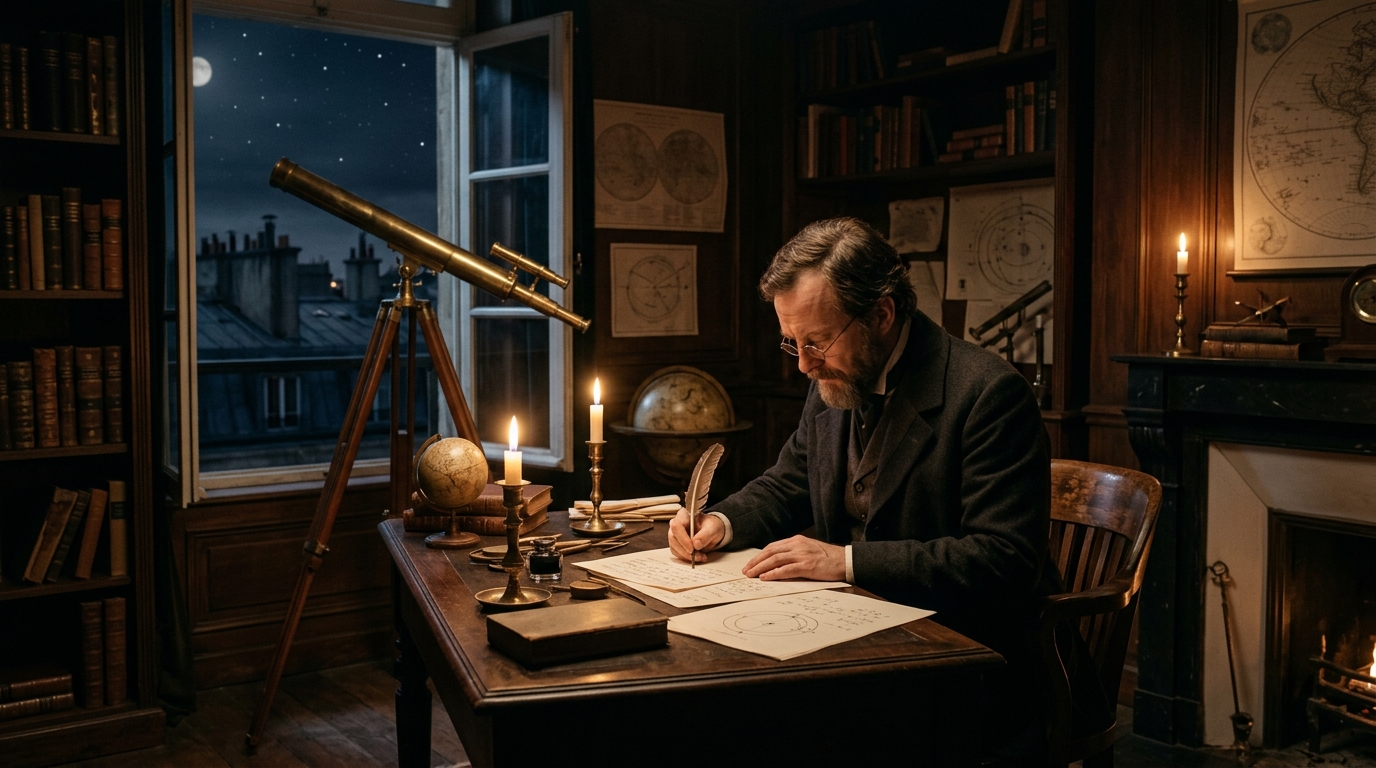
Picture the scene: in the chill of a late-summer Berlin night in 1846, an astronomer is patiently adjusting his telescope. He isn’t searching by chance, he isn’t sweeping the sky blindly. He holds a precise address, scribbled on a letter that came from Paris a few days earlier. Less than an hour after aiming his instrument at that exact spot, he discovers an entire world, a planet that no one had ever seen before. No stroke of luck, no fortunate accident: only mathematics, pushed to its limits by a Frenchman who himself had never laid eyes on this planet. That is how Neptune entered the history of astronomy.
- Anomalies in Uranus’s orbit led Urbain Le Verrier to calculate the position of an unknown planet purely mathematically, without ever observing it.
- On September 23, 1846, the astronomer Johann Gottfried Galle discovered Neptune in Berlin in under an hour, within less than a degree of Le Verrier’s calculated position.
- This discovery triggered a Franco-British dispute over scientific precedence, the Briton John Couch Adams claiming earlier calculations.
- When Uranus refuses to obey Newton’s laws
- The bold wager of a mathematician who had never looked at the sky
- Berlin, the night when paper defeated the telescope
- France snubbed, England furious: a discovery that nearly turned into a scientific war
When Uranus Refuses to Obey Newton’s Laws
It all begins with an anomaly that vexed nineteenth-century astronomers. The planet Uranus, discovered in 1781, did not behave as expected. Its trajectory deviated slightly, but persistently, from the predictions derived from Newton’s laws, which at the time were considered almost infallible. The French astronomer Alexis Bouvard, tasked with computing the ephemerides of this planet, hit a wall: it was impossible to reconcile calculation and observation. He then put forward a bold hypothesis for his era, that an as-yet-unknown celestial body, located further out in the solar system, would exert a gravitational attraction strong enough to perturb Uranus’s course.
This intuition, as appealing as it is, remained for the moment untestable. Bouvard did not push further, but he left behind a trail that other minds, younger and just as stubborn, would eagerly follow. For in the scientific world of the time, the idea that a planet could reveal itself only through the perturbations it imposed on its neighbor amounted almost to an intellectual revolution.
The Bold Wager of a Mathematician Who Had Never Looked at the Sky
This is where Urbain Le Verrier, a French mathematician, enters the scene, his talent for celestial mechanics destined to prove decisive. For nearly two years, he undertakes a monumental undertaking: to reconstruct, solely from equations, the exact position of a planet that no one had ever seen. No direct observation, no visual clue, only columns of numbers and endless hours spent correcting, refining, and restarting his calculations.
On August 31, 1846, he finally presents his conclusions to the The Academy of Sciences: according to him, an unknown planet lies about 4.5 billion kilometers from the Sun, and he specifies its precise location in the sky. A completely crazy bet in the eyes of many, since it entails asserting the existence of an entire world without ever having observed it, relying solely on the logic of mathematics. Le Verrier does not possess a telescope powerful enough in Paris to verify his own calculations. He therefore decides to write directly to a German astronomer renowned for his seriousness, Johann Gottfried Galle, at the Berlin Observatory.
Berlin, the Night When Paper Defeated the Telescope
The letter reaches Galle on September 23, 1846. Upon receipt, the German astronomer, assisted by his colleague Heinrich Louis d’Arrest, decides to attempt the experiment immediately. That very evening, the two men point their telescope toward the region of the sky designated by Le Verrier. In less than an hour, they spot an object that does not appear on any known star chart. It is Neptune, discovered within less than a degree of the theoretical position calculated from Paris, a gap so small that it borders on a miracle for the era.
Further historical analyses have even refined this result: viewed from Earth, the position calculated for that precise night lay only one degree behind the planet’s actual position, i.e., an offset of barely 52 arcminutes. To give an idea of this precision, it would be akin to predicting, from Paris, the exact location of a coin placed on a sidewalk several kilometers away. This discovery remains unique in the history of astronomy, because it is the only one to have been obtained entirely by calculation, without any prior observation. The success is resounding: Le Verrier becomes instantly famous around the world, a scientific glory rarely equaled.
France Snubbed, England Furious: a Discovery That Nearly Turned into a Scientific War
Yet Le Verrier’s fame did not win universal acclaim across the Channel. A young British astronomer, John Couch Adams, claims to have carried out similar calculations a few months earlier, but he failed to convince English astronomers to point their telescopes toward the area he had identified. This late revelation triggered a genuine dispute over scientific priority between France and England, each side claiming precedence. The debate, fueled by national pride in both countries, dragged on for years before history largely sided with Le Verrier, the only one to have actually enabled the observation of the planet.
Even the name of this new planet was contested for a time. Several proposals circulated, including Janus, Oceanus, or even Le Verrier itself, in honor of its discoverer. It was ultimately Neptune, the Roman god of the seas, who endured, consistent with the mythological tradition already used for the other planets of the solar system. Today, a statue of Le Verrier, crafted by sculptor Henri-Michel-Antoine Chapu in 1889, stands at the Paris Observatory, reminding all visitors that one day a man discovered an entire world without ever lifting his eyes to the sky.
This scientific adventure remains a benchmark rarely equaled in the history of science: the theory outpaced observation, calculation preceded sight. It invites us to ponder what the sole power of human reasoning can still achieve today, in an era when astronomical discoveries rely on instruments of unimaginable sophistication compared to Le Verrier’s time. The question persists, almost dizzying: how many worlds still await revelation somewhere, not by a telescope, but by a simple sheet of paper covered in equations?
