
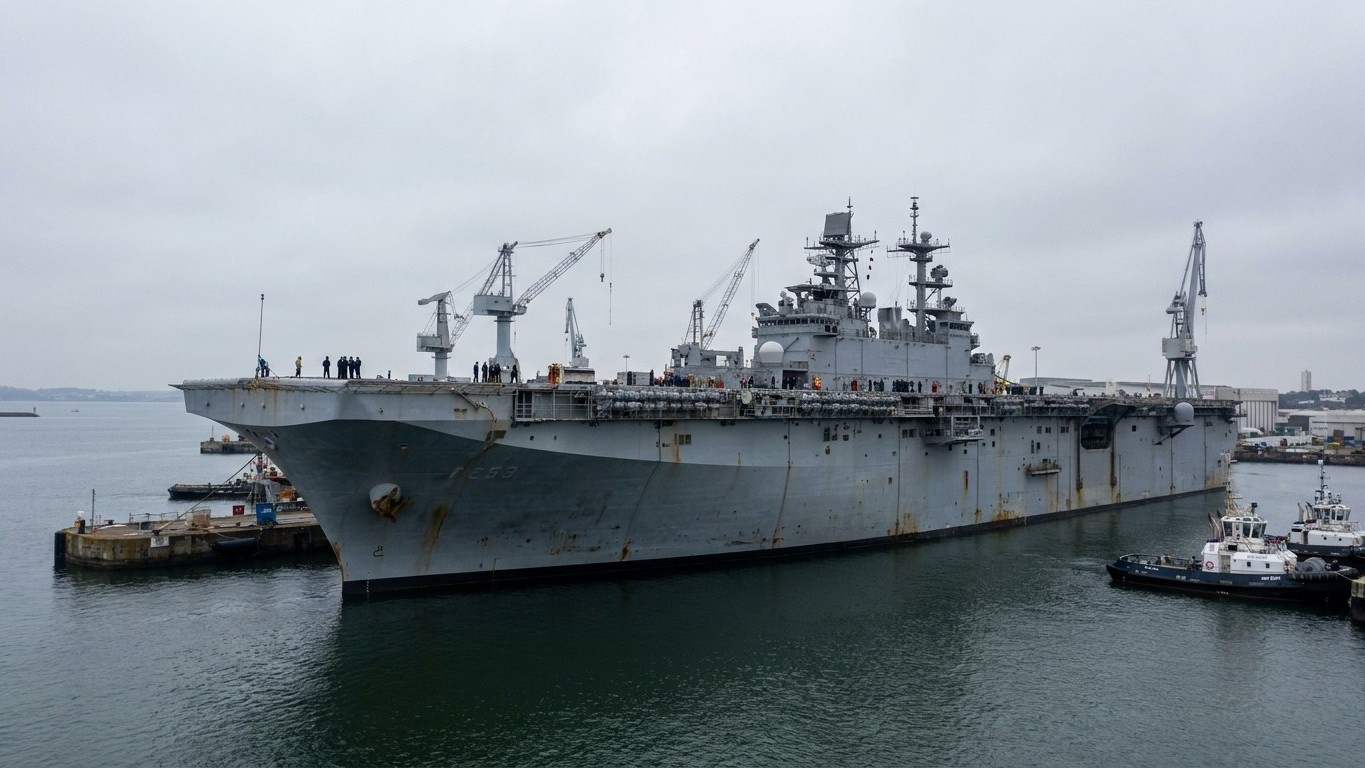
Two brand-new warships, moored at the quay for almost eighteen months and never once setting sail for their originally planned destination. This is the stark summary of the Mistral affair: France paid Russia €949.7 million for two helicopter carriers that it had built, financed, and nearly completed, only to sell them to Egypt after stripping away everything that still tied them to Moscow—even the Cyrillic inscriptions on the bulkheads.
Key takeaways
- Why did two brand-new ships remain immobilized at Saint-Nazaire for 18 months without ever setting sail?
- How much did this diplomatic and military maneuver actually cost the French budget?
- How did Russia turn its equipment withdrawn from the ships into a business opportunity with Egypt?
A historic arms contract trapped by Crimea
The story begins in June 2011, when DCNS (the former name of Naval Group) signs with the Russian state arms dealer Rosoboronexport a contract for the construction of two Mistral-class amphibious assault ships. A contract valued at €1.2 billion for the construction of two Mistral-type ships is signed between DCNS and the Rosoboronexport group, with delivery planned for Vladivostok at the end of 2014 and Sevastopol in 2015. These ships are not hollow shells: each measures 199 meters in length and can carry a squadron of sixteen helicopters, hundreds of soldiers, and dozens of armored vehicles.
The schedule progresses normally until the summer of 2014. About 550 Russian sailors, including 400 future crew members of the Vladivostok, arrive in Saint-Nazaire in June, and the first sea trials with a Russian crew aboard take place on September 13. But Russia’s annexation of Crimea in 2014 changes the game. On September 3, 2014, France suspends the delivery of the first Mistral to sanction Moscow for its intervention in Ukraine. Concretely, President François Hollande freezes a delivery that was initially due on November 14, 2014.
The situation quickly becomes absurd. DCNS confirms that 400 Russian sailors will leave the port of Saint-Nazaire before the end of 2014, while the handover of Vladivostok had originally been scheduled for November 14. The sailors depart for Russia without their ship, while the two vessels remain immobilized on the quays of Saint-Nazaire, under French supervision, in an unprecedented diplomatic and industrial standoff for a contract between an NATO member and Moscow.
€949.7 million to start over from scratch
Eight months of tense negotiations later, an agreement is reached. On August 5, 2015, Hollande and Vladimir Putin announce the end of the contract. Under this agreement between Paris and Moscow, the French government pays the Russian authorities the sum of €949,754,849. This figure, nearly one billion euros to the euro, precisely matches the amounts already advanced by Russia for the original contract.
The breakdown of this bill reveals the scale of the fiasco. The repayment covers the delivery of the two ships, the costs incurred for the development of the Vladivostok port, the adaptation of 32 Ka-52 helicopters, and the training of 400 Russian sailors, for a total of which €56.7 million concerns only crew training. And France manages to come away relatively unscathed on one point: the agreement is concluded without financial charges, penalties, or compensation. A relative relief, given the months of Russian threats of legal action that hovered over the negotiations.
But repaying Moscow does not close the file. Each month of delay costs French taxpayers dearly. Coface, the French export credit agency, must compensate the guard costs, amounting to €1 million per month per ship, in addition to general expenses that remain the subject of discussions with the industrialist. Two million euros per month, simply to keep two ships idle at the quay. Enough to fund, each year, the renovation of a mid-sized secondary school—merely to monitor that sheet-metal.
Erasing Russia before selling to Egypt
The remaining task was to find a new client. The answer arrives just three weeks after the Franco-Russian agreement. The Élysée announces that Egypt will buy the two Mistral ships not delivered to Russia, for around €950 million. Cairo, which had just ordered Rafale fighters and French frigates, becomes the new owner of vessels initially designed for the Russian Pacific Fleet.
The problem, however, is that these ships were not neutral. They had been designed, wired, and equipped for a specific client, with its own standards and its own language. The agreement provided that the Russian systems already installed on the ships would be sent back to Russia, after which France would regain full ownership and use of the vessels. Before any resale, the Russian equipment on board had to be dismantled, Cyrillic signage on the corridors and control posts removed, and the initial layouts redesigned to accommodate Ka-52 helicopters that had been intended for the Russians.
This large industrial cleanup took time. Russia and France were to sign the final documents on the withdrawal of radio-electronic systems from the helicopter carriers at the beginning of November 2015. And even after the Egyptian contract was signed, Russia continued to wait for the return of its equipment from France before it could resell it, a Russian military official confirming: “we are waiting for our equipment to come back from France, then we can begin deliveries.” Moscow thus retrieved its equipment only to offer it directly to Egypt, which was ordering naval Ka-52 helicopters—the same aircraft originally destined for the Russian Mistrals.
Renamed Gamal Abdel Nasser and Anwar El-Sadat, the two former Vladivostok and Sevastopol ultimately joined the Egyptian Navy, one assigned to the Red Sea and the other to the Mediterranean. According to calculations by the Senate Finance Committee, the overall operation, from reimbursing Russia to selling at a cut-rate price to Egypt, left a net deficit of nearly €250 million charged to the French state budget. A sobering reminder: in major defense contracts, geopolitics can cost as much as an entire helicopter carrier.
Sources: opex360.com | franceinfo.fr
