
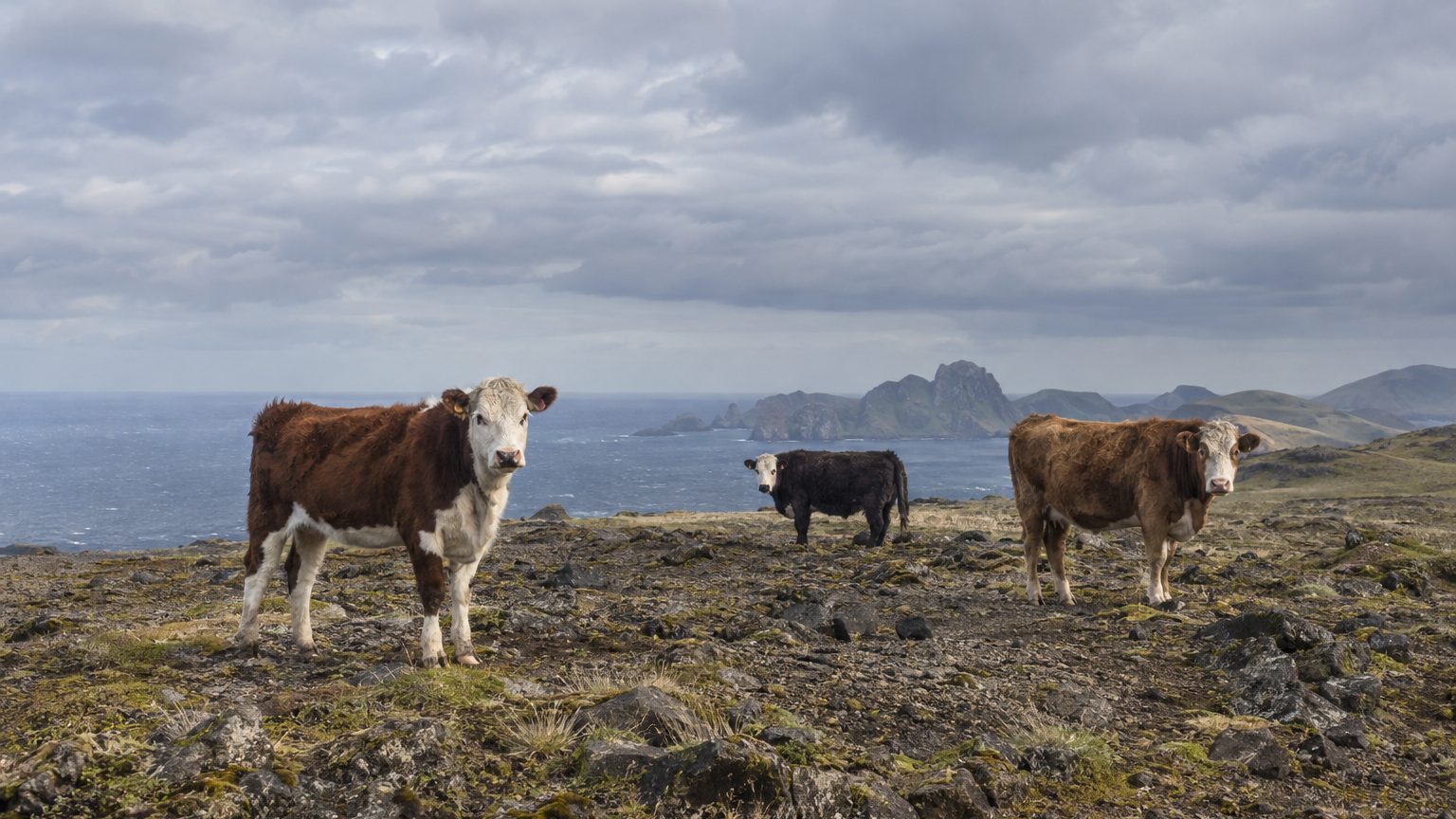
Six cows, a Réunionese farmer, and a foregone bet: this is how France, almost unwittingly, bred one of the most unusual herds in its colonial history. Amsterdam Island, 55 square kilometers tucked away south of the Indian Ocean, today hosts only a scientific base, Martin-de-Viviès. But in 1871, one man firmly believed in an agricultural future there. One hundred and thirty-nine years later, the State had to extinguish the last animal born from that failure.
- Six cows abandoned in 1871 by a Réunionese family bred unchecked on Amsterdam Island for 139 years.
- The herd reached 2,000 head in 1988 and destroyed 99% of the island’s native Phylica arborea forest through overgrazing.
- The French state eradicated the herd completely between 2008 and 2010, preserving only DNA samples in laboratories.
A Réunionese farmer, six cows, and a dream that turns sour
Everything began in January 1871. The Heurtin family, originating from Réunion, arrived on this isolated volcanic island to attempt cultivation and livestock farming. The subantarctic climate, battered by winds and perpetual humidity, crushed their ambitions in just a few months. They returned to Réunion. Behind them, they left their cattle, animals of mixed French breeds, without fences or supervision.
Left to fend for themselves on an island with no predators, the animals did not perish. They thrived. The herd returned to a feral state and reproduced in a closed loop, generation after generation, with no external genetic input for more than a century. A census conducted in 1986 already counted 1,600 head. Two years later, in 1988, the herd reached 2,000 animals, occupying two-thirds of the island’s surface according to data compiled by the French Southern and Antarctic Lands (TAAF).
An island eroded down to rock
This demographic success came at a price. The repeated trampling and overgrazing erode soils to the point where bare rock protrudes in places. The Phylica arborea forest, the only native tree of the French southern lands, bears the heaviest burden. This species once formed a true forest belt between 100 and 250 meters in altitude.
In the XVIIth century, this forest covered about 1,500 hectares, nearly 27% of the island’s surface. By 1988, only about ten hectares remained, a loss exceeding 99%. The cows were not the sole culprits; six major fires, five of which were human-caused, along with the wood-cutting carried out by visiting ship crews, contributed equally to this near-total disappearance.
The Amsterdam albatross, an endemic species of the island that does not breed anywhere else in the world, also suffers the consequences of overgrazing. Driven away from its natural habitats, the bird finds itself confined to the Tourbières plateau.
The fencing, then the slaughter
Facing the scale of the damage, a fence was stretched across the island in 1987. The objective was simple: physically separate the herd in order to sacrificially reduce its numbers. In 1988 and 1989, the 1,059 cattle living south of this fence were slaughtered, according to the landmark study published by Berteaux and Micol in the Journal of Zoology in 1992.
The remainder of the herd, confined to the north of the island, continued to exist for more than two decades. The scientific base itself took between 50 and 80 bulls each year, slaughtered to supply fresh meat to the staff on site. A pragmatic form of management that allowed scientific research and a makeshift butcher shop at the edge of the world to coexist.
Between 1988 and 1993, alongside these operations, 7,000 Phylica plants were replanted in an attempt to reconstruct a semblance of the forest canopy. The soil, bare for more than a century, took time to respond.
2010, the end of a unique herd
On August 19, 2008, an order from the TAAF sealed the definitive fate of the remaining herd. Order number 2008-82 decreed the complete eradication of the herds introduced to the island. The plan was launched the following October.
This decision did not go unnoticed in the Senate. On February 2, 2010, Senator Richard Yung questioned the government during a session of oral questions. He spoke of a “cattle herd” that had “developed in a closed environment (inbreeding), without any external input, forming a completely autonomous population” for 150 years, and called for a moratorium to protect this genetic heritage deemed exceptional. The government refused but pledged to carry out genetic sampling before the animals’ definitive elimination.
In December 2010, the TAAF announced that the elimination of the herd was complete. After 139 years of wild existence, Amsterdam’s cows exist only as DNA samples preserved in laboratories.
What the island has become again
The result, however, is measured on the ground today. The areas that were once grazed are gradually recolonizing with native plants, free from animal pressure to restrain their return. The Amsterdam albatross, meanwhile, shows a remarkable trajectory: from barely five breeding pairs in 1983, the species rose to 51 breeding pairs in 2018, according to data published by the TAAF as part of the national action plan dedicated to it.
It took nearly a century and a half for France to repair, methodically and not without parliamentary debate, the consequences of an agricultural project abandoned within months by a single family. On this island where hardly anyone lives year-round anymore except the scientists at the Martin-de-Viviès base, the only traces left of the Heurtin family are a name given to a volcanic flow and genetic sequences frozen somewhere in a metropolitan laboratory.
Sources: theconversation.com | etreheureux.net
