
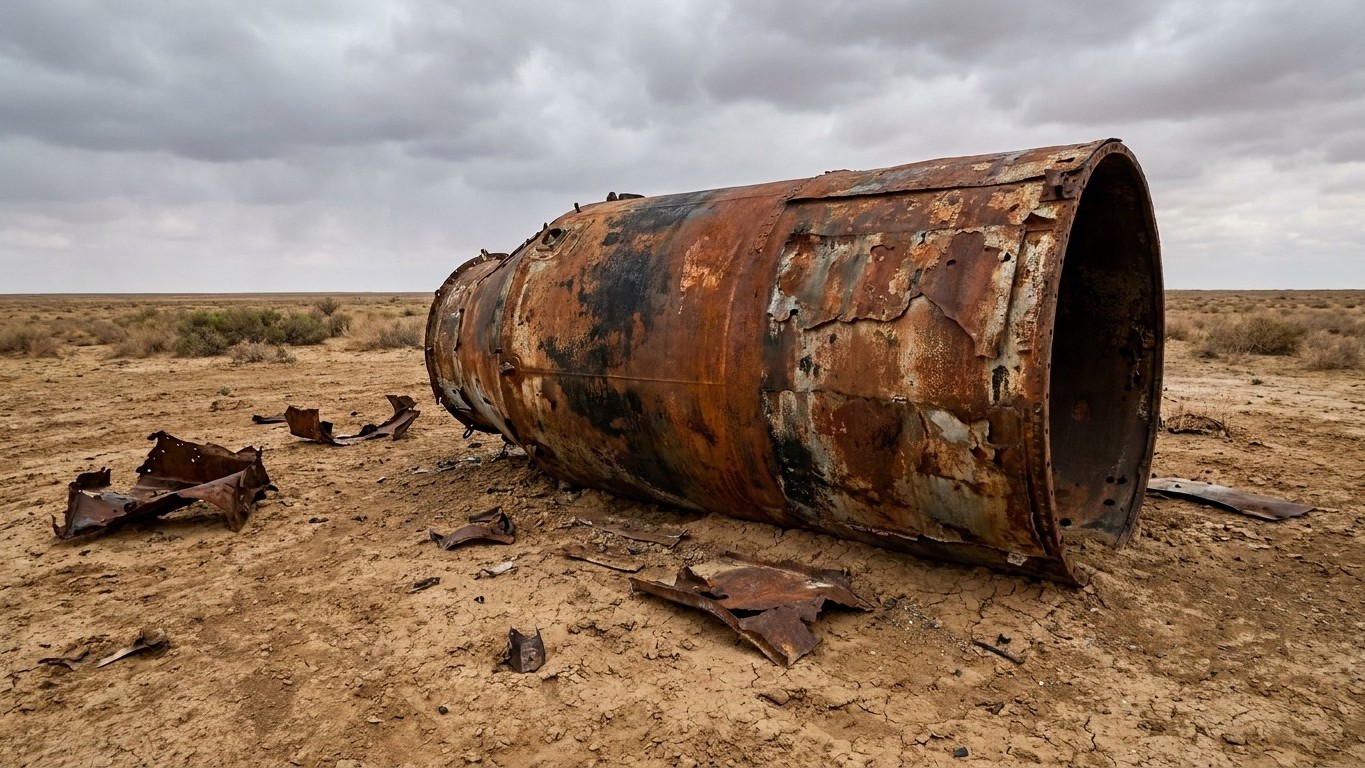
Four launches, four failures, five kilotons of explosion and a project buried without a visible trace on the launch pad. The N1 rocket, the Soviet Union’s secret weapon in the race to the Moon, never reached space. Today, at Baikonur, only scraps of metal recycled into makeshift shelters remain from this colossus, and, for one of them, into a simple summer house.
Key takeaways
- Why did four consecutive launches all fail at liftoff?
- Which non-nuclear explosion remains the most powerful ever recorded?
- How did the remnants of a secret weapon become a summer house?
A Giant Built to Beat the Americans, Never Reached Orbit
The N-1 rocket, also known as Hercules, was a super-heavy launcher developed in the 1960s by the USSR to send a man to the Moon as part of the space race against the United States, which bet on Saturn V. The program remained shrouded in secrecy for decades: the very existence of this launcher and more broadly the Soviet crewed lunar program, a symbol of the USSR’s failure in the space race, was long concealed by the government, with the first official information only emerging after the regime’s collapse in the early 1990s. While Moscow pretends not to aim for the Moon, American satellite images tell another story. A KH-4B reconnaissance satellite photo already reveals, in September 1968, a giant rocket installed on its launch pad at Baikonur.
Four launches, four catastrophes in three years
All four launches from Site 110 at Baikonur’s cosmodrome of the lunar rocket N1 ended in failure due to a malfunction in the first stage, the initial N-1 carrying a mock-up of the lunar module and exploding upon impact on February 21, 1969. The first flight’s scenario is almost cinematic: at 10 seconds, the KORD control and thrust vector system disconnects two engines, then at T+66 seconds a liquid oxygen line ruptures under vibration and a fire breaks out at the rear of the launcher, before all engines shut down at T+70 seconds and 14 km altitude.
The second flight, on July 3, 1969, becomes an absolute disaster. The rocket falls back onto its pad and wrecks a large portion of the installations. The ensuing explosion remains one of the most violent ever caused by a man-made device: equivalent to five kilotons of TNT, and regarded as the most powerful non-nuclear explosion. It would take nearly three years to rebuild the damaged pad, the right-hand pad rebuilt from August 1969 to 1972.
The third flight, on June 26, 1971, fails in a different way: the rocket veers off its trajectory and loses control at T+51 seconds, one second too late to trigger engine shutoff. The fourth and final flight takes place in November 1972: another explosion hits the first stage just seconds before separation. After this fourth setback, the project is halted in 1974, five years after Apollo 11’s Moon landing. While engineers gathered debris, the Americans, meanwhile, had already planted six flags on the lunar surface.
Giant tanks transformed into garden shelters
The fate of the program’s hardware is almost more surprising than the explosions themselves. Once the project was canceled, the N1 units still under construction or already assembled were not destroyed cleanly: a unit ready for launch had even been brought to the pad for a fueling test before the equipment, with the program’s cancellation, was junked and then widely recycled around Baikonur. The paradox is almost comic: the rockets that were meant to be destroyed ended up among the best documented, photographed piece by piece by enthusiasts who traveled to the cosmodrome.
concretely, what remains? Fragments of hull, stage supports and, above all, enormous tanks designed to hold high-pressure oxygen or kerosene. One of these main-stage tanks underwent an unexpected transformation: half of a tank from Block A was turned into a summer house, with its thermal shield kept on top. Other pieces had more modest but equally revealing fates of Soviet salvage ingenuity: lattice fins were repurposed into a simple shelter. The launch pad itself did not vanish entirely from the landscape: after the N1’s cancellation, the site found a second life in the 1980s with the Energia launcher and the Buran shuttle, before being abandoned again after the dissolution of the USSR.
A Failure That Cost the Moon Race
It is impossible to dissociate these repeated explosions from the American victory in the lunar race. Each failure pushed the Soviet timetable back by months, sometimes years: the pad’s reconstruction after the July 1969 disaster immobilized the program while Apollo missions continued across the Atlantic. Today it is hard to grasp the scale of Baikonur at the time: a territory as vast as some European countries, studded with launch pads, where tens of thousands of technicians worked in the utmost secrecy on a rocket their own government publicly denied.
The contrast with the Saturn V’s American success is striking, with several exemplars now on display, restored in museums in Houston, at the Kennedy Space Center, or in Huntsville. The N1, by contrast, has no monument. Its remnants lie in the Kazakh steppe, repurposed into huts or improvised shelters, far from the spotlight. This absence of official memory is not accidental: it tells, better than a museum, what this failure really meant for Soviet prestige.
Sources: un-regard-sur-la-terre.org | techno-science.net | osi-univers.org
