
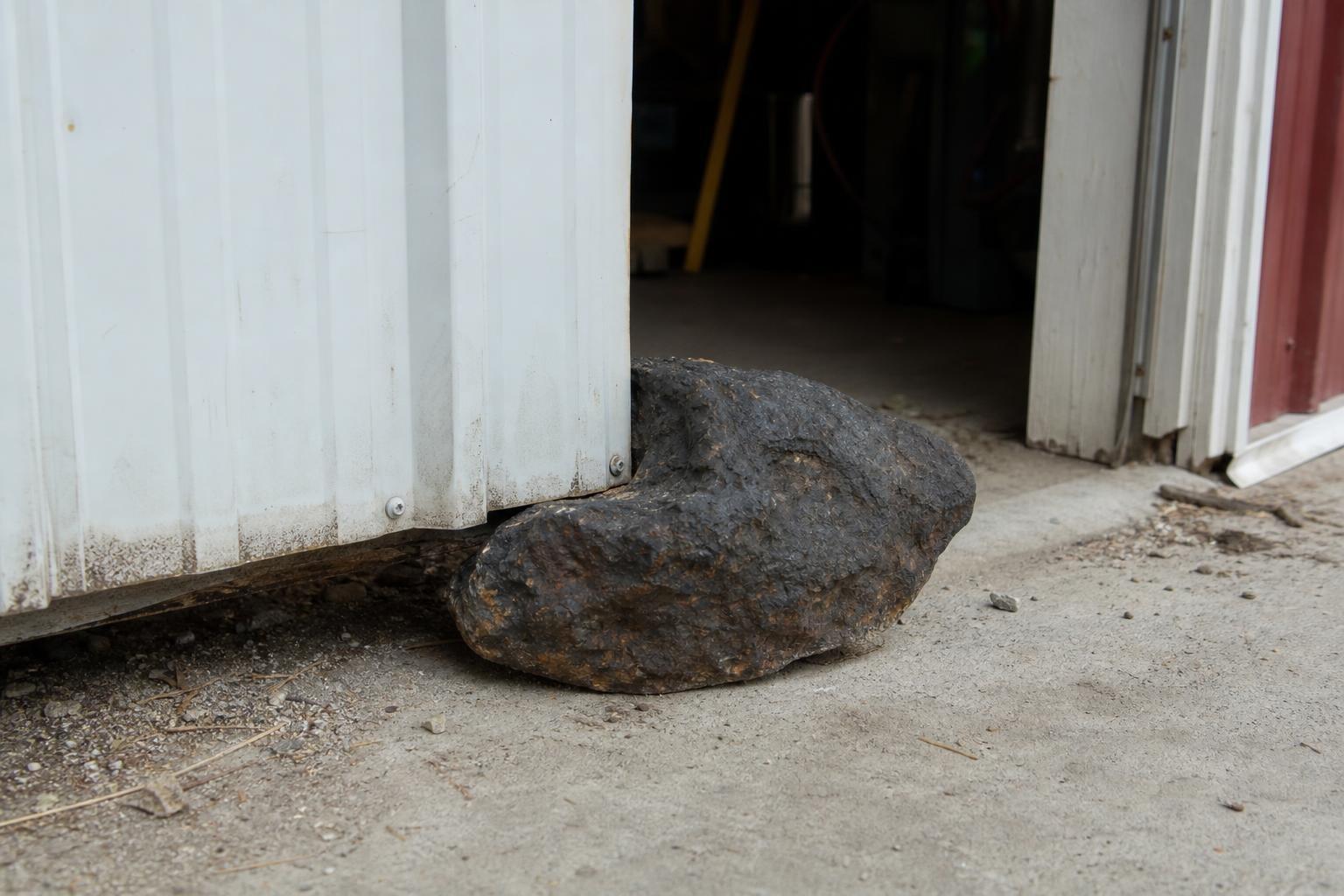
For three decades, a Michigan farmer propped his barn door with a rock that felt satisfyingly heavy. It was dark, dense, and reliable—good enough to keep the wind from banging the hinge. No one in the family fussed about it. Why would they? It was just a doorstop.
Only it wasn’t. Beneath the dust and barn-smell sat a meteorite—an iron-rich fragment of space—later authenticated by university geologists and pegged at a value brushing into the six figures. A humble farm habit had been guarding a literal piece of the cosmos.
A chance discovery that waited decades
The story began with a farm sale and an unusual handoff: the previous owner reportedly shrugged and said the rock had “fallen from the sky” years back. So it stayed by the door, earning nicks, scratches, and a nickname or two, its shimmering secret untouched.
Over the years, visitors noticed the weight. Kids tried to lift it. Someone mentioned a magnet that clung too eagerly to the surface. Still, life on a farm runs on chores, not on cosmic speculation. The rock kept the door open, season after season.
From barn corner to laboratory bench
Curiosity eventually won. The owner reached out to a regional university, where a geologist took one look at the thumb-like imprints, the metallic sheen, and said the magic word: “meteorite.” Lab tests confirmed a high iron-nickel composition—classic for a spacefaring fragment. The piece weighed around 22 pounds, dense enough to command respect on any workbench, let alone a barn threshold.
“Space doesn’t always announce itself,” the scientist noted during the evaluation. “Sometimes it waits, very quietly.” The waiting, in this case, spanned generations: a fall remembered by locals, a sale, a habit, and finally a phone call that changed the rock’s identity forever.
Why iron meteorites hit different
Not all meteorites are created equal. Iron meteorites—rich in metal and often etched with delicate crystalline patterns—tell stories about the cores of ancient planetesimals, the building blocks of worlds. Slice one thinly, and intricate Widmanstätten patterns glint like geometry from deep time.
Collectors prize the combination of rarity, scientific importance, and tactile presence. Even to the untrained hand, an iron meteorite feels “wrong” in the best possible way—too heavy, too magnetic, too stubbornly tough. It’s the kind of rock that turns practical people into believers.
The moment value enters the room
When the lab’s verdict arrived, reality tilted. The farmer’s dependable wedge became an object with pedigree. Phone calls multiplied, and the number—roughly equivalent to a comfortable sedan or a semester’s worth of college tuition—hovered like a new kind of gravity.
“It’s the most expensive doorstop I’ll ever own,” became the running joke among friends and neighbors, a line delivered with equal parts pride and disbelief. But tucked inside the humor was a lesson: ordinary life often shelters the extraordinary.
What a doorstop can teach us about wonder
There’s something disarming about the image: a barn door, a draft, a rock from space doing a small, domestic job. It collapses the distance between the everyday and the infinite. You don’t need a telescope to meet the universe; sometimes it’s scuffed, cold to the touch, and leaves a rusty kiss on your palm.
“Value,” as a neighbor quipped, “depends on what you’re looking for.” On a farm, weight can be as useful as beauty. In a lab, beauty reveals itself as structure, history, and the fingerprint of a broken world.
Could your rock be a space rock?
If you’ve got a suspiciously heavy, oddly charismatic stone kicking around, a little skepticism is healthy—and a little testing doesn’t hurt.
- Strongly magnetic and surprisingly heavy for its size
- Dark, fusion-crusted exterior with thumb-like indentations
- Metallic flecks or a subtle, silvery sheen
- Resists scratching more than common rocks
- Leaves a rusty streak after years in damp places
A local university, natural history museum, or rock and mineral club can point you toward reputable testing. Start with a magnet, then seek out an expert who can run a quick density or nickel test. “When in doubt, test it out.”
The afterglow of a small miracle
News of the find traveled fast, but the barn kept breathing hay and sawdust like it always had. The door still opened and closed. The difference was invisible but unmistakable: every scrape of hinge now sounded like a story.
The meteorite moved from threshold duty to curation, destined for hands and eyes that would read its metal like a manuscript. Yet the charm of the whole affair remains where it started—in the ordinary, where utility meets surprise, where a piece of the night sky minds the gap in a sunlit doorway.
Call it luck, patience, or the long game of the universe. All that time, amid chores and weather and the rhythm of rural work, a star-born rock waited to be properly named. And when it finally was, the everyday felt a little more cosmic, the barn a little more like a private observatory—proof that wonder sometimes wears mud and keeps the door from slamming.
