
Eight volunteers entered a colossal structure near Oracle, Arizona, and the door shut behind them for two years. They were sealed inside a three-acre enclosure of glass and steel, where they would remain for the full term. Financed by billionaire Ed Bass, the project mobilized Space Biospheres Venture, a company created with systems thinker John P. Allen, for roughly $200 million.
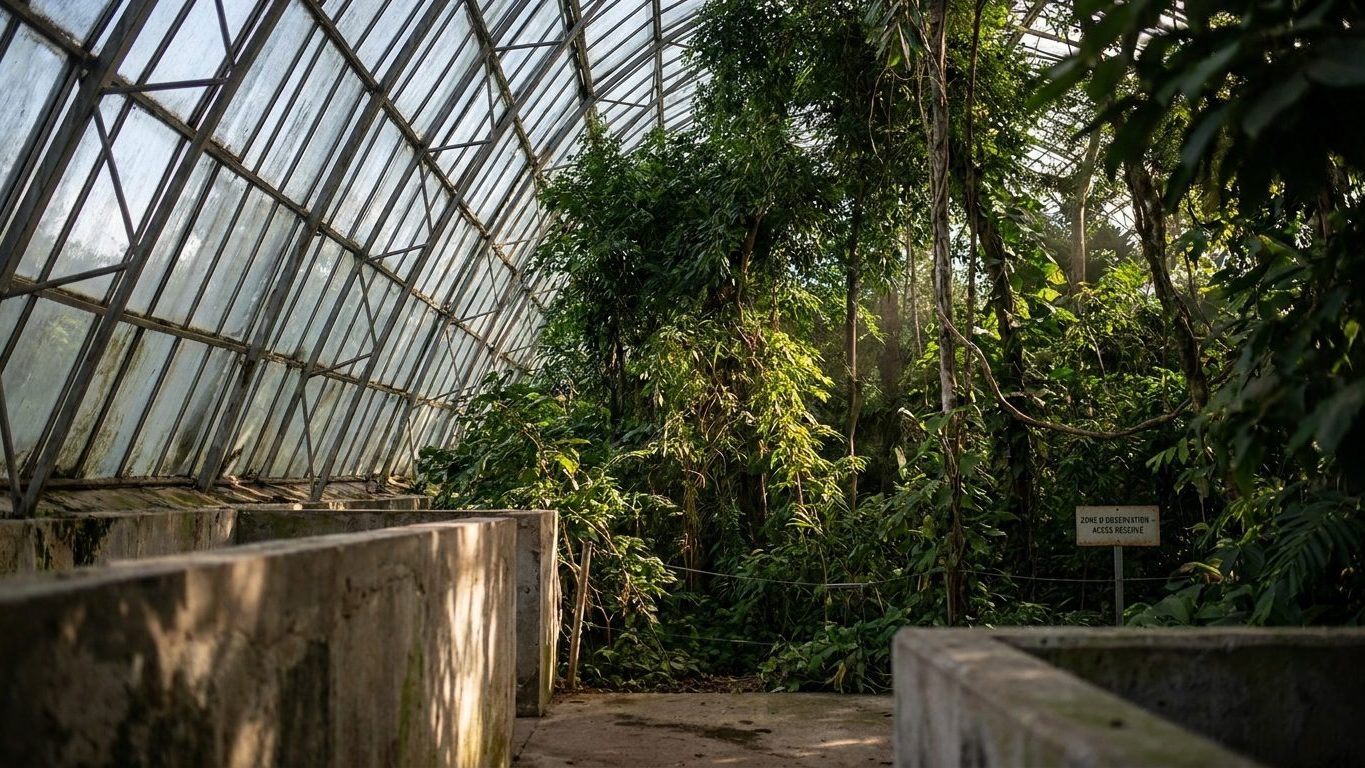
The facility spans 1.27 hectares and houses a fully realized miniature world. Five wild biomes were recreated: a tropical forest, a marine environment with a coral reef, a mangrove area, a savanna, and a desert, in addition to an agricultural zone and a human habitat.
The wager, on paper, was straightforward: to determine whether humans could survive inside a completely closed ecosystem, with no material exchange with the outside world. It was a real-life test run for a future space colony.
The Oxygen That Escapes
Sixteen months after the seal, the indoor atmosphere grew increasingly alarming. The oxygen level fell from 21% to 14% over the first sixteen months, to the point of causing health problems for the inhabitants. It was akin to breathing air at an altitude of around 4,000 meters.
The biospherians, as they called themselves, could physically feel the thinning air. They climbed stairs out of breath, pausing mid-sentence to catch their breath.
At the time, no one understood the source of the leak. By January 1993 the situation had become untenable, and the crew had to inject external oxygen to keep the residents alive, an operation repeated a few months later in August of the same year.
The Trap of Fresh Concrete
The answer arrived in 1994, courtesy of geochemist Jeff Severinghaus from the Lamont-Doherty Earth Observatory. His team demonstrated that the oxygen loss was caused by microbial respiration of an excess amount of organic matter embedded in the soils of the experiment, and that the CO2 produced reacted with the concrete of the structure to form calcium carbonate.
The mechanism unfolded in two stages. First, soil microorganisms, rich in organic matter in the forest and savanna zones, consumed ambient oxygen at an abnormally high rate and emitted carbon dioxide in return. Meanwhile, a large portion of Biosphere 2 was built with concrete that contains calcium hydroxide, so this surplus CO2 reacted with that compound instead of being absorbed by the plants. The plants, meant to convert the excess carbon dioxide into fresh oxygen through photosynthesis, were effectively short-circuited by a parasitic chemical reaction. The concrete, still curing, captured the carbon rather than the vegetation, locking it into its walls for good.
Severinghaus settled the matter with a precise isotopic analysis of the carbon in the concrete. He measured CO2 absorption rates by the structural concrete ranging from 0.23 to 0.31 grams of CO2 per square meter per hour. The oxygen hadn’t escaped to the outside: it had simply changed form, imprisoned within the walls.
The Wound Still Open
Biosphere 2 remains standing to this day. After nearly being demolished to make way for housing and commercial developments, the structure was repurposed for research by the University of Arizona in 2007 and was fully taken over in 2011. It now serves as a laboratory to study climate change and is no longer hermetically sealed as it once was.
Yet it retains a unique status. It stands as the largest closed ecological system ever created. No other world of this size has been sealed off to humans since 1993.
That void is not insignificant. The original project’s architects posited a simple principle: an ecosystem closed enough to be viable on Earth must be viable as a stepping stone before attempting to build one in space, because a system that fails here won’t fare any better in orbit, on the Moon, or on Mars. Thirty years on, that milestone has still not been achieved at a comparable scale.
The concrete that breathes, quite literally, embodies a lesson space exploration has yet to fully absorb: every material chosen to construct a closed habitat becomes a chemical actor within the system, capable of skewing an oxygen balance calculated to the gram. Future Martian bases, should they ever exist, will have to contend with this same invisible equation.
Sources: earthlymission.com | agupubs.onlinelibrary.wiley.com
