
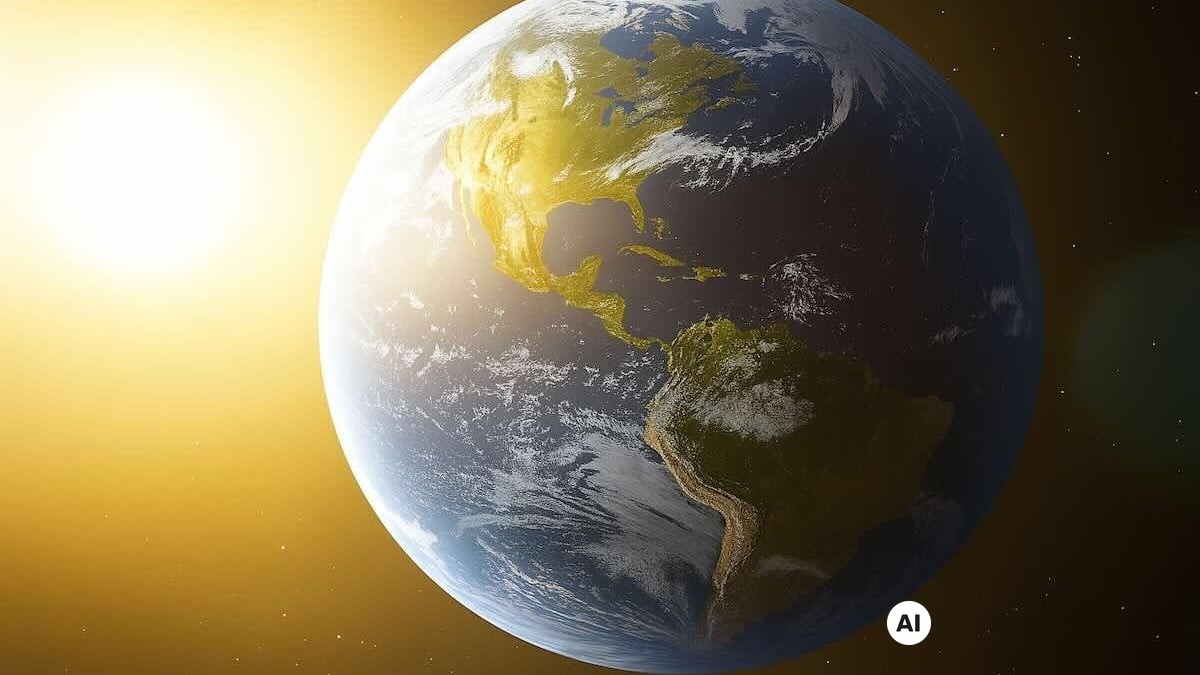
Early July, thermometers are running hot on Parisian terraces, and yet: the Earth has just moved to the maximum distance from the Sun. Aphelion, the orbital point where the Earth-Sun distance is greatest (about 152 million kilometers), occurs each year at the beginning of July. It’s the height of the apparent paradox. The Earth at the far end of its orbit, and we roasting. The idea that summer heat comes from the Sun drawing closer is one of the most widespread physics mistakes. It is completely false. And the real explanation is far more elegant.
An Elliptical Orbit, Not a Circle
Earth does not describe a perfect circle around the Sun, but a slightly eccentric ellipse. It was Johannes Kepler who formalized this in the 17th century, ending centuries of belief in perfectly round orbits. Kepler was moreover the first to envisage that planetary orbits are ellipses, with the Sun at one of the foci, and it is he who introduced the term “aphelion” to describe this moment of the year.
Direct consequence of this geometry: perihelion, the closest point, occurs in early January at about 147 million kilometers from the Sun, while aphelion, on the other hand, occurs in early July at about 152 million kilometers. Five million kilometers of difference. Impressive on paper. Insignificant on the thermometer. Even though there is about a 7% difference in solar flux between perihelion and aphelion, this variation in the amount of light received does not yield large temperature differences on Earth.
The most immediate proof of this insignificance? When the Earth is at aphelion, it is summer in the Northern Hemisphere and winter in the Southern Hemisphere. The same distance. Opposite seasons. The distance therefore cannot be the cause of the seasons; two hemispheres cannot be simultaneously “closer” or “farther” from the Sun.
Inclination: the Real Conductor of the Seasons
The axial tilt of the Earth is about 23.5 degrees and is responsible for the seasonal variations, because it changes the exposure of the hemispheres to solar radiation throughout the year. A matter of posture. An angle. That is all it takes to turn winter into summer.
The mechanism is as follows: between May and August, when the Earth tilts toward the Sun, its northern hemisphere, the apparent path of the Sun in the sky is higher there, and consequently the energy received by that part of the globe is greater. The solar rays strike the ground almost perpendicularly. This concentration makes all the difference. In summer, in Marseille, every square meter of ground receives 2.4 times more energy, for twice as long. There you have the genuine engine behind the heatwave.
Winter is the exact opposite. When a hemisphere is tilted away from the Sun, the Sun sits lower in the sky, the rays are more spread out and less focused: it is therefore cooler. Think of a flashlight held upright: it lights a small bright circle. Tilt it by 30 degrees: the spot widens, the brightness at the center falls. The Sun, in winter in Paris, plays exactly that role. At the winter solstice, the noonday Sun’s altitude is around 17°, while at the summer solstice, the angle can reach 65°.
The long days of summer further amplify the effect. Because of this tilt, the Sun rises earlier, sets later, and the days are indeed longer. More hours of direct sunlight, rays more vertical: heat accumulates.
The Longest Summer, a Gift from Aphelion
The Earth’s ellipse yields an incidental, unexpected side effect: it changes the speed of the Earth along its orbit. As the Paris Observatory explains, the Earth moves faster along its orbit in January (at perihelion) and winter is the shorter season; it moves more slowly in July, which makes summer the longer season. Northern Hemisphere summers therefore last slightly longer than winters. An astronomical bonus, offered by Kepler’s mechanics, that ends up tempering the harshness of winter a little.
The fact that perihelion falls at the start of January means that the Southern Hemisphere receives more solar energy in summer than the Northern Hemisphere. Australians, for their part, experience summers near the Sun’s closest approach. Southern summers thus receive a bit more solar energy, but they remain cooler than our northern summers, because the vast oceans of the South absorb that excess.
When Astronomy Shapes the Climate of Tomorrow
These orbital variations do not operate only on the scale of the seasons. The three Milankovitch cycles—eccentricity, axial tilt (obliquity), and precession—work together to modulate the amount, distribution, and seasonality of the solar radiation reaching Earth. Over tens of thousands of years, these slow orbital motions have triggered ice ages and warm periods that shaped the planet.
Earth’s obliquity varies between 22° and 24.5° according to a cycle of about 41,000 years. A higher obliquity amplifies the seasonal contrast: hotter summers at the poles, colder winters. Today, obliquity is in a downward phase, which, absent human intervention on the climate, would tend to soften seasonal extremes in the long term.
Where this becomes dizzying: in about 13,000 years, due to the precession of the equinoxes, aphelion will coincide with… winter in the Northern Hemisphere. Precession indeed shifts the calendar of the seasons, influencing the moment when the Earth is closest to and farthest from the Sun. Future boreal winters will occur when the Earth is farthest from the Sun, stacking these two cooling factors. The word “climate” itself comes from the Greek klima, which precisely means “inclination,” a linguistic reminder that our ancestors, without formalizing it, perceived the essence.
Sources: The Earth has just reached aphelion, but what does that mean? (rse-magazine.com) | fr.geologyscience.com
Article prepared with the help of AI · Our method
